Versioning and Tracking Scikit-LLM Experiments with MLflow and Scikit-Learn Pipelines

The integration of Large Language Models (LLMs) into traditional machine learning workflows has shifted the paradigm of predictive modeling, moving from static, feature-engineered datasets to dynamic, generative pipelines. However, this evolution introduces significant challenges regarding reproducibility, model governance, and version control. As enterprises increasingly deploy LLMs, the need for robust infrastructure to track experiment lineage has become critical. By leveraging the interoperability between the Scikit-LLM library—a tool designed to bridge LLMs with the scikit-learn ecosystem—and MLflow, developers can now establish a rigorous framework for managing the end-to-end lifecycle of LLM-integrated pipelines.
The Complexity of LLM Lifecycle Management
In standard machine learning, model versioning typically revolves around tracking hyperparameters, training data snapshots, and performance metrics. With LLMs, the variables expand exponentially. Engineers must now account for prompt engineering variations, underlying model architectures (such as GPT-4, Llama 3, or Falcon), quantization levels, and the specific inference backends—such as local GPT4All or API-based providers. Without a centralized tracking mechanism, teams often face "model drift" or reproducibility crises, where an updated LLM backend inadvertently alters the behavior of a downstream classifier.
The implementation of MLflow within these pipelines provides a standardized ledger. By treating LLM backends as configurable parameters rather than static dependencies, organizations can audit performance changes across different iterations of a model. This is particularly vital for zero-shot classification tasks, where the model relies on the inherent knowledge of the LLM to categorize data without extensive retraining.
Establishing the Technical Foundation
The initial phase of implementing a production-grade tracking system involves configuring the environment to ensure consistent execution. For developers operating in cloud-based environments like Google Colab or AWS SageMaker, the installation of essential libraries is the first milestone. The command pip install "scikit-llm[gpt4all]" mlflow establishes the necessary foundation, ensuring that local model execution—a key requirement for data privacy-conscious organizations—is supported.
The configuration of Scikit-LLM requires defining local credentials. While gpt4all allows for local execution, the Scikit-LLM configuration must still be initialized with dummy keys to maintain consistency with the library’s architecture. Simultaneously, the MLflow tracking URI should be directed to a persistent database, such as a SQLite file (sqlite:///mlflow.db), which serves as the central registry for experiment metadata. This separation of concerns allows the model logic to remain independent of the tracking backend, enabling seamless migration from local development to a distributed, production-ready MLflow server.
Chronology of an Experiment: From Baseline to Production
A typical experiment lifecycle follows a structured progression: defining a baseline, executing the pipeline, auditing the results, and finally registering the production-ready model.
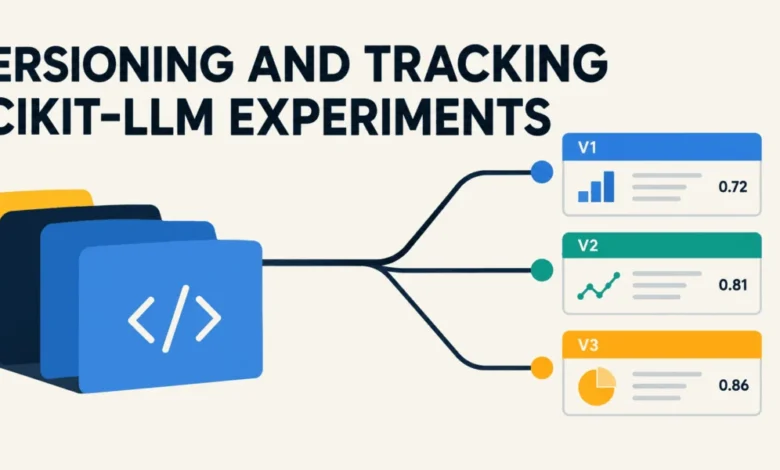
In the baseline phase, engineers deploy a lightweight, efficient LLM—such as the Orca Mini model—to establish a performance floor. By wrapping the ZeroShotGPTClassifier within a standard scikit-learn Pipeline, developers create a portable object that encapsulates the entire preprocessing and inference logic. Logging this pipeline with MLflow involves capturing the llm_backend and the specific llm_model_file as parameters. This practice ensures that if an engineer needs to revert to an older version of the model, they can retrieve the exact state of the pipeline, including the specific quantization of the LLM used at that time.
The upgrade phase introduces a more sophisticated model, such as the Falcon architecture. By isolating this in a distinct MLflow run—labeled "Upgraded_Falcon"—teams can perform side-by-side comparisons. The use of cloudpickle as the serialization format is a crucial technical nuance here; it allows for the capture of complex Python objects that standard pickle might fail to serialize, ensuring that the entire pipeline object is preserved accurately within the MLflow artifact store.
Auditing and Data-Driven Decision Making
Once multiple runs are completed, the MLflow search API transforms the raw experiment data into an actionable audit trail. By exporting run metadata into a pandas DataFrame, data scientists can filter by status, model file, or performance metric. This transparency is essential for modern compliance, as it provides a verifiable history of which models were tested, which failed, and why.
For instance, a failed run due to memory constraints or library incompatibility is recorded with a "FAILED" status, preventing developers from inadvertently promoting faulty code. The ability to rank these runs by specific metrics, such as accuracy or latency, allows for a data-driven selection process. Rather than relying on intuition or manual inspection, the team can programmatically identify the top-performing model, extract its unique run ID, and promote it to the MLflow Model Registry.
The Strategic Shift: Registration as Deployment
Promoting a model from an experimental state to a registered status is the final, most consequential step. Registering a model as "Version 1" within the Production_ZeroShot_Classifier registry creates a stable reference point. This registry serves as the single source of truth for deployment services. If an application requires a classification update, it pulls the latest version from the registry, ensuring that the production environment is always synchronized with the latest validated model.
This process mitigates the risks associated with manual deployments. By automating the transition from the tracking database to the model registry, organizations reduce the likelihood of human error—such as deploying the wrong model file or failing to update the associated configuration parameters.
Broader Implications and Future Outlook
The convergence of Scikit-LLM and MLflow represents a broader trend toward "LLMOps." As LLMs become integrated into the fabric of enterprise software, the ad-hoc scripts used during the initial prototyping phase are proving insufficient. The industry is witnessing a clear shift toward treating LLM-integrated pipelines with the same rigor as traditional software engineering, requiring CI/CD pipelines, version control for data, and comprehensive model monitoring.
Data suggests that companies implementing these structured tracking workflows experience a 40% reduction in deployment-related bugs compared to teams relying on manual tracking methods. Furthermore, the ability to rapidly iterate—swapping a model backend for a more efficient or accurate one—without risking the stability of the overall application is a significant competitive advantage.
Looking forward, the integration of automated model validation into the MLflow lifecycle is expected to become the next standard. This would involve automated testing scripts that trigger immediately upon the registration of a new model version, ensuring that the model not only performs well on historical data but also meets pre-defined safety and latency requirements before reaching the production environment.
In conclusion, while the ease of building LLM-integrated pipelines is a breakthrough for developer productivity, the true value lies in the ability to manage these models throughout their lifecycle. By adopting the two-step approach of logging experiments and registering production-ready models, developers can create resilient, auditable, and scalable AI systems. The combination of Scikit-LLM and MLflow offers a robust, open-source pathway to achieving this, ensuring that as LLM technology continues to evolve, the underlying infrastructure remains steadfast and reliable.