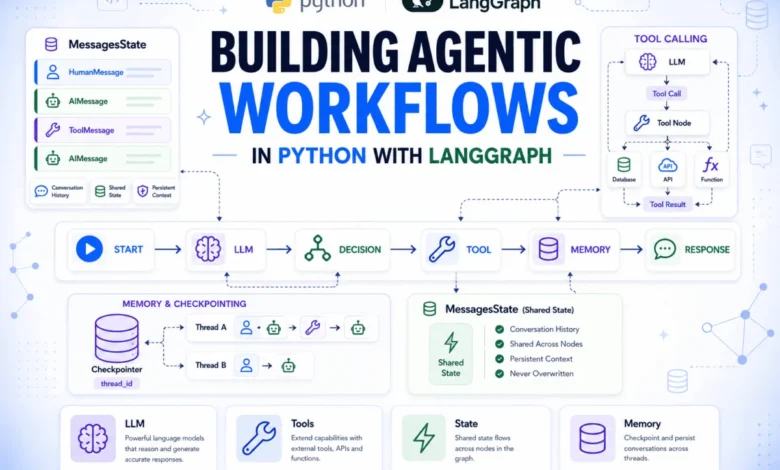
The landscape of artificial intelligence is rapidly evolving, moving beyond single-turn interactions to embrace sophisticated "agentic" systems capable of complex reasoning, tool utilization, and persistent memory. This shift addresses critical limitations in earlier AI applications, which often struggled with context retention, dynamic decision-making, and integration with external data sources or actions. LangGraph, an extension of the popular LangChain framework, emerges as a pivotal tool in this paradigm, offering a robust and intuitive structure for developing such advanced AI agents in Python. This article will delve into the core principles and practical applications of LangGraph, demonstrating how it facilitates the creation of complete agentic workflows, from basic model calls to intelligent, tool-using agents with enduring conversational memory.
The Evolution of AI Agents and the Need for Orchestration
For years, AI-powered applications, particularly chatbots and virtual assistants, primarily functioned as stateless entities. Each user query was treated in isolation, processed by a large language model (LLM), and a response was generated. This single-turn approach, while effective for simple question-answering, quickly exposed limitations when users required multi-step interactions, context-aware dialogues, or actions that necessitated accessing external information or systems. The "harder problems" of AI agent development — such as querying databases, remembering past interactions, or providing transparency into the model’s decision-making process — often led developers down a path of building intricate, custom plumbing for every unique use case. This bespoke approach was not only time-consuming but also prone to errors, difficult to scale, and lacked modularity.
The advent of more powerful LLMs, capable of not just generating text but also understanding intent and suggesting actions, paved the way for "agentic AI." This new generation of AI systems is designed to exhibit autonomy, adaptability, and the ability to interact with their environment through tools. However, harnessing these capabilities requires a structured framework for orchestrating the flow of information and control. This is precisely where LangGraph steps in, providing a clean, graph-based architecture that simplifies the development of complex agentic behaviors.
LangGraph’s Foundational Architecture: State, Nodes, and Edges
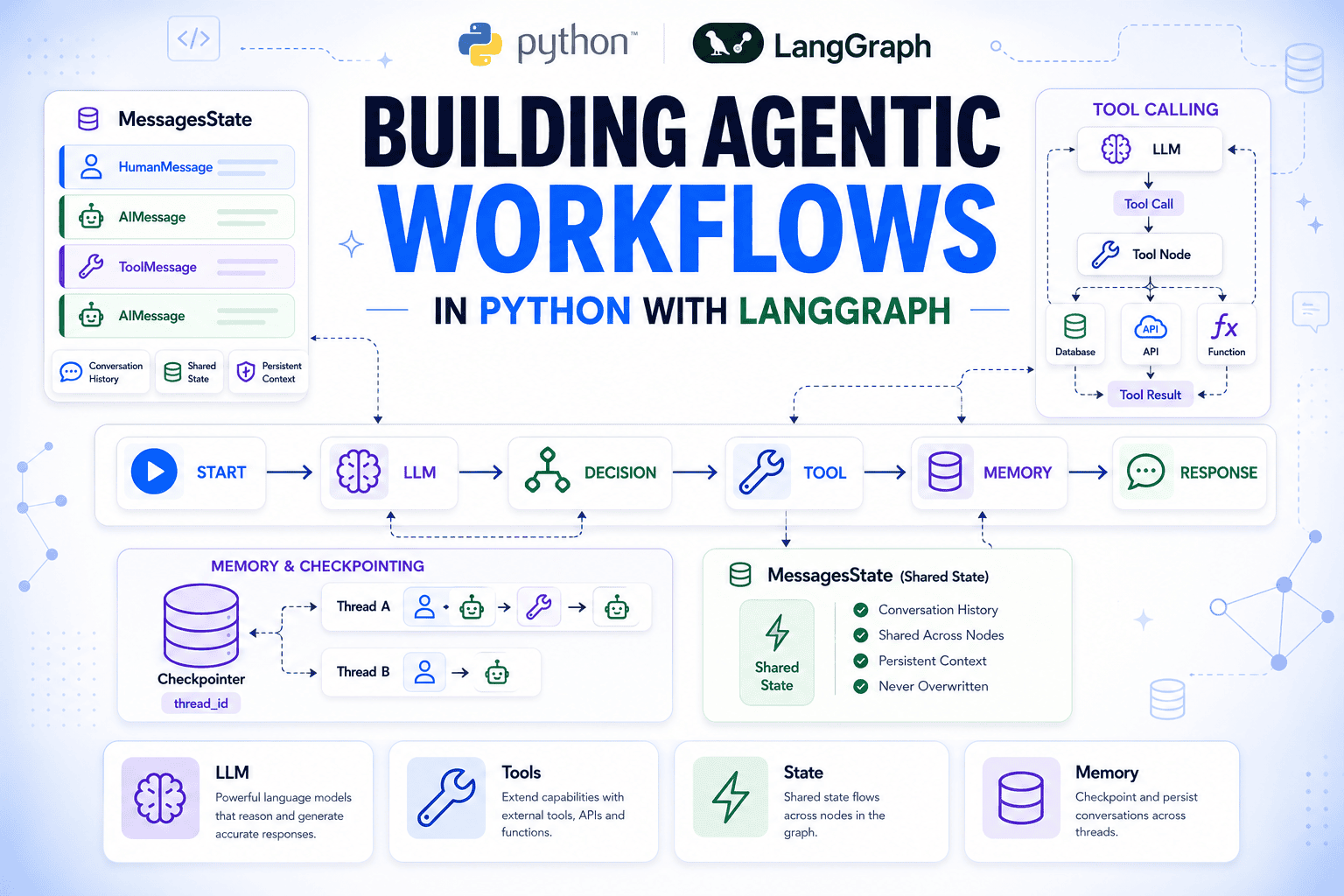
At its heart, LangGraph represents an agent as a directed graph, where each component plays a distinct and crucial role in defining the agent’s behavior and lifecycle. Understanding these foundational primitives—State, Nodes, and Edges—is paramount for effectively designing and implementing LangGraph-based agents.
-
State: The Agent’s Shared Memory
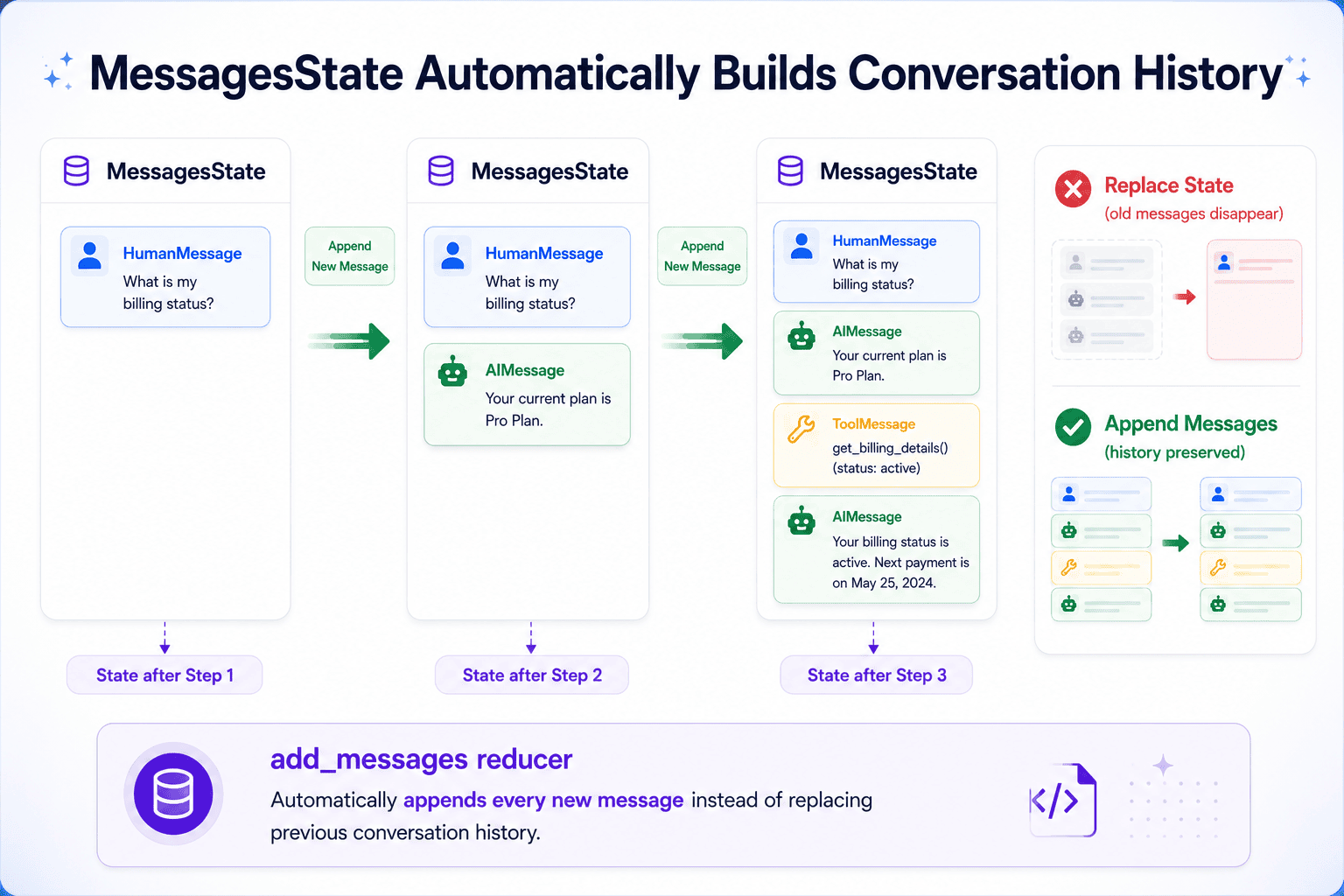
TheStatein LangGraph is aTypedDictobject that functions as the shared memory for the entire graph. It is the central repository of all information relevant to the agent’s current task and conversation. Every node within the graph reads from this shared state and writes updates back to it. This design ensures that context is consistently maintained and accessible across all stages of the workflow. Unlike traditional function calls where data is passed explicitly between functions, LangGraph’s state management abstracts this, allowing nodes to simply declare what they need to modify, with unchanged fields persisting automatically. A crucial feature of state management is the use of reducer functions for specific fields. For instance, alogormessagesfield might be annotated withoperator.addor a customadd_messagesreducer, ensuring that new entries are appended rather than overwriting existing history. This mechanism is vital for maintaining a complete and accurate conversational transcript, including user inputs, AI responses, and tool outputs. -
Nodes: Atomic Units of Work
Nodes are the building blocks of a LangGraph agent’s logic. Conceptually, a node is a plain Python function that takes the currentStateas its argument and returns a dictionary of the fields it wishes to update within that state. The beauty of this design lies in its simplicity and flexibility: any Python function can become a node, without requiring special decorators or inheriting from base classes. This allows developers to encapsulate diverse functionalities, from calling an LLM and parsing its response, to executing a specific tool, retrieving data from a database, or performing a custom computation. Registering a function withStateGraph.add_node()integrates it into the graph, making it a distinct step in the agent’s workflow. -
Edges: Defining the Flow of Execution
Edges dictate the order and conditions under which nodes are executed, effectively defining the agent’s decision-making logic.StateGraph.add_edge(A, B)establishes a sequential flow, meaning that after nodeAcompletes its operation, nodeBwill run next. More complex scenarios, where the next step depends on the outcome of a preceding node, are handled byStateGraph.add_conditional_edges(). This mechanism allows for dynamic routing based on a routing function’s output, enabling the creation of intricate decision trees and branching workflows. Every LangGraph must define aSTARTnode as its entry point and at least one path toEND, ensuring a clear beginning and conclusion to the agent’s operation.
Practical Implementation: Building a Conversational Agent
The power of LangGraph becomes evident in its practical application, particularly in building conversational agents that can maintain context, interact with external systems, and adapt their responses dynamically.
1. Setting Up the Environment:
The initial setup is straightforward, requiring the installation of langgraph, langchain-openai, and python-dotenv. Securely managing API keys via a .env file and load_dotenv() ensures that sensitive credentials are not hardcoded, adhering to best practices in development.
pip install langgraph langchain-openai python-dotenvFollowed by a .env file containing:
OPENAI_API_KEY="your_key_here"And loading it in your script:
from dotenv import load_dotenv
load_dotenv()
2. Managing Conversation History with MessagesState:
Central to any conversational agent is its ability to remember past interactions. LangGraph simplifies this with MessagesState, a built-in TypedDict designed specifically for managing message history. Its messages field, annotated with the add_messages reducer, automatically appends new messages to the existing list, handling deduplication and ordering. This eliminates the need for developers to manually stitch together conversation history, ensuring that the LLM always receives the complete context. This abstraction is critical for maintaining coherent dialogues and preventing context window overflows in longer conversations.
3. Calling the Model Inside a Node:
The core of a LangGraph agent often involves an LLM. A dedicated node, such as run_model, takes the current MessagesState, passes the messages list (augmented with a SystemMessage for persona setting) to a ChatOpenAI instance, and returns the LLM’s AIMessage response. By returning this response within a dictionary keyed to "messages", it is seamlessly appended to the MessagesState, thanks to the add_messages reducer. This modular approach allows for easy swapping of LLM providers (e.g., Anthropic, Google, local Ollama models) without altering the overall graph structure.
4. Registering Tools and Routing Tool Calls: The ReAct Pattern:
One of the most significant advancements in agentic AI is the ability to use tools. Tools empower agents to perform actions in the real world, access up-to-date information, and overcome the inherent limitations of LLMs (e.g., lack of current data, inability to perform calculations accurately). LangGraph integrates tools through the @tool decorator, which transforms a Python function into a structured, LLM-callable entity. The tool’s docstring becomes its "description," crucial for the LLM to understand when and how to invoke it.
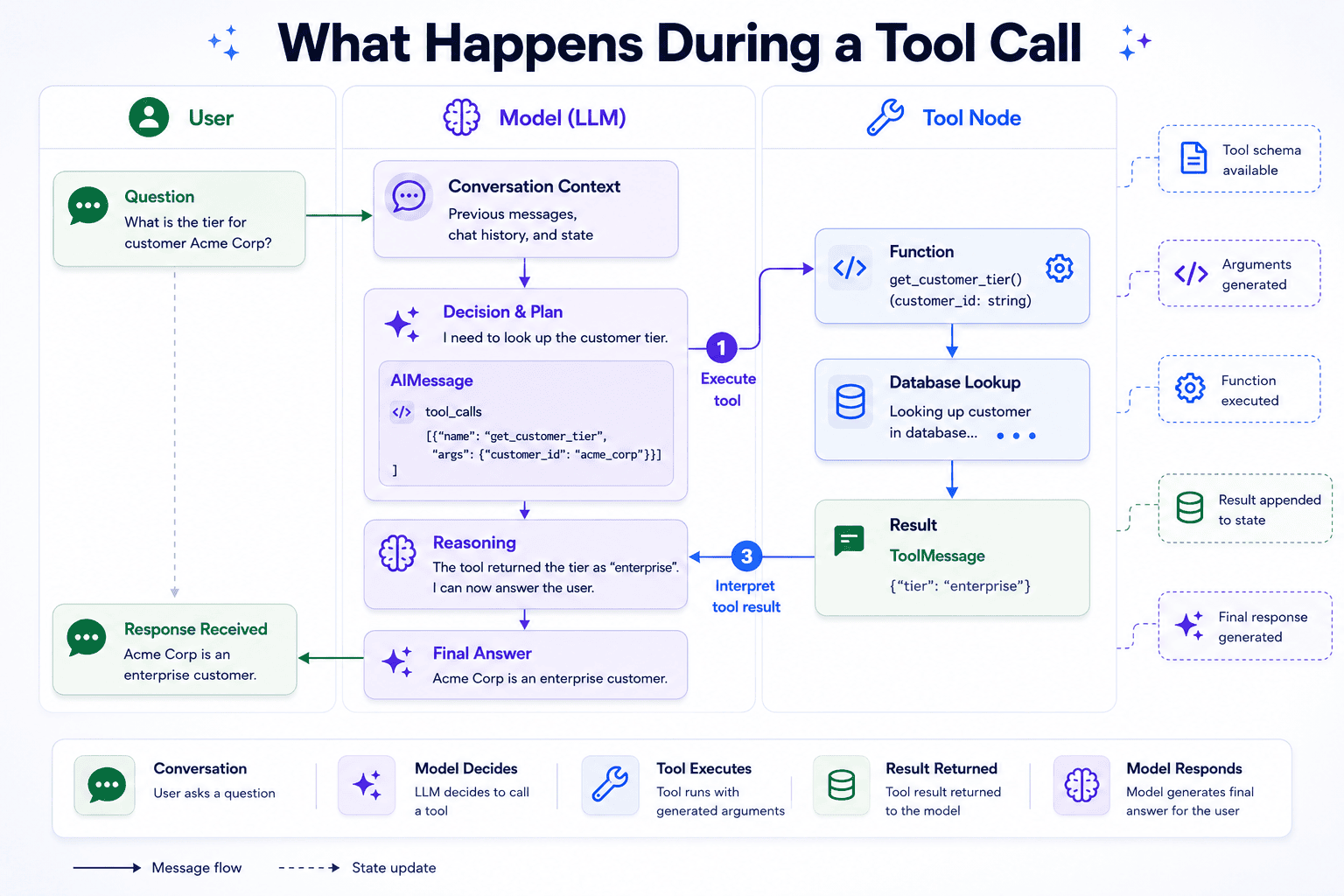
After defining a tool (e.g., get_customer_tier), it is bound to the LLM using llm.bind_tools(). This action sends the tool’s schema to the model with every request, allowing the LLM to decide if a tool call is necessary. When the model decides to use a tool, its response is an AIMessage containing a tool_calls field, rather than plain text.
To execute these tool calls, LangGraph utilizes ToolNode and tools_condition. ToolNode reads the tool_calls from the AIMessage, executes the corresponding Python function with the specified arguments, and appends the result as a ToolMessage to the state. tools_condition acts as a router, checking the last AIMessage. If tool_calls are present, it routes the execution to the ToolNode; otherwise, it routes to __end__. This creates a critical loop: run_model -> tools -> run_model. This sequence, known as the ReAct (Reasoning and Acting) pattern, allows the agent to reason about a problem, act by calling a tool, and then reason again based on the tool’s output to formulate a final response. This loop is foundational to building intelligent and capable agents, though it’s important to note that each tool use typically incurs two model calls, impacting latency and cost.
5. Tracing the Reasoning Loop:
The graph-based structure of LangGraph inherently provides an exceptional level of transparency into the agent’s decision-making process. By inspecting the result["messages"] after an invoke call, developers can trace the complete sequence of messages: the initial HumanMessage, the AIMessage with a tool_call, the ToolMessage with the tool’s output, and finally, the AIMessage with the LLM’s synthesized answer. This visibility is invaluable for debugging, understanding agent behavior, and ensuring that the agent is making logical and appropriate decisions. It highlights the modularity, where each step is a distinct message in the overall state.
6. Persisting Conversations Across Calls with Checkpointers:
For real-world applications, agents need to remember conversations beyond a single invoke() call. LangGraph addresses this with checkpointers, which persist the graph’s state between invocations. By attaching a checkpointer (e.g., InMemorySaver for development, or a database-backed solution for production) during graph compilation and passing a consistent thread_id with each invocation, the agent can resume conversations exactly where they left off. This capability is crucial for applications like customer support, where continuity of interaction is expected. While InMemorySaver is suitable for development, production environments demand durable storage solutions for checkpointers, integrating with databases like Redis, Postgres, or custom file systems to ensure state persistence and resilience.
Checkpointers vs. Stores:
It’s important to distinguish between checkpointers and stores within the LangGraph ecosystem. Checkpointers are specifically designed to persist the graph state for a particular thread or conversation. They are about maintaining the internal operational memory of the agent. In contrast, Stores provide application-level storage for data that exists independently of any single conversation thread. This could include user profiles, preferences, long-term memories, or business-specific data that multiple agents or threads might need to access. Stores complement checkpointers by providing durable storage for broader application data, allowing agents to access persistent information that is not necessarily part of the immediate conversational context.
Broader Impact and Implications of LangGraph
LangGraph represents a significant leap in the development of agentic AI, democratizing the creation of complex, intelligent systems. Its modular, graph-based approach simplifies the orchestration challenges that previously hindered the widespread adoption of multi-turn, tool-using agents.
- Accelerated Development: By providing a structured framework, LangGraph allows developers to focus on defining agent logic and capabilities rather than building complex state management and routing systems from scratch. This significantly accelerates the development cycle for advanced AI applications.
- Enhanced Reliability and Debuggability: The explicit definition of state, nodes, and edges, coupled with the ability to trace the full reasoning loop, makes LangGraph agents more predictable, easier to debug, and inherently more reliable. This transparency is crucial for deploying AI in critical business processes.
- Scalability to Multi-Agent Systems: The core primitives of LangGraph naturally extend to multi-agent architectures. A coordinator agent, for instance, can be designed as a graph that routes requests to specialized sub-agents, each potentially also a LangGraph agent. This allows for the construction of highly sophisticated, distributed AI systems capable of tackling complex, multifaceted problems.
- Diverse Use Cases: Beyond customer support, LangGraph opens doors for a multitude of agentic applications:
- Autonomous Research Agents: Capable of searching databases, synthesizing information, and generating reports.
- Personalized Assistants: That understand user preferences, manage schedules, and interact with various APIs.
- Complex Workflow Automation: Automating multi-step business processes that require dynamic decision-making and external tool interaction.
- Data Analysis and Reporting: Agents that can query data warehouses, perform analyses, and generate insights.
While LangGraph offers immense capabilities, developers should remain mindful of potential challenges, including managing the complexity of very large graphs, ensuring the reliability and security of integrated tools, and optimizing for cost and latency, particularly in scenarios involving multiple model calls per interaction. However, the framework’s inherent modularity and clarity provide a strong foundation for addressing these considerations.
In conclusion, LangGraph stands as a powerful enabler for the next generation of AI applications. By providing a flexible yet structured framework for building agentic workflows, it empowers developers to move beyond simple chatbots and create intelligent systems that can reason, act, remember, and adapt, ushering in an era of more capable and autonomous AI. The emphasis on shared state, atomic nodes, and dynamic edges ensures that these complex systems remain manageable, inspectable, and extensible, paving the way for innovative solutions across various industries.