Prompt Engineering Isn’t Enough: How Four Bricks of Context Engineering Stop RAG Hallucinations

The journey towards truly reliable artificial intelligence applications, particularly those leveraging Large Language Models (LLMs) for information retrieval and generation, is often fraught with subtle complexities. Recent research, highlighted in a comprehensive analysis published on Towards Data Science, meticulously details why a simplistic, "naive" approach to Retrieval-Augmented Generation (RAG) pipelines frequently falters in real-world enterprise scenarios, while an upgraded, "context-engineered" methodology consistently delivers accurate, cited, and typed answers. This crucial distinction underscores a fundamental truth: the efficacy of an LLM-powered system is not solely dependent on the model itself, but on the quality and structure of the information it receives—a process dubbed "context engineering."
The Foundational Promise of RAG and Its Early Limitations
The advent of powerful LLMs in the early 2020s sparked immense excitement, promising unprecedented capabilities in natural language understanding and generation. However, these models, while adept at generating human-like text, inherently faced challenges with factual accuracy and "hallucination"—the generation of plausible but incorrect information. Retrieval-Augmented Generation emerged as a pivotal solution, designed to ground LLM responses in external, authoritative knowledge bases. The core idea was elegant: instead of relying solely on the LLM’s pre-trained knowledge, a RAG system would first retrieve relevant information from a specified document corpus and then use that retrieved context to formulate an answer. This approach offered several key advantages: reduced hallucination, access to proprietary or real-time data, and the ability to cite sources, thereby increasing trust and verifiability.

Initial implementations, often termed "naive RAG," typically involved straightforward steps: parsing documents into flat text chunks, embedding these chunks into vector representations, querying the document store for the "closest" chunks based on semantic similarity to a user’s question, and then feeding these chunks to an LLM for summarization and answer generation. For short, clean, prose-based documents, this minimalist pipeline often performed adequately, as demonstrated by early tests on widely cited papers like "Attention Is All You Need." However, as enterprises began to deploy RAG systems against their vast, complex, and often imperfect real-world document repositories—ranging from intricate financial reports with dense tables to lengthy technical specifications with broken tables of contents—the limitations of the naive approach quickly became apparent.
The core finding of the "Towards Data Science" research is unambiguous: naive RAG pipelines break down not in one place, but systematically across four critical stages, or "bricks": document parsing, question parsing, retrieval, and generation. Each failure point stems from a predictable flaw in how context is handled, leading the LLM to provide a confident but ultimately incorrect answer. This revelation challenges common reflexes in AI development, such as endlessly tweaking prompts, shrinking chunk sizes, or swapping embedding models. The problem, it asserts, lies upstream, in the fundamental engineering of the context provided to the model.
Deconstructing the Four Pillars of Failure and Context Engineering Solutions
The research vividly illustrates these failures through side-by-side comparisons of a naive baseline pipeline and an upgraded, "context-engineered" pdf_qa pipeline across various real-world documents and questions. Each example serves to isolate a specific "brick" where the naive approach falters and the upgraded system provides a robust solution.

1. Document Parsing: Beyond Flat Text – Preserving Structure
The first critical failure point often occurs at the very beginning: document parsing. Naive RAG pipelines typically treat documents as undifferentiated streams of text, extracting content using methods like get_text() and then chopping it into fixed-size chunks. While acceptable for continuous prose, this approach is "fatal for tables."
-
The Naive Failure: Consider a question like, "What is the 2025 annual average price forecast for U.S. natural gas (Henry Hub)?" asked of a World Bank Commodity Markets Outlook report, which is replete with price tables. A flat text parser linearizes the tabular data, losing the inherent grid structure. When chunks are created, a row label like "Henry Hub" might land in one chunk, while its corresponding "3.5" price cell for 2025 lands in another. Retrieval then presents the LLM with incomplete context, leading it to honestly report, "not stated in these lines," with a confidence of 0.00. The information was present, but the parser destroyed its crucial relational integrity.
-
The Context-Engineered Fix: The solution lies in relational parsing. Instead of flat text, the upgraded parsing brick returns a
line_df—a data frame where each row represents a text line, complete with its bounding box coordinates. This preserves the table’s row integrity, ensuring that "Henry Hub" and "3.5" are seen together. With this structured context, the LLM accurately answers, "$3.5 per mmbtu," at a confidence of 0.99. This highlights a broader industry trend towards advanced document intelligence solutions that go beyond simple text extraction, focusing on layout understanding, table detection, and form recognition to maintain the semantic and structural relationships within documents. Analysts suggest that with 80% of enterprise data existing in unstructured formats, sophisticated parsing is no longer a luxury but a necessity for accurate AI applications.
2. Question Parsing: Bridging Semantic Gaps – Understanding User Intent
Even with perfectly parsed documents, a RAG pipeline can fail if it misunderstands the user’s query or the document’s terminology.
-
The Naive Failure: Take the question, "What are the pillars of zero trust architecture?" directed at NIST SP 800-207, Zero Trust Architecture. The document, however, never uses the word "pillars"; it consistently refers to "tenets." A naive pipeline, relying on keyword matching, will search for "pillars," find no matches, and consequently return, "the specific pillars are not listed," with a low confidence of 0.20. The answer is unequivocally present in the document, but a semantic mismatch prevents its retrieval. This is not a ranking issue but a fundamental vocabulary problem.
-
The Context-Engineered Fix: The solution is intelligent question parsing. Before retrieval, this upgraded brick normalizes and expands the query, mapping user-provided synonyms (e.g., "pillars") to the document’s actual vocabulary ("tenets," "principles"). This semantic expansion ensures retrieval searches for the terms the document uses. The system then anchors to the relevant "tenets" section, and the LLM accurately returns all seven tenets with a confidence of 0.95, even noting the document’s original term. This emphasizes the growing importance of domain-specific knowledge graphs and advanced natural language processing techniques to create robust semantic search capabilities, ensuring that AI systems can understand user intent even when language varies.

3. Retrieval: Navigating Information Hierarchies – The Power of Structure-Aware Search
Once documents are well-parsed and questions are well-understood, the next challenge is efficiently and accurately retrieving the most relevant context, especially in lengthy, complex documents.
-
The Naive Failure: Consider the question, "How is a Profile defined in CSF 2.0?" asked of the 32-page NIST Cybersecurity Framework 2.0. The term "Profile" appears frequently across many pages, naming sections, recurring in prose, and heading examples. However, only one specific section provides its formal definition. Naive keyword or cosine similarity retrieval ranks pages based on term frequency, treating all "Profile" mentions as equally relevant. Consequently, the defining page might fall below the
top-kcutoff of retrieved chunks, leading the LLM to state, "not defined in these lines," with a confidence of 0.10. The correct information was available, but the retrieval mechanism failed to prioritize the definitive source. -
The Context-Engineered Fix: The solution involves retrieval that routes on structure. The upgraded brick leverages the document’s native table of contents, often processed by a small LLM or specialized parser, to understand its inherent hierarchy. For the "Profile" question, it identifies the "CSF Profiles" section as the definitive source. This structure-aware routing anchors retrieval directly to the relevant definitional paragraph, allowing the LLM to return the full definition with a citable span and a confidence of 0.95. This method scales significantly better than frequency-based ranking. For instance, on the 400-plus-page NIST SP 800-53 control catalog, naive retrieval for a specific control (AU-2 Event Logging) would be diluted among a thousand similar entries, returning "NA" at 0.00. A structure-aware router, however, would directly locate the AU family and the AU-2 entry, providing the full requirement at 0.98 confidence. This demonstrates a shift towards leveraging metadata, document graphs, and intelligent navigation for efficient and precise information retrieval in large knowledge bases.

4. Generation: Ensuring Factual Integrity – The Typed Answer Contract
Even when the correct context is successfully retrieved, the final "generation" brick can introduce errors, particularly hallucinations, if not properly constrained.
-
The Naive Failure: Consider the question, "What is the 2026 annual average price forecast for crude oil (Brent)?" asked of the World Bank Commodity Markets Outlook, April 2024, whose forecasts only extend to 2025. In this scenario, both pipelines retrieve the correct energy pages and price tables. However, the document simply lacks a 2026 forecast. A naive pipeline, configured for free-text generation, will often attempt to answer the question regardless. The LLM might grab the nearest available number, like the 2025 value of $79, and confidently state, "the 2026 Brent forecast is $79 per barrel." This is a fluent, confident, and entirely incorrect hallucination, as nothing in a free-text answer would compel the model to acknowledge the information’s absence.
-
The Context-Engineered Fix: The critical solution here is a typed generation contract. Instead of requesting free-text, the upgraded generation brick demands adherence to a predefined schema. This schema includes fields like
complete_answer_found(which the model must explicitly set to true or false), anevidence_spanfor citation, and aconfidencescore with justification. Faced with the absence of a 2026 value, the model cannot quietly fill the gap. It is obligated to setcomplete_answer_found: falseand return, "the 2026 forecast is not provided; the latest is 2025." This mechanism transforms a potential hallucination into a transparent, verifiable statement of information availability. It’s a crucial step towards building trust and accountability in AI outputs, moving beyond mere fluency to verifiable, structured responses. The implications for regulated industries, where factual accuracy and traceability are paramount, are immense.
Context Engineering: The Holistic Approach to RAG Reliability
The overarching message from this research is that most "hallucinations" attributed to LLMs in RAG systems are not inherent flaws of the model’s intelligence but rather symptoms of upstream failures in context provision. The model, in each instance, faithfully answers the context it is given, even if that context is scrambled, semantically misaligned, incomplete, or falsely interpreted as sufficient. The label "hallucination," while pointing at the model, often misdirects from the root cause within the RAG pipeline.
"Context engineering" emerges as the holistic paradigm to address these challenges. It signifies a deliberate and systematic approach to building RAG pipelines, emphasizing precise contracts at each brick:
- Parsing: Preserve the document’s relational and structural shape.
- Question Processing: Bridge semantic gaps by searching in the document’s own vocabulary.
- Retrieval: Navigate complex information landscapes by routing on the document’s inherent structure and hierarchy.
- Generation: Bind answers to a typed, checkable contract that enforces transparency and verifiability.
This integrated approach ensures that the LLM receives the most accurate, relevant, and well-structured context, making confident wrong answers virtually impossible. This marks a maturing phase for RAG technology, transitioning from experimental prototypes to robust, production-ready enterprise solutions.

Broader Implications and the Future of Enterprise AI
The findings hold significant implications for the widespread adoption of AI in enterprise environments. As businesses increasingly rely on AI to automate knowledge work, inform critical decisions, and enhance customer interactions, the reliability of RAG systems becomes paramount. An inaccurate AI response can lead to financial losses, legal liabilities, eroded customer trust, and operational inefficiencies.
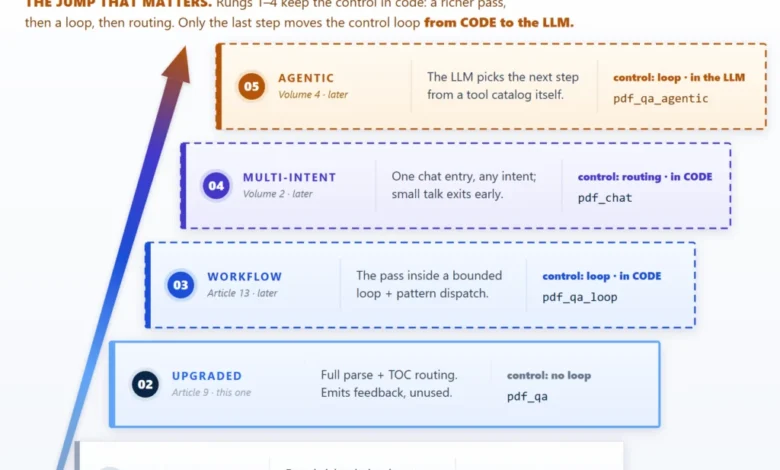
The insights from this research resonate with a growing consensus among AI researchers and industry practitioners: building truly effective AI applications requires more than just access to powerful foundation models. It demands sophisticated engineering across the entire data pipeline, from ingestion and processing to retrieval and output formatting. The "rung" metaphor used in the original research—depicting the upgraded pipeline as rung 2 of 5, with higher rungs building on this foundation—underscores that context engineering is a continuous journey of refinement, essential for unlocking the full potential of AI.
While naive RAG may suffice for simple, clean datasets, the complexity of real-world enterprise documents necessitates a more nuanced, engineered approach. The current emphasis on "context engineering" represents a critical evolution, promising a future where AI systems are not only intelligent but also consistently accurate, transparent, and trustworthy—a vital step towards truly intelligent automation and decision support in the digital age. The companion notebook, openly available on GitHub (doc-intel/notebooks-vol1), further validates these claims by allowing developers to reproduce and observe these failures and fixes firsthand, fostering a deeper understanding of robust RAG pipeline design.