The Death of the Interface: How Intent-Driven Design is Replacing the Click-Based Web

For decades, the digital landscape has been defined by a rigid architecture of menus, forms, and navigation bars—a legacy of the Graphical User Interface (GUI) revolution that began with the Xerox Star and was cemented by the original Apple Macintosh. In this paradigm, users were required to act as the primary operators of software, manually navigating labyrinthine funnels to achieve simple objectives. However, a seismic shift is currently underway. As artificial intelligence and large language models (LLMs) mature, the web is transitioning toward a philosophy of intent-driven design, where the interface serves not as a destination, but as a silent facilitator that anticipates and executes human goals without the need for manual orchestration.
This transition marks the end of an era where software success was measured by metrics such as time-on-page, click-through rates, and session depth. Today, the focus is shifting toward "invisible" computing, a concept famously championed by Golden Krishna in his work The Best Interface Is No Interface. The industry is now aligning with the "Time Well Spent" movement, which argues that the most effective digital tool is one that solves a problem with the least amount of user friction.

A Chronology of the Interface Paradigm
The evolution of user interaction can be broken down into three distinct eras. From the late 1970s through the 1990s, the "Command Line" era gave way to the GUI, which introduced the mouse, icons, and windows. This made computing accessible to the masses but established the "point-and-click" contract: the computer as a passive container, and the human as the active laborer.
From the early 2000s to the early 2020s, the "Mobile-First" era refined this model. It optimized the GUI for smaller screens, focusing on touch-based gestures and swipe interactions. Despite these improvements, the underlying friction remained; users still spent the majority of their digital time managing software—filling out fields, navigating nested menus, and reconciling data across multiple browser tabs.
Since 2023, the emergence of generative AI has ushered in the third era: "Intent-Driven Design." In this phase, the user defines the goal, and the system—acting as an autonomous agent—performs the task. This represents a fundamental inversion of the user-computer relationship. Instead of the user learning the software’s language, the software is learning to interpret the user’s intent.
Supporting Data and User Behavior Shifts
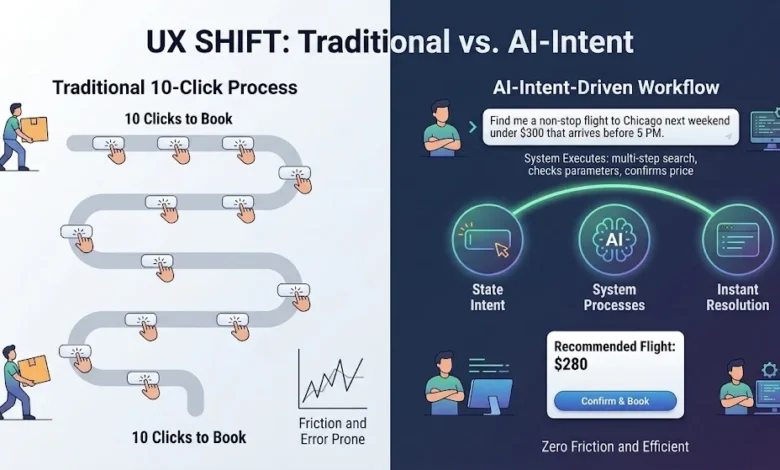
Recent research from the Nielsen Norman Group suggests that the cognitive load associated with traditional interface navigation is a primary cause of "digital fatigue." In a typical e-commerce workflow, a user might navigate through 12 to 15 distinct clicks to finalize a flight booking, including search parameters, filtering, seat selection, and payment confirmation. Each of these steps creates an opportunity for "drop-off," a phenomenon that costs the global e-commerce industry billions in lost revenue annually.
By contrast, intent-driven systems reduce these multi-step workflows to a single natural language input. For instance, when a user asks an AI-powered assistant to "find a flight to Chicago under $300 that arrives before 5 PM," the system interprets the specific constraints, queries live databases, parses the results, and returns the best-fit solution. This reduces the interaction cost from minutes to seconds, effectively eliminating the "10-click" process.
Real-World Applications: From Search to Creation
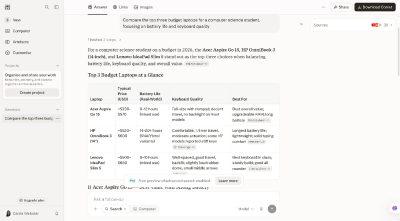
Several platforms are currently pioneering this shift. Perplexity AI, for example, has disrupted the traditional search engine model. Where Google historically provided a directory of blue links—forcing the user to curate information manually—Perplexity synthesizes disparate sources into a single, cohesive answer. This bypasses the need for the user to open multiple tabs and perform their own synthesis.
In the realm of professional tools, Vercel’s v0 platform has fundamentally altered the web development workflow. Rather than a designer or developer manually dragging and dropping UI components in a tool like Figma, v0 uses generative models to build functional code components from text prompts. The "interface" here is the conversation itself. Similarly, Goblin.tools has applied this to personal productivity for neurodivergent users, offering a suite of AI-driven utilities that break down complex, overwhelming tasks into manageable, step-by-step checklists without requiring a complex onboarding process or manual configuration.
The Three Pillars of Intent-Driven UX
Designers operating in this new space are moving away from static, fixed-layout design. The architecture of modern, intent-driven applications relies on three foundational pillars:
- High-Level Goal Processing: Systems now use environmental metadata—such as device location, historical habits, and real-time context—to proactively offer solutions. This moves beyond passive input to ambient intelligence.
- Generative UI: Unlike traditional web design, where every user sees the same static page, generative UI allows the interface to morph in real-time. If a user needs to calculate financial projections, the application renders a dynamic calculator widget on the fly, which then disappears once the task is complete.
- Autonomous Execution: By integrating AI agents that can act on behalf of the user, platforms are shifting the burden of task execution from human to machine. This necessitates a pivot in error handling: because the agent is doing the work, the focus shifts from "prevention" (pop-up warnings) to "frictionless reversibility" (the "Undo" button).
Ethical Implications and the Black Box Problem
While the transition to invisible interfaces offers immense efficiency, it introduces significant ethical and design risks. The "Black Box" problem is perhaps the most pressing concern. In a traditional interface, a user can diagnose why a search failed by checking their filters. In an intent-driven system, the process is opaque. If an AI agent executes an incorrect action, the user may be left confused as to why the system "misunderstood" them.
To mitigate this, experts from the Google PAIR (People + AI Research) group advocate for transparent feedback loops. Systems must explicitly state their interpretation of the user’s intent—for example, "I am searching for non-stop flights to Chicago under $300"—to allow the user to verify the agent’s logic before a high-stakes transaction is finalized.
Furthermore, the "Illusion of Control" remains a hurdle. If an AI makes too many autonomous decisions, users may feel a loss of agency or become suspicious of the system’s motivations. The Center for Humane Technology has cautioned that designers must be careful not to build manipulative defaults that prioritize platform profit over user intent. High-stakes actions, such as financial payments or privacy setting changes, must always require explicit, intentional human confirmation.
Broader Impact and Industry Outlook
The implications for UX design as a profession are profound. The role of the designer is evolving from a creator of static, pixel-perfect buttons to an architect of AI behavior and conversation flow. Designers must now learn to map the boundaries of autonomy, design for dynamic layouts that adapt to context, and build trust through clear, transparent communication.
The industry is moving toward a future where the "web" is no longer a collection of websites, but a layer of intelligence that sits between the user and their goals. As we look toward the coming years, the metrics of success will continue to migrate away from engagement volume. The most successful platforms will be those that can demonstrate a decrease in interaction time while maintaining a high level of user satisfaction and accuracy.
Ultimately, the goal of modern web development has shifted from making interfaces "flashier" to making them disappear entirely. As we refine the ability of software to understand and execute human intent, the digital experience will become increasingly seamless. We are no longer designing for the user to "visit" a site; we are designing for the user to reach their objective, with the interface providing only the necessary assistance to get there. The future is not in more clicks, but in the total elimination of the friction that once defined the digital age.