Cyclops Blink Malware Evolves: Sophisticated Linux Implant Targets Cisco Firewall Management Center Infrastructure

In August 2026, cybersecurity researchers at the Counter Threat Unit (CTU) identified a highly sophisticated, modular 64-bit Linux executable designated as timezone_check. This malicious implant, discovered during forensic investigations on compromised Cisco Firewall Management Center (FMC) devices, represents a significant evolution of the Cyclops Blink malware framework. Originally brought to public attention by the UK National Cyber Security Centre (NCSC) in 2022, this new variant demonstrates increased operational flexibility and a broader attack surface, marking a concerning shift in how state-aligned threat actors target critical network-edge infrastructure.
The discovery prompted a rapid response from Cisco, which released detailed technical advisories on September 9, 2026, regarding an ongoing campaign exploiting their management appliances. The CTU, having corroborated these findings, has since released comprehensive analysis confirming that the malware is linked to the Russia-based threat group known as IRON VIKING—an entity widely identified by the global intelligence community under aliases such as Sandworm and Seashell Blizzard.

The Evolution of Cyclops Blink: From Firmware to System V
The most critical distinction between the 2022 iteration and the 2026 version lies in its deployment methodology. The original Cyclops Blink samples were specifically engineered for WatchGuard Firebox devices, relying on complex, vendor-specific firmware modifications to achieve persistence. This required deep knowledge of proprietary boot processes, effectively locking the malware to specific hardware platforms.
By contrast, the 2026 variant is a generalized x86-64 Linux implant that utilizes standard System V (SysV) initialization scripts. By eschewing hardware-specific persistence mechanisms in favor of ubiquitous Linux standards, the attackers have significantly lowered the barrier for cross-platform infection. This shift allows the malware to operate on a wide variety of network appliances, including SD-WAN controllers, VPN concentrators, and various enterprise-grade management platforms, provided they run on x86-64 Linux environments.
Operational Architecture and Persistence
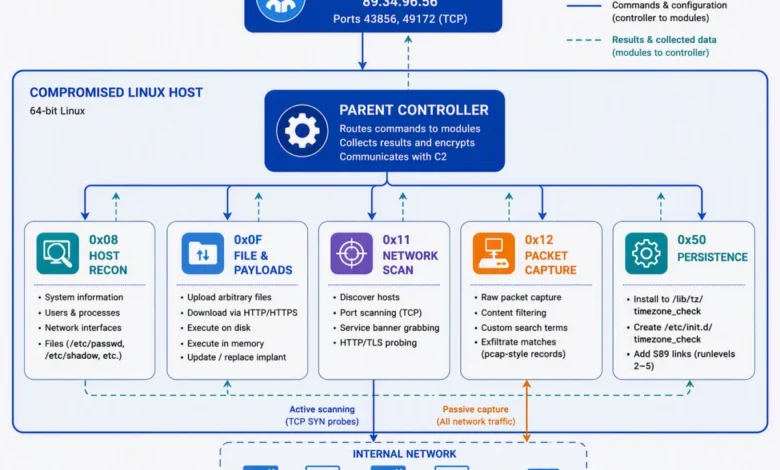
The malware operates as a modular botnet framework governed by a parent controller process, which strategically disguises itself as the legitimate Linux kernel thread [kworker/0:1]. By masquerading as a common background kernel process, the implant effectively blends into standard process listings, complicating detection for system administrators who rely on basic monitoring tools.

The controller manages a sophisticated inter-process communication (IPC) system, coordinating five distinct worker modules. This modularity ensures that the failure of one component does not destabilize the entire framework. The worker modules handle diverse tasks, including:
- Module 0x08 (Host Reconnaissance): Profiles the host system, exfiltrates environment configurations, and attempts to scrape sensitive files such as /etc/shadow for password hashes.
- Module 0x0F (File Transfer and Execution): Facilitates the movement of malicious payloads and exfiltration of stolen data. It features a unique, hard-coded DNS-over-HTTPS resolver that communicates directly with public DNS servers, bypassing local network logs to mask C2 traffic.
- Module 0x11 (Network and Service Scanner): Enables lateral movement by scanning internal IPv4 networks for vulnerable management services, including SSH, web-based interfaces, and various industrial or administrative protocols.
- Module 0x12 (Packet Capture and Surveillance): Implements a programmable traffic sniffer that uses an Aho-Corasick matching algorithm to selectively capture packets containing specific strings of interest, such as credentials or tokens, without overwhelming the C2 channel with unnecessary data.
- Module 0x50 (Persistence): Automates the relocation of the binary to /lib/tz/timezone_check and ensures system-wide startup by creating symbolic links in the SysV init runlevel directories.
Command and Control (C2) and Cryptographic Safeguards
The implant’s communication strategy is equally robust. It utilizes TLS-encrypted outbound connections to a hard-coded C2 address, 89.34.96.56. While it uses standard TLS for the transport layer, the controller adds an additional layer of application-level encryption using RSA-3072 public keys. This dual-encryption strategy ensures that even if a TLS inspection tool were to decrypt the traffic, the internal payloads—such as reconnaissance data or captured network traffic—would remain obfuscated.
The use of a "timezone_check" naming convention is a deliberate attempt to mimic legitimate system services, a classic tactic employed by IRON VIKING to evade scrutiny by security teams during routine maintenance or audit cycles.

Strategic Implications for Enterprise Infrastructure
The selection of Cisco FMC devices as a primary target is not coincidental. Network management appliances sit at the nexus of modern enterprise security, often possessing administrative privileges over the entire network infrastructure. By compromising a central management point, the attackers gain a "bird’s-eye view" of internal network segments, enabling them to map target environments, collect intelligence, and stage follow-on operations against high-value systems.
Security analysts have noted that the inclusion of an active network scanning module is a force multiplier for the adversary. Whereas the 2022 version was largely passive, the 2026 version allows the operator to actively probe the internal network from a trusted location. This capability poses a severe risk to organizations that assume their management infrastructure is inherently secure and isolated from internal or external threats.
Chronology of the 2026 Campaign
- August 2026: CTU researchers identify the timezone_check executable on multiple Cisco FMC devices.
- Late August 2026: Initial analysis identifies the modular architecture and its link to the historical Cyclops Blink framework.
- September 9, 2026: Cisco publishes an official advisory regarding ongoing exploitation of FMC devices, confirming the risk to customers.
- Mid-September 2026: Following the public disclosure, CTU releases comprehensive technical findings to aid the global defense community.
Industry and Official Response
While specific statements from the impacted vendors underscore the necessity of patching and hardening, the broader cybersecurity community has warned that traditional endpoint detection and response (EDR) tools may struggle to identify the implant due to its reliance on system-level masquerading. Organizations are being urged to conduct proactive threat hunting, specifically looking for anomalous processes with names mimicking kernel threads and unauthorized files located in /lib/tz/ or /etc/init.d/.

"The transition from niche firmware exploitation to general-purpose Linux persistence represents a maturity in the adversary’s toolkit," said one independent security consultant. "They have effectively moved from a ‘bespoke’ approach to a ‘modular’ approach, allowing them to scale their operations across diverse hardware environments with minimal reconfiguration."
Broader Impact and Future Outlook
The activities of IRON VIKING (Sandworm) continue to represent one of the most persistent threats to global stability in cyberspace. Historically associated with disruptive campaigns targeting energy sectors and government infrastructure, their current focus on network management devices indicates a desire for long-term, low-visibility persistence rather than immediate, loud-impact attacks.
The implications for the industry are profound. The shift toward standardized Linux-based persistence means that the security of an entire network may hinge on the integrity of a single management appliance. As threat actors continue to refine their ability to manipulate Linux environments, organizations must shift their defensive posture toward "zero-trust" management—treating even the most trusted administrative appliances as potential points of compromise.

Moving forward, the cybersecurity industry expects to see a surge in forensic investigations as administrators audit their network-edge devices for signs of the timezone_check implant. The reliance on SysV init scripts provides a clear, actionable indicator for defenders, yet the difficulty lies in the fact that these scripts can be modified or hidden by a sufficiently privileged adversary. As this threat continues to evolve, the cooperation between vendors, threat intelligence providers, and government agencies will be the only effective mechanism for mitigating the risk posed by such advanced persistent threats.