Closing the Incident Remediation Loop: Automating Distributed Systems Recovery with AWS DevOps Agent and Kiro CLI

The modern landscape of distributed cloud architecture has created a paradox for operations teams: while infrastructure has become infinitely more scalable, the manual toil required to maintain that scale during incidents has reached a breaking point. For years, the industry standard for incident response has relied on a reactive, human-intensive cycle: detection via telemetry, manual investigation across siloed logs, and the tedious creation of patches. Today, a new integration between the AWS DevOps Agent and Kiro CLI is fundamentally altering this trajectory, enabling an end-to-end autonomous remediation pipeline that shifts the role of the engineer from a manual responder to an architectural auditor.
The Evolution of Operational Toil
The historical reality of managing distributed workloads on Amazon Web Services is defined by the “2 AM incident” problem. When an Amazon CloudWatch alarm triggers, the traditional workflow requires an on-call engineer to perform a frantic synthesis of data: correlating metrics, searching application logs, and reviewing recent deployment pipelines. This “MTTR” (Mean Time to Recovery) tax is not merely an inconvenience; it is a significant drain on organizational productivity. Industry benchmarks indicate that manual investigation can account for up to 80% of total incident duration.
The introduction of the AWS DevOps Agent was designed to disrupt this cycle by automating the first half of the equation. By utilizing agentic AI to investigate incidents, the tool identifies root causes and proposes mitigation plans with a documented 94% accuracy rate. However, until recently, a critical gap remained: the transition from a proposed fix to a deployed reality still required a human to write, test, and ship code. The new integration with Kiro CLI closes this loop, turning mitigation strategies into executable pull requests without the manual overhead of traditional coding workflows.
Architecture of the Autonomous Bridge
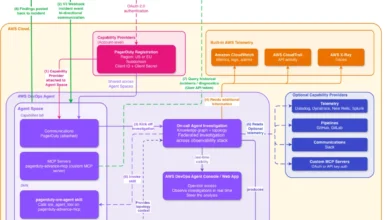
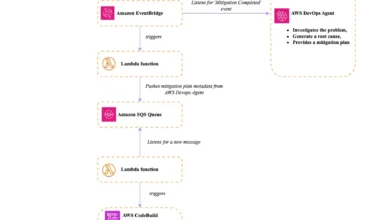
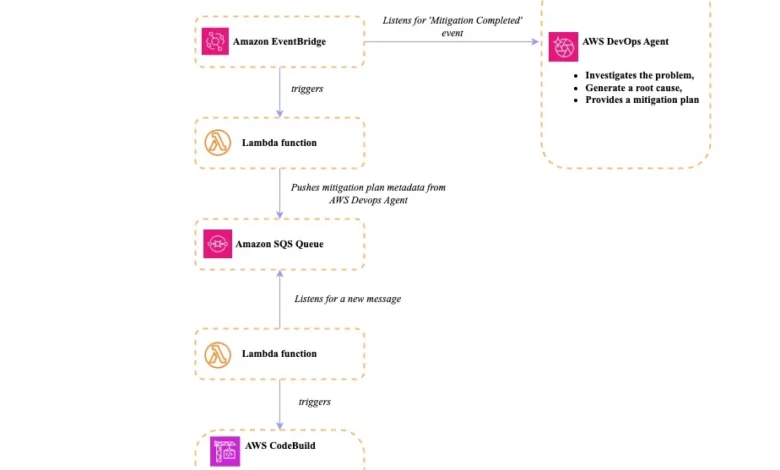
The solution leverages a serverless, event-driven architecture to bridge the gap between diagnostic agents and code execution. At its core, the system utilizes Amazon EventBridge to capture lifecycle events generated by the AWS DevOps Agent. When the agent successfully completes a mitigation analysis, it publishes a “Mitigation Completed” signal to the default event bus.
This signal serves as the trigger for a downstream chain of events. A specialized AWS Lambda function parses the event metadata—specifically the agent_space_id and execution_id—to extract the granular mitigation summary and the step-by-step execution plan. This structured data is then pushed to an Amazon SQS queue, which acts as a buffer to ensure reliable, ordered processing of remediation tasks. By decoupling the diagnostic phase from the execution phase, the architecture ensures that the system remains resilient even during high-volume incident periods.
Headless Remediation: The Role of Kiro CLI
The transition from a theoretical plan to a tangible code change is managed by Kiro CLI, a tool that has evolved significantly with its 2.0 release. The critical innovation here is “headless mode,” which allows the CLI to operate within an ephemeral compute environment—specifically AWS CodeBuild—without requiring a persistent interactive session.
When an event hits the SQS queue, the orchestration layer triggers an AWS CodeBuild job. This job performs a series of precise operations: it clones the relevant application repository, authenticates against secret management services to authorize changes, and executes the Kiro CLI with the prompt generated by the AWS DevOps Agent.
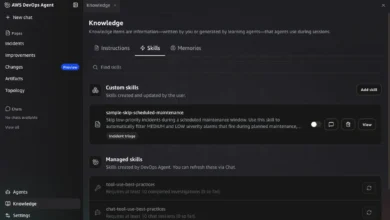
The effectiveness of this process is heavily reliant on the “steering file.” This configuration file acts as a set of guardrails, providing the AI with the necessary context regarding coding conventions, repository structures, and organizational security policies. By embedding these guardrails into the repository itself, organizations ensure that the AI-driven remediation is not only rapid but also compliant with existing engineering standards.
Data-Driven Efficiency and Performance
The performance metrics associated with this integrated approach are compelling. During the preview phase, early adopters reported a 75% reduction in MTTR. This efficiency gain is largely attributed to the elimination of context switching. By removing the need for an engineer to manually “context switch” into the codebase to write a fix, the time from detection to remediation is compressed from hours to mere minutes.
Furthermore, the auditability of this process is significantly improved. Because the entire chain of command—from the CloudWatch alarm to the final pull request—is logged through the agent’s execution IDs, organizations maintain a clear, immutable record of every incident and its corresponding remediation. This facilitates post-incident reviews, as the reasoning behind every change is captured directly from the agent’s output.
The Human-in-the-Loop Safeguard
Despite the move toward full automation, the system maintains a vital human-in-the-loop requirement. Once Kiro CLI has modified the code and generated a pull request, the system halts. The pull request contains not only the code changes but also the diagnostic narrative provided by the AWS DevOps Agent.
This deliberate bottleneck serves as the final quality assurance gate. A human developer reviews the proposed fix to ensure it aligns with the broader architectural goals and safety requirements. By transforming the engineer’s role from a "manual fixer" to a "reviewer," the system increases throughput while maintaining the necessary level of oversight required for production environments.
Broader Implications for Enterprise Operations
The integration of these agents signals a shift in the philosophy of DevOps. We are moving toward a future where "Operations" becomes a function of configuration and policy, rather than manual execution. For large enterprises managing hundreds of microservices, the ability to automate L1 and L2 incidents—the routine, high-volume issues that plague SRE teams—represents a massive recapture of engineering talent.
However, the implementation of such systems is not without its challenges. It requires a high degree of maturity in infrastructure-as-code (IaC) and a rigorous approach to testing. The dependency on well-structured steering files and robust CI/CD pipelines means that organizations must invest in the foundational "hygiene" of their codebase before they can reap the benefits of autonomous remediation.
Future Outlook and Strategic Adoption
As the industry continues to integrate agentic AI into the development lifecycle, the pattern demonstrated by the AWS DevOps Agent and Kiro CLI is likely to become the blueprint for future incident response systems. The ability to chain specialized agents together—one for diagnosis, one for execution, and a third for validation—creates a modular, extensible framework that can adapt to evolving operational needs.
For organizations looking to adopt this model, the starting point is the rigorous documentation of current incident workflows. By identifying the repetitive, predictable steps in the remediation process, teams can begin to migrate these segments into the event-driven architecture described here. The accompanying repository, provided by AWS samples, serves as a comprehensive starting point, offering the necessary CloudFormation templates and steering configurations to move from concept to implementation.
Ultimately, the goal is not to remove the engineer from the process, but to elevate them. By offloading the mechanical aspects of incident response to intelligent, automated systems, organizations can empower their teams to focus on high-value initiatives—innovation, architectural improvement, and the strategic scaling of their cloud environments. In a world where uptime is the primary metric of success, the ability to turn detection into deployment in minutes is no longer just a competitive advantage; it is an operational imperative.