Amazon Bedrock AgentCore Runtime Introduces Runtime Instances for Complex, Long-Running Multi-Agent Workloads

As organizations increasingly transition artificial intelligence agents from isolated experimental prototypes to mission-critical production environments, the underlying infrastructure requirements have grown exponentially more complex. Modern AI agents are no longer restricted to answering simple, single-turn queries; instead, they are tasked with executing intricate, multi-step workflows that can span hours, days, or even weeks. These sophisticated workloads require persistent states, seamless coordination among multiple collaborative agents, shared computational contexts, and, in many specialized scenarios, direct access to graphics processing units (GPUs) and the underlying operating system.
To address these escalating technical hurdles, Amazon Web Services (AWS) has officially announced the launch of runtime instances, a powerful new complementary compute option designed for Amazon Bedrock AgentCore Runtime. This architectural enhancement delivers persistent, fully managed infrastructure engineered specifically to support heavy, complex, and long-running agent workloads without forcing engineering teams to manually provision and orchestrate foundational infrastructure.
The Evolution of Agentic Infrastructure and Operational Challenges
Historically, scaling AI agents past the proof-of-concept phase involved navigating significant infrastructural bottlenecks. When workflows were designed to run continuously for days, developers faced the arduous task of manually provisioning Amazon Elastic Compute Cloud (EC2) instances, configuring complex networking parameters, establishing secure session management frameworks, implementing robust auto-scaling policies, and stitching together disparate monitoring tools. Furthermore, orchestrating multiple collaborating agents—such as a writer-reviewer feedback loop or an autonomous software development pipeline—required custom-built communication protocols and data transfer pipelines.

While Amazon Bedrock AgentCore Runtime microVMs have successfully provided a fully managed environment for short-to-medium-term invocations lasting up to eight hours with managed session storage, certain enterprise workloads demand far more robust compute capabilities. Applications involving continuous multi-day operations, deep operating system-level interactions, GPU acceleration for compute-intensive machine learning tasks, or multiple cooperative agents operating on a single host required a more dedicated infrastructure model. Runtime instances directly bridge this gap by offering AWS-managed EC2 infrastructure that seamlessly handles these resource-heavy demands while integrating cleanly with existing AgentCore APIs, robust identity controls, and native observability suites.
Core Architectural Capabilities of Runtime Instances
The introduction of runtime instances brings a comprehensive suite of features designed to alleviate the operational burdens traditionally associated with deploying multi-agent systems at scale. By leveraging AWS-managed EC2 infrastructure, development teams can deploy multiple distinct agents within a single runtime environment, with each agent maintaining its own unique dependencies and artifact types.
One of the standout architectural advantages is the ability for multiple agents to collaborate natively on the same physical host within shared sessions that persist for up to 14 days. During these extended windows, agents can interact directly through shared file systems, eliminating the need for complex API calls or redundant data transfers between disparate services. For instance, data that needs to survive beyond an active session can be permanently preserved by pairing runtime instances with Amazon Elastic Block Store (Amazon EBS) and AgentCore Memory, granting agents long-term recall across sessions and environments.
Additionally, the platform supports GPU acceleration for highly compute-intensive tasks, such as large-scale data processing, complex mathematical modeling, or intensive computer vision operations. To optimize operational costs during idle periods, the service incorporates advanced session stop and restart functionalities, allowing workflows that span multiple days—such as pausing operations on Monday night and resuming them Wednesday morning—to maintain complete state integrity. Containerized deployments are fully supported, giving engineering teams the flexibility to ship updates independently using their preferred frameworks, including CrewAI, LangGraph, LlamaIndex, and Strands, alongside any foundation model of their choice.
Complementary Integration: MicroVMs and Runtime Instances
Rather than forcing developers to choose a single infrastructure paradigm, AgentCore Runtime is architected so that runtime microVMs and runtime instances act as highly complementary compute options. These options can be utilized independently or combined dynamically through unified AgentCore runtime APIs to build hierarchical, highly efficient multi-agent systems.
In a typical hybrid architecture, a lightweight orchestrator agent running on a fast-scaling runtime microVM can handle incoming API calls, manage task routing, and aggregate final results. Simultaneously, this orchestrator can dispatch heavy computational workloads to specialized worker agents operating on dedicated runtime instances. These worker agents can then execute resource-intensive operations—such as large-scale code compilation, rigorous automated security scanning, or complex graphical user interface (GUI) automation—that explicitly require persistent state management, extended execution windows, and direct operating system access.
Step-by-Step Implementation and Multi-Agent Collaboration
To demonstrate the practical application of runtime instances, developers can configure multi-agent systems using minimal packaging requirements, typically involving a simple @app.entrypoint decorator and a deployment package via a zip file or container image.
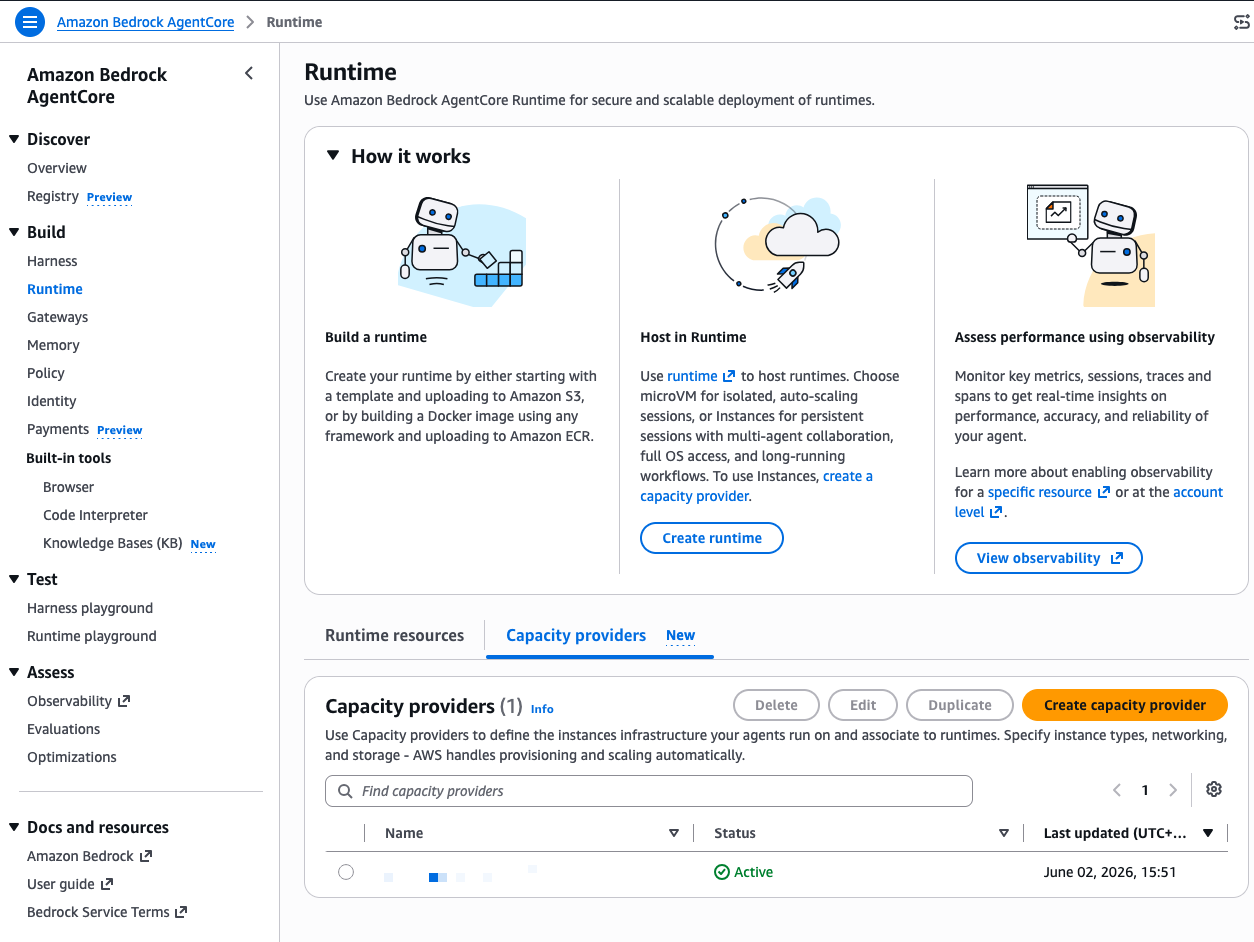
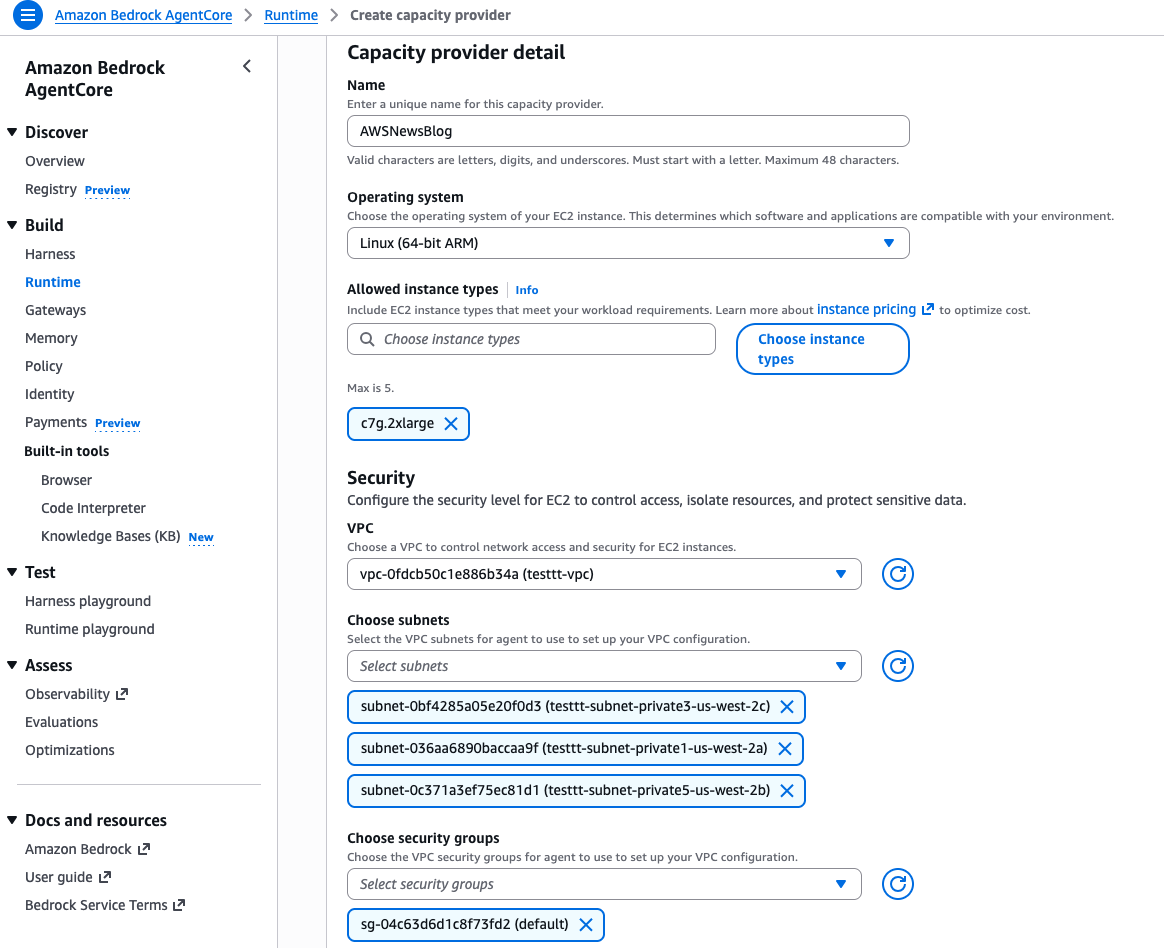
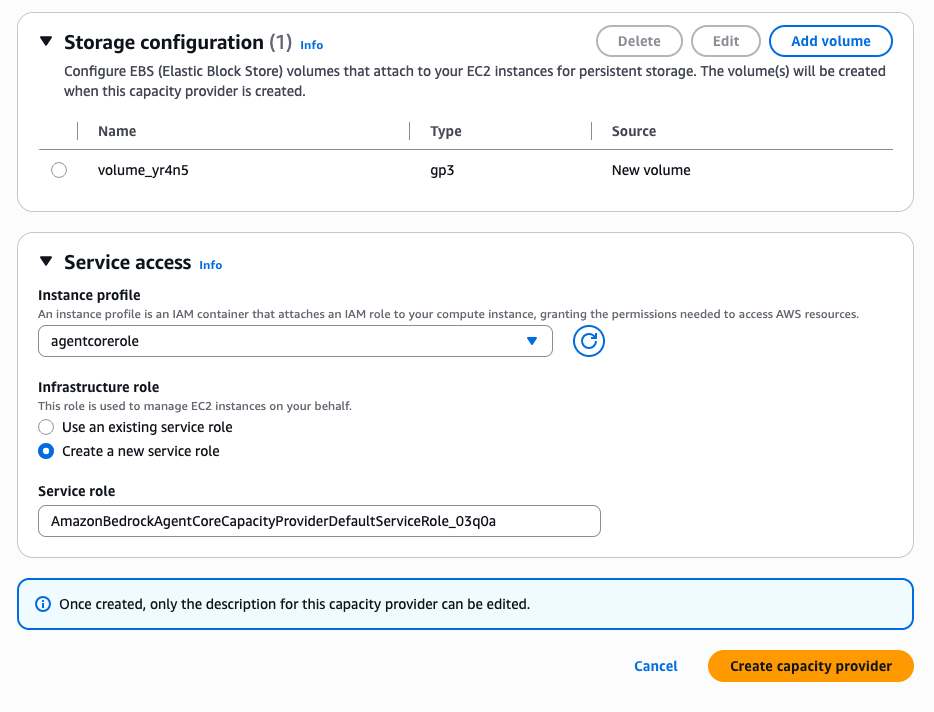
The deployment process generally begins with the creation of a capacity provider via the AWS Management Console, the AgentCore CLI, the standard AWS Command Line Institute (AWS CLI), or infrastructure-as-code tools. By defining a capacity provider, developers establish the underlying EC2 specifications—such as selecting a Linux 64-bit ARM operating system and instance types like c7g.2xlarge to secure adequate vCPUs and memory—alongside configuring necessary Virtual Private Clouds (VPCs), subnets, security groups, and IAM service roles.
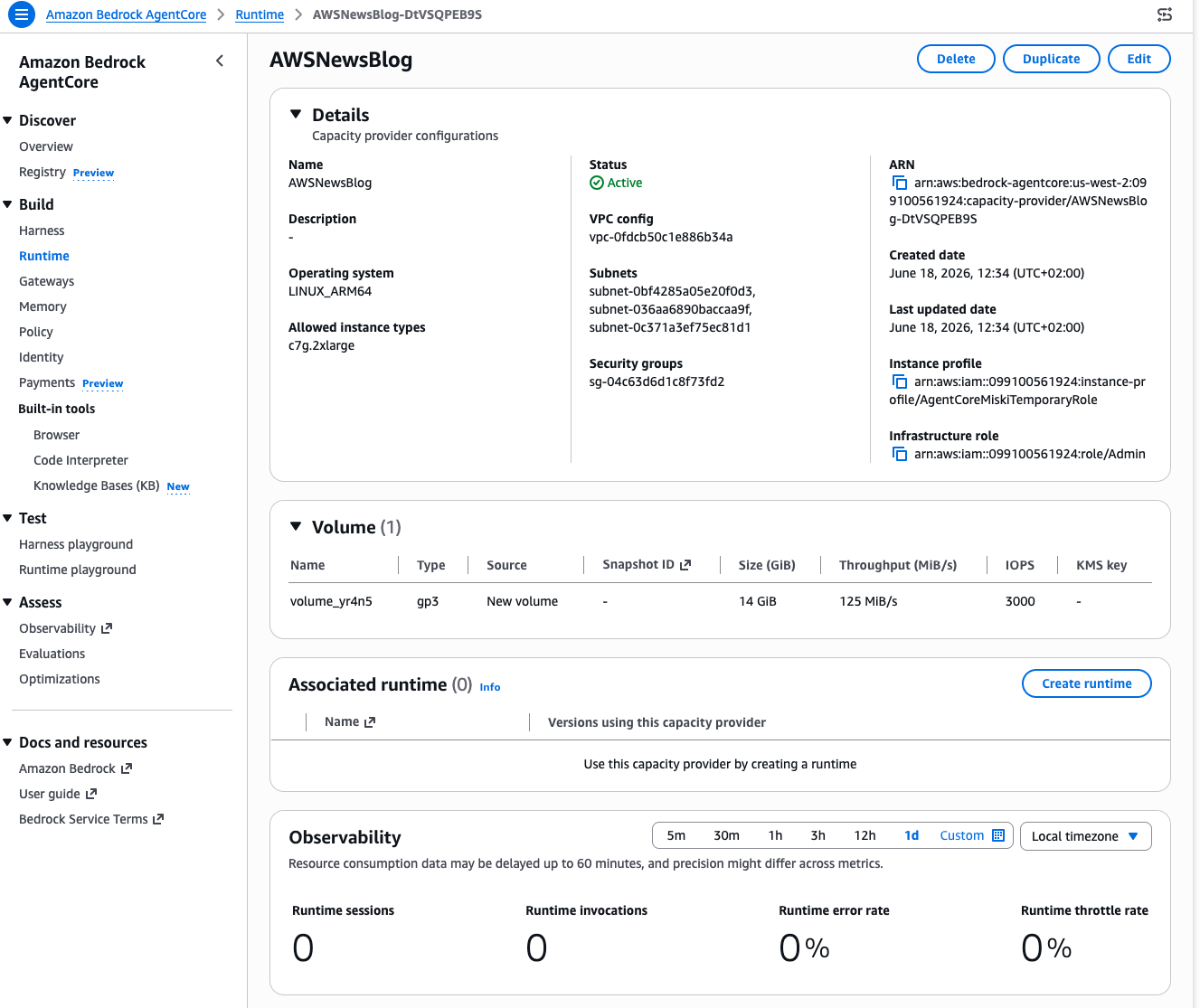
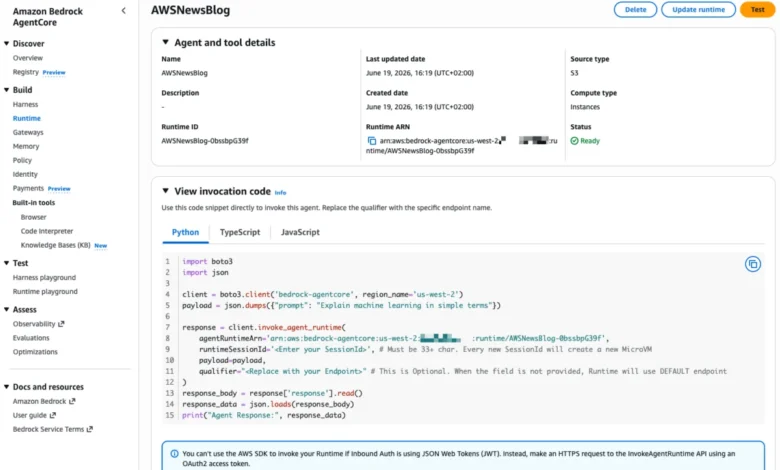
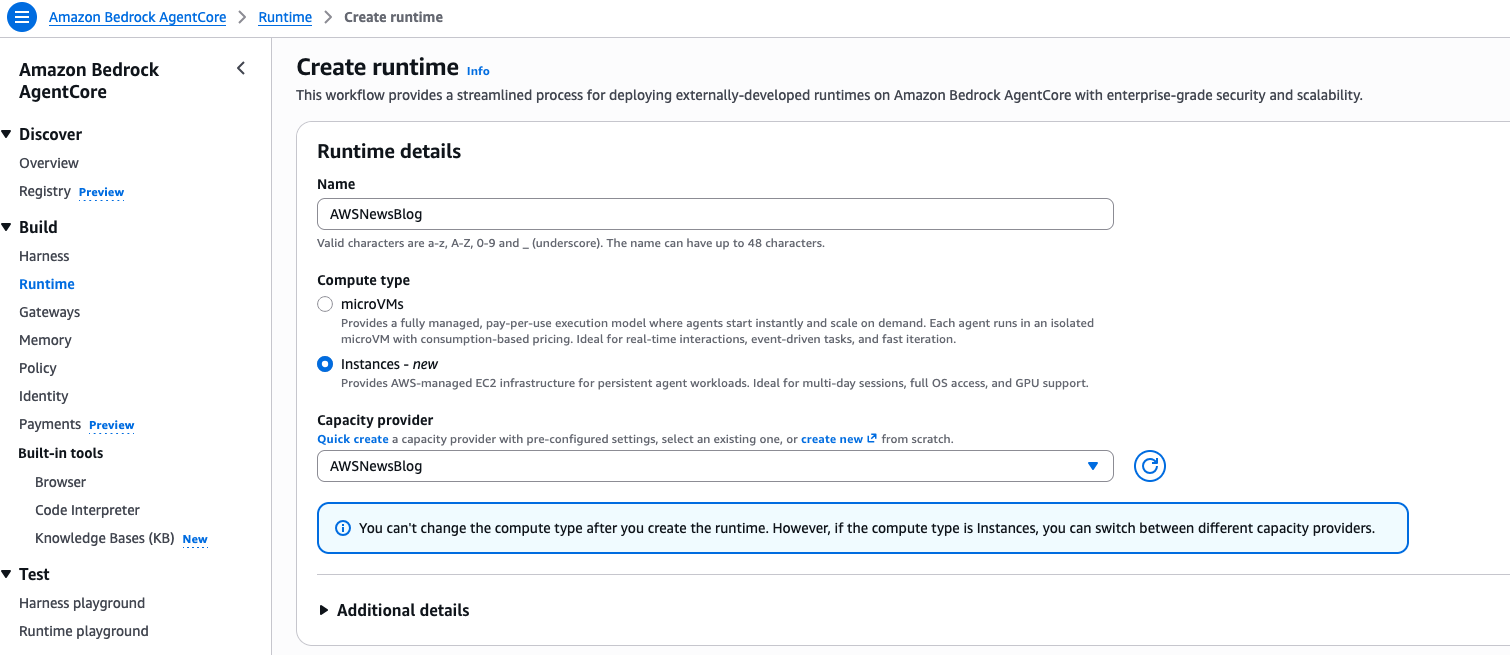
Once the capacity provider achieves an active status, developers create distinct runtimes for each specialized agent, linking them to the shared capacity provider and uploading their respective code packages. In a representative collaborative scenario involving a Python code writer agent and a strict code reviewer agent, both applications can be deployed to share the exact same underlying EC2 infrastructure.
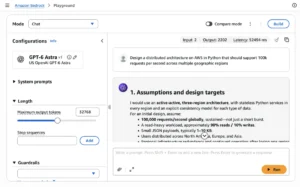
When invoked programmatically or through the built-in Runtime playground within the AWS Management Console, the writer agent receives a natural language prompt—such as generating a Fibonacci sequence suite—and writes the resulting Python code to a designated session directory. By passing the exact same Session ID to the reviewer agent, the reviewer instantly gains access to the shared file system directory. Without exchanging network packets or executing external API calls, the reviewer reads the generated file, analyzes it for potential bugs, stylistic issues, and architectural improvements, and returns a comprehensive review. This collaborative pattern can be scaled infinitely to include testing agents, documentation generators, and automated vulnerability scanners.
Industry Implications and Future Outlook
The launch of Amazon Bedrock AgentCore Runtime instances marks a significant maturation point in the enterprise generative AI landscape. By abstracting away the heavy undifferentiated lifting of provisioning, networking, scaling, and monitoring multi-agent infrastructure, AWS is lowering the barrier to entry for deploying complex, autonomous agentic systems in production environments.
As enterprises increasingly demand AI solutions capable of performing long-horizon tasks with minimal human intervention, the ability to maintain persistent state, coordinate specialized multi-agent teams across shared hosts, and leverage flexible hardware configurations like GPUs will become a critical competitive differentiator. The integration of runtime instances into the Amazon Bedrock ecosystem provides developers with the scalability, reliability, and security required to transition AI agents from experimental novelties into core drivers of enterprise productivity and innovation.