Java 27 in IntelliJ IDEA: A Comprehensive Overview of the Latest Release and Developer Integration

On September 15, 2026, the Java ecosystem reached another milestone with the official release of Java 27. Following the established six-month release cadence mandated by Oracle and the OpenJDK community, this version continues the rapid evolution of the language. With nine Java Enhancement Proposals (JEPs) included—four of which have reached final status—Java 27 emphasizes performance, security, and developer productivity. As the primary integrated development environment (IDE) for the Java and Kotlin ecosystems, JetBrains’ IntelliJ IDEA has simultaneously updated its toolchain to ensure developers can leverage these new capabilities from the first day of availability.
The Evolution of the Java Release Cycle
Since the transition to a six-month release cycle in 2017 with Java 10, the platform has shifted from infrequent, massive updates to a continuous delivery model. This strategy aims to provide developers with a steady stream of language enhancements, library updates, and performance optimizations. Java 27 follows this trajectory, refining features that have been in development for several cycles while introducing critical infrastructure improvements.
The release of Java 27 is particularly notable for its focus on JVM-level optimizations. By transitioning internal components—such as the default garbage collector and object header structure—the JDK is becoming more efficient for modern, high-density cloud environments. This shift directly addresses the needs of microservices and containerized deployments, where memory footprint and startup latency are primary performance indicators.
Core Enhancements: Stability and Performance
The four finalized JEPs in Java 27 represent a significant effort to modernize the runtime environment.
JEP 523, which makes the Garbage-First (G1) garbage collector the default for all environments, marks the end of the Serial GC era for most standard deployments. Historically, the Serial collector was reserved for resource-constrained environments or single-CPU systems. However, with the cumulative performance improvements made to G1 over recent years, the OpenJDK team concluded that G1 is now superior in throughput and latency management for virtually all use cases. Developers who specifically require the Serial collector for legacy or ultra-low-memory constraints can still opt-in via the -XX:+UseSerialGC flag.

Security remains a top priority in this release with JEP 527, which introduces post-quantum hybrid key exchange for TLS 1.3. As quantum computing research advances, the risk of "harvest now, decrypt later" attacks—where encrypted data is stored today to be cracked once quantum technology matures—has become a tangible threat. By integrating hybrid key exchange algorithms, Java 27 provides a defense-in-depth approach, ensuring that current network traffic remains secure against future decryption capabilities.
Perhaps the most impactful change for memory-intensive applications is JEP 534: Compact Object Headers. By reducing the size of object headers from 96 bits to 64 bits on 64-bit architectures, the JVM can store more objects within the same heap space. This optimization improves cache locality and data density. JetBrains’ internal telemetry indicates that IntelliJ IDEA itself, which manages millions of objects during indexing and analysis, has observed measurable memory savings, confirming the real-world utility of this change.
Finally, JEP 536 enhances the JDK Flight Recorder (JFR) by enabling in-process data redaction. This ensures that sensitive command-line arguments and environment variables are scrubbed before they are written to recording files, providing a higher level of security for developers debugging production systems.
Preview Features and the Developer Experience
Preview features in Java 27 allow the community to influence the language’s trajectory. IntelliJ IDEA provides robust support for these, allowing developers to toggle language levels to experiment with cutting-edge functionality without committing to a final API.
The "Lazy Constants" (JEP 531) continue their journey through the preview process. By allowing fields to be evaluated only when accessed, rather than eagerly at class initialization, developers can achieve faster startup times and more efficient resource utilization. This is particularly relevant for large-scale applications where eager loading of static constants can contribute to "cold start" latency.
Pattern matching also sees continued expansion in JEP 532. By allowing primitive types to be used within instanceof and switch constructs, Java is removing historical friction points that forced developers to rely on manual, error-prone casting. This refinement improves code readability and safety, as the compiler can now handle range checks and conversions natively.
Structured Concurrency (JEP 533) remains in its seventh preview, cementing its role as the future of Java’s multithreaded programming model. As part of Project Loom, structured concurrency allows developers to treat multiple threads as a single unit of work, significantly simplifying error handling and cancellation logic. JetBrains has optimized IntelliJ IDEA to support this, offering "live templates" that allow developers to scaffold structured concurrency patterns rapidly, reducing the boilerplate traditionally associated with thread management.
Integrating Java 27 into the IntelliJ Workflow
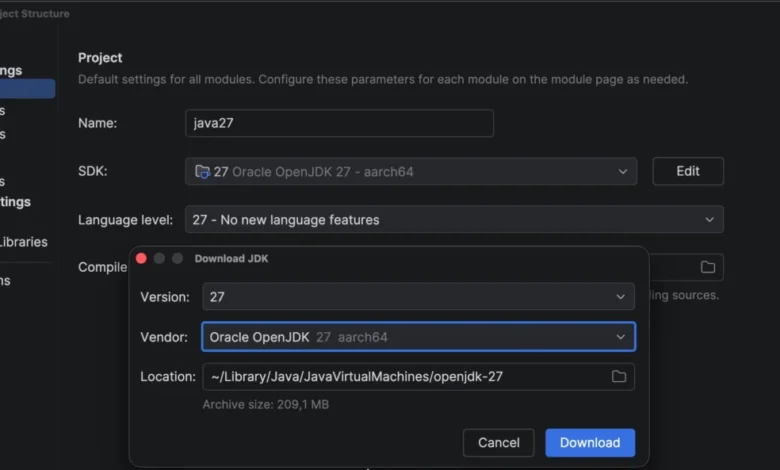
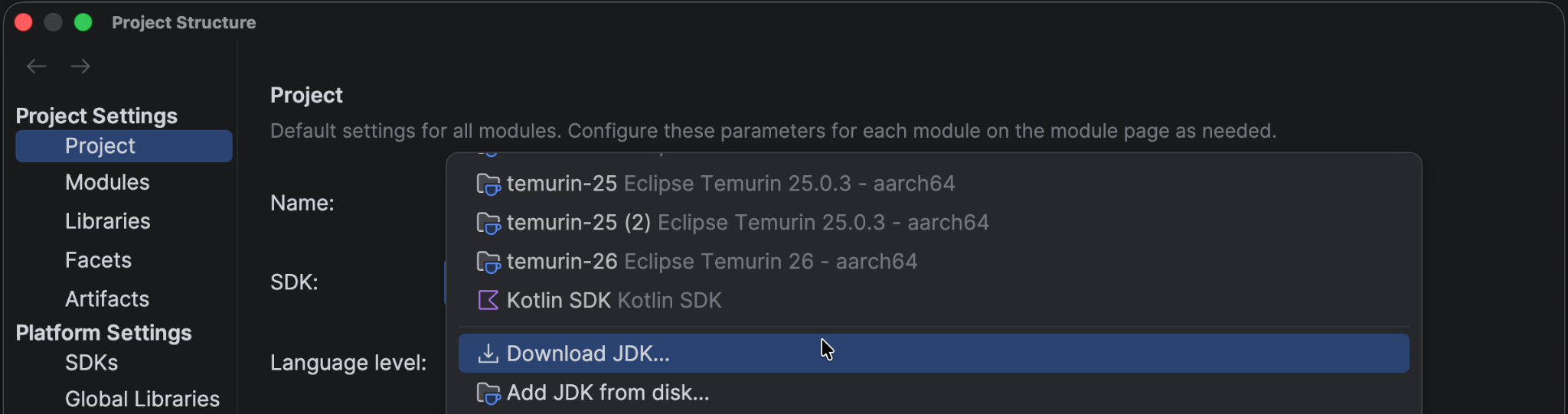
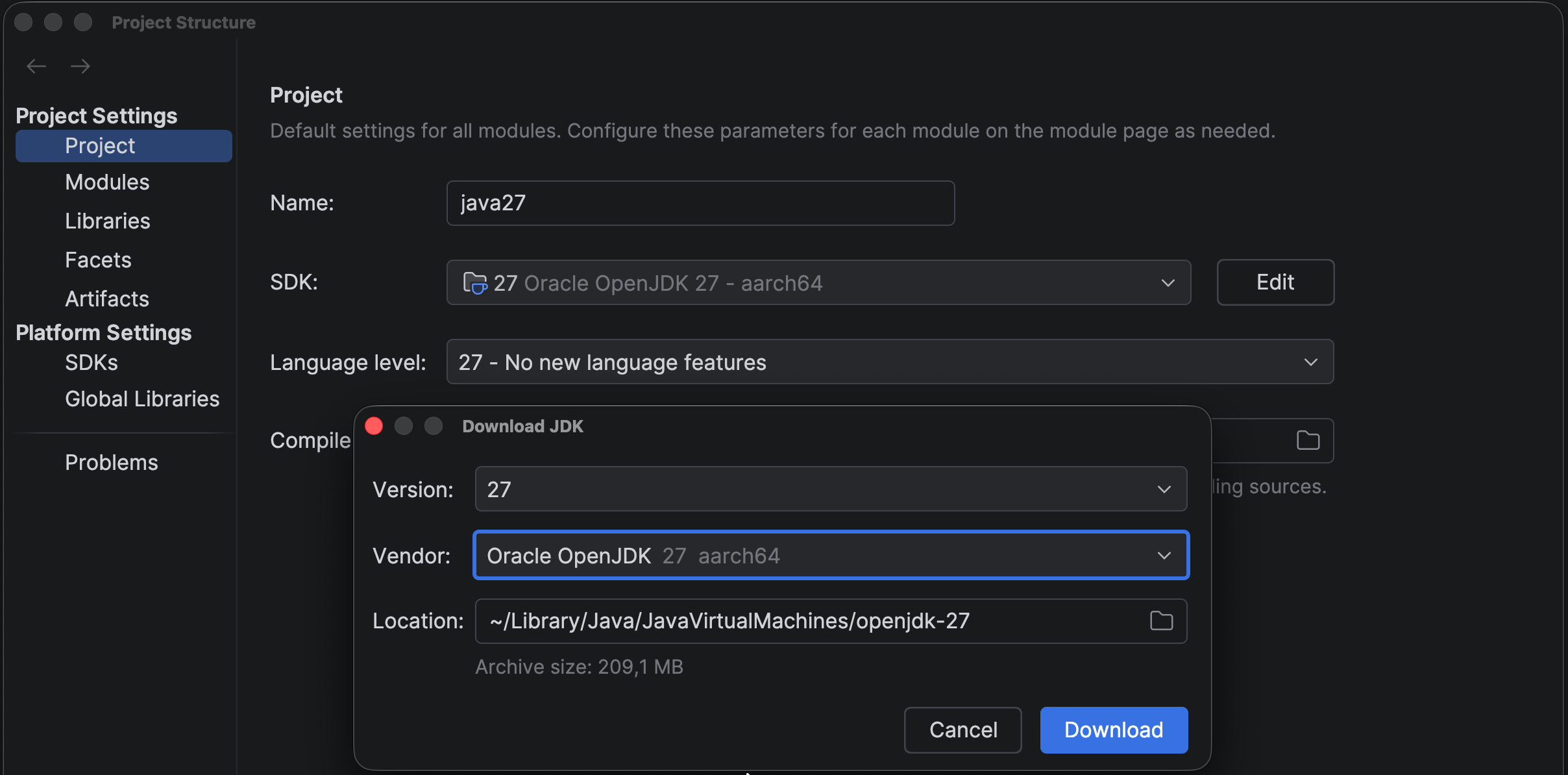
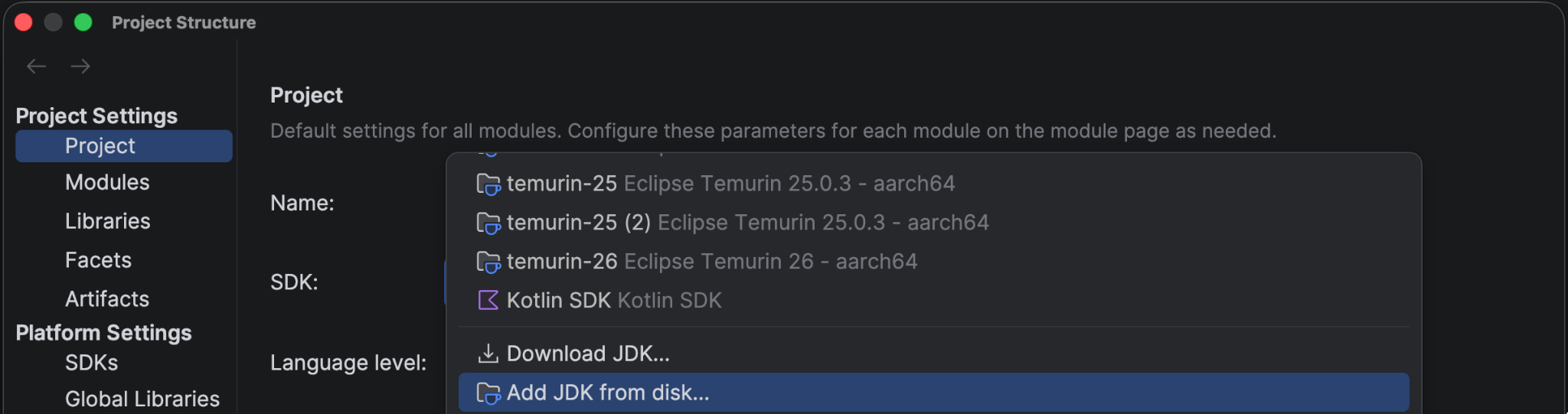
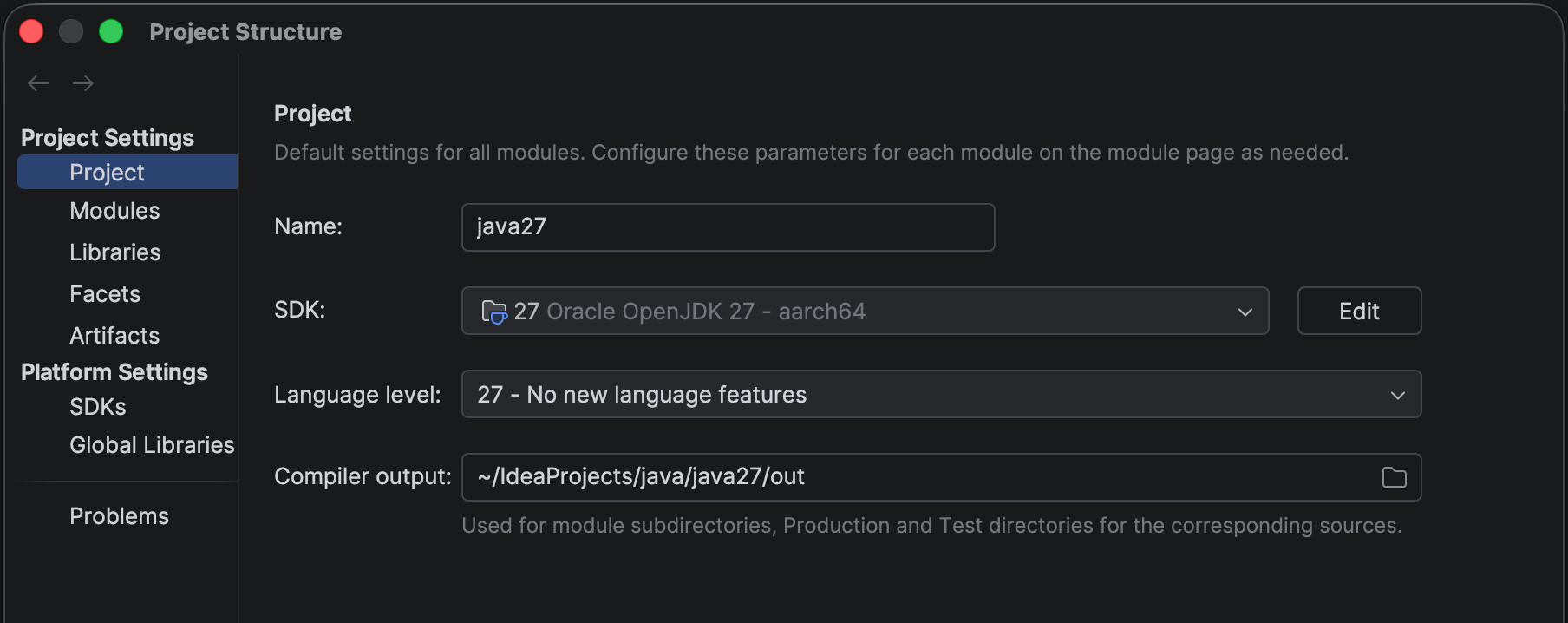
The integration of a new JDK version into IntelliJ IDEA is designed to be seamless. The IDE’s "Download JDK" feature allows developers to pull the latest builds from various vendors directly through the Project Structure menu. Furthermore, the IDE’s ability to detect .sdkmanrc or .tool-versions configuration files ensures that projects remain consistent across team members and CI/CD pipelines.
IntelliJ IDEA also continues to lead in documentation ergonomics. With the adoption of Markdown for Javadoc (JEP 467), the IDE now provides real-time conversion tools and context-aware editing. This transition acknowledges that modern developers prefer the flexibility of Markdown over the legacy HTML-based tag system.
Additionally, the debugger in Java 27 has seen a significant performance overhaul. By resolving long-standing issues with stepping latency, the JVM now provides a smoother experience when navigating through complex call stacks. JetBrains has already backported these debugger optimizations into the JetBrains Runtime (JBR), ensuring that users of the IDE benefit from these improvements immediately.
Broader Implications and Future Outlook
The release of Java 27 serves as a bridge toward the highly anticipated features of Project Valhalla, which focuses on bringing value types to the JVM. As evidenced by the inclusion of JEP 401 (Value Objects) and JEP 539 (Strict Field Initialization) in the roadmap for JDK 28, the language is preparing for a paradigm shift in how data is stored and manipulated.
The fact that these upcoming features are already appearing in Early Access (EA) builds of JDK 28 highlights the speed at which the Java ecosystem is evolving. By maintaining support for these experimental versions, IntelliJ IDEA is positioning itself as the primary sandbox for developers who need to prepare their codebases for the future of the platform.
Conclusion: A Mature Ecosystem
Java 27 represents a disciplined approach to language evolution. While it does not introduce a paradigm-shifting feature on the scale of Lambdas or Records, it provides the "quality of life" improvements and performance gains necessary to keep Java competitive in a cloud-native world.
For developers, the combination of compact object headers, improved TLS security, and better pattern matching represents a net gain in both performance and maintainability. With IntelliJ IDEA providing native, "day-one" support for these features, the barrier to adoption is minimal. As the industry moves toward Java 28 and the eventual arrival of Project Valhalla, the consistency provided by the current release cycle and the corresponding IDE support ensures that Java remains a robust, performant choice for enterprise-grade software development. Developers are encouraged to update their project configurations to Java 27 to take advantage of these efficiency gains and to begin testing the preview features that will define the next generation of the language.