Microsoft is fundamentally reshaping how its Azure cloud platform operates by introducing "Brain," an advanced Artificial Intelligence for IT Operations (AIOps) system. This innovative intelligence layer acts as a sophisticated digital twin of Azure’s health, meticulously integrating platform telemetry, advanced AI and machine learning models, intricate service dependencies, and real-time customer impact data. The result is a continuously updated, unified view of performance across every service, region, and workload within Azure. This transformative system is already actively powering critical customer-facing features, including Azure resource health notifications, deployment safeguards, and outage declarations. Brain is not merely an incremental improvement; it is the foundational technology underpinning a new era of agentic AI that is actively redefining the operational landscape of Azure. This article marks the commencement of a multi-part series dedicated to dissecting Brain’s architecture, its development journey, lessons learned from its large-scale deployment, and its future trajectory.
The advent of Brain signifies a paradigm shift in cloud management, moving beyond conventional monitoring and alerting towards a proactive, intelligent system capable of anticipating and mitigating issues before they broadly affect users. This initiative addresses a critical challenge inherent in operating hyperscale cloud infrastructure: the sheer volume of data generated often outpaces human comprehension, leading to a detrimental gap between measured performance and actual understanding. By fusing disparate data streams into a coherent, AI-driven model, Brain aims to close this gap, transforming raw signals into actionable insights that drive automated reliability enhancements.
The Genesis of Azure’s AI-Powered Reliability Intelligence
At its core, Azure’s digital twin of its own health is powered by Brain, an AIOps-driven cloud health intelligence system. Operating as an intelligent layer atop Azure Resource Graph (ARG), Brain and ARG together construct this comprehensive digital twin. This system is engineered to ingest and integrate platform telemetry, sophisticated AI/ML models, and robust data engineering pipelines. The objective is to continuously maintain and enrich a real-time panorama of how services, geographical regions, and customer workloads are performing across the expansive Azure ecosystem. This unified perspective is rapidly becoming the bedrock for a more automated reliability surface, one that possesses the capability to translate profound insights directly into tangible actions.
Currently, Brain is actively contributing to several pivotal reliability workflows within Azure. These include delivering precise health notifications for customer resources, implementing robust deployment safeguards to prevent potential issues, and facilitating accurate and timely outage declarations. For any entity operating on Azure, Brain’s influence is already manifesting in three key observable areas, enhancing transparency and proactive management of their cloud presence. This introductory post delves into the mechanics of Brain and illuminates the novel operational capabilities it unlocks.
The Imperative for Brain: Addressing the Scale of Azure’s Operations
Azure’s operational footprint is truly staggering. The platform orchestrates hundreds of distinct services across more than 80 global regions, encompassing over 500 datacenters and an extensive network of over 800,000 kilometers of fiber optic and subsea cable. This vast infrastructure represents one of the most significant global cloud footprints in existence. Despite the immense scale of activity that Azure services generate, manage, and process worldwide, a persistent challenge has been the occasional discovery of critical issues through customer reports before internal systems can flag them. For customers, this delay is a particularly damaging type of incident, forcing them into the untenable position of debugging their own applications while unaware that the root cause lies within the cloud provider’s infrastructure.
This discernible gap between what is measured and what is truly understood has emerged as a primary limiting factor in achieving optimal cloud reliability today. The issue is not a deficiency in tooling; Azure possesses an abundance of sophisticated monitoring tools. Instead, the challenge is fundamentally one of comprehension. The sheer volume of operational signals generated by a hyperscale cloud has surpassed the human capacity for effective interpretation. The conventional response—deploying more dashboards, issuing more alerts, and increasing on-call rotations—has proven to be an unsustainable treadmill rather than a genuine solution. Each additional dashboard offers an operator yet another window into the system, but what is critically missing is a system that can interpret the displayed information in real-time and advise on the necessary actions.
Bridging this critical gap necessitated the development of a capability previously absent: not merely better dashboards or smarter alerts, but a continuously updated model of the platform’s health. This model is designed to reason across every available signal in real time and to autonomously act upon its conclusions at the immense scale demanded by the platform.
Unveiling Brain: Azure’s Centralized AIOps for Cloud Reliability
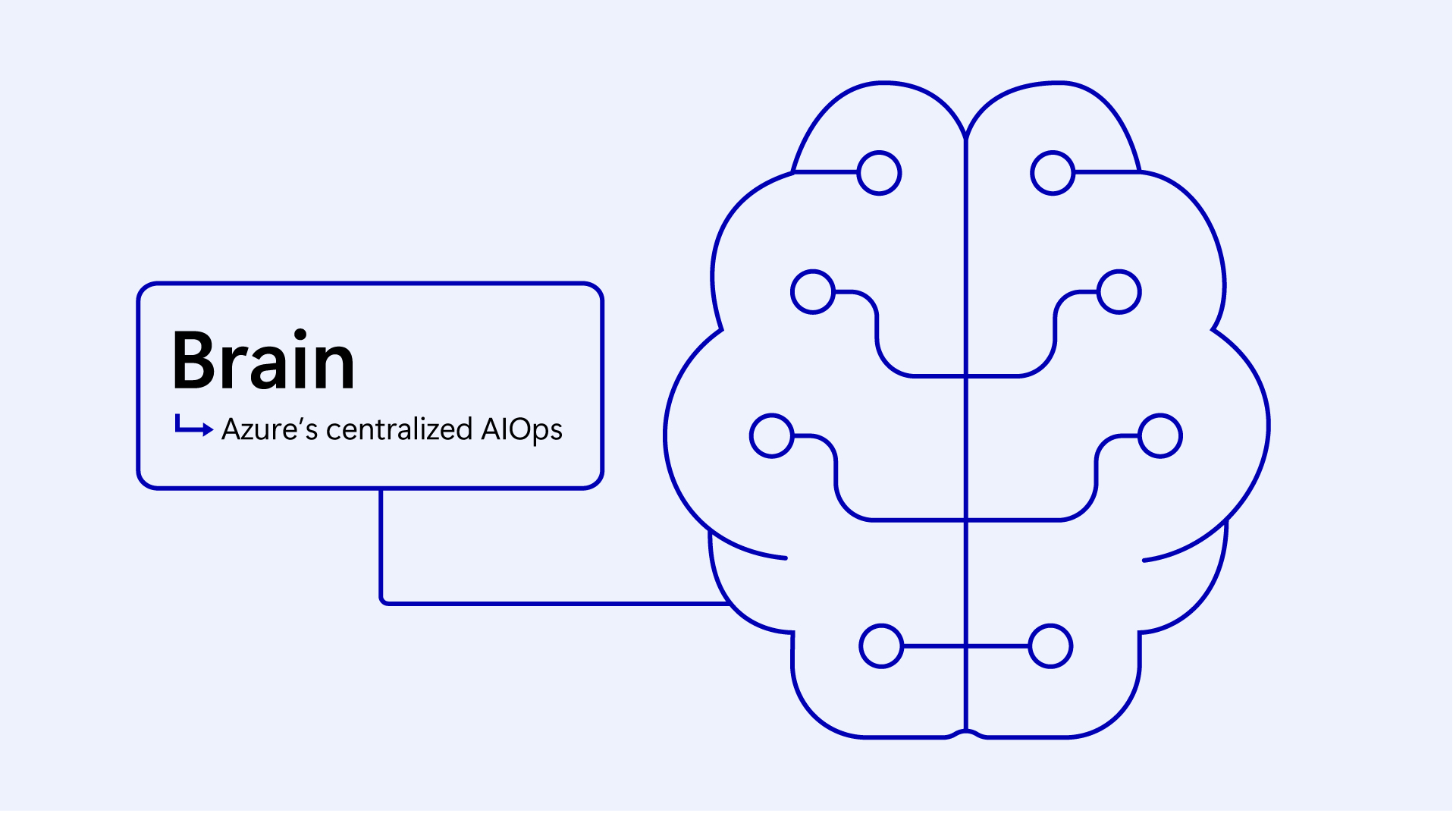
Brain stands as Azure’s centralized AIOps-powered cloud health intelligence system. It leverages the power of AI/ML, including cutting-edge agentic AI and advanced data engineering, to continuously model Azure’s health and to autonomously execute reliability actions based on these insights. This system has already been extensively deployed in Azure production environments, where it actively generates resource health determinations across the entire platform.
The core functionality of Brain is shaped by three fundamental components: the data it ingests, the insights it generates, and the actions its outputs drive.
Data Ingestion: The Pillars of Brain’s Understanding
Brain ingests signals from three primary classes of sources, each contributing a unique perspective to its comprehensive understanding of Azure’s health:
-
Platform Telemetry: This encompasses a vast array of real-time operational data generated by Azure’s infrastructure. This includes metrics on resource utilization (CPU, memory, network I/O), error rates, latency, system logs, and configuration changes. This data provides a granular, moment-to-moment view of how individual components and services are functioning. For instance, a sudden spike in network latency for a specific region’s storage service would be captured here.
-
AI/ML Models: Brain integrates a suite of sophisticated machine learning models trained on historical data and real-time signals. These models are designed to identify anomalies, predict potential failures, detect subtle degradation patterns that might evade traditional threshold-based alerts, and understand complex interdependencies. For example, a model might learn that a specific pattern of increasing error rates in a backend service, even if below a critical threshold, historically precedes a customer-impacting incident.
-
Customer Impact Data: This crucial data stream provides direct insights into how Azure’s performance is affecting end-users. It includes anonymized telemetry from customer applications running on Azure, customer support ticket data, and real-time feedback mechanisms. This data is vital for prioritizing issues based on their real-world impact. For example, if multiple customers in a specific region report slow application response times, this data is fed directly into Brain.
Each of these input pathways serves a distinct purpose, and their collective integration provides Brain with a holistic coverage that no single path could achieve in isolation.
Outputs: A Unified Language of Health
Regardless of the input source, Brain systematically evaluates every subject within its purview—be it a service, a region, a deployment unit, or an individual customer resource. It then generates four key outputs:
- Health State: A clear categorization of the subject’s current operational status (e.g., healthy, degraded, impaired, unhealthy).
- Severity: An indication of the criticality of the current state, often mapped to potential impact levels.
- Impact: A quantification or qualitative description of the extent to which the current state is affecting services, regions, or customers.
- Reason: A concise explanation detailing the underlying cause or contributing factors leading to the determined health state, severity, and impact.
These standardized outputs, expressed in a consistent vocabulary, ensure that every downstream system operates from the same foundational understanding. This eliminates the ambiguity and miscommunication that can arise when different teams use disparate definitions of terms like "impacted."
Automated Actions: Turning Insight into Proactive Reliability
The insights generated by Brain power a growing suite of automated reliability actions. These actions are designed to proactively address issues and minimize disruption, including:
- Automated Outage Declaration: Triggering official outage notifications when Brain detects a service-impacting event.
- Deployment Safeguards: Automatically pausing or rolling back problematic deployments that are identified as causing degradation.
- Resource Health Notifications: Providing customers with timely and accurate notifications about the health of their specific Azure resources.
- Incident Routing and Escalation: Directing alerts and diagnostic information to the most appropriate engineering teams for rapid resolution.
- Automated Remediation: Initiating predefined corrective actions to resolve identified issues without human intervention.
The Foundation of Azure’s Digital Twin for Cloud Health
To truly grasp what differentiates an "intelligence system" like Brain from a mere "dashboard," it is beneficial to examine its foundational components. Brain’s representation of Azure meticulously incorporates several critical elements:
- Topology and Dependencies: A comprehensive understanding of how all Azure services, regions, and infrastructure components are interconnected. This includes mapping upstream and downstream dependencies, which is crucial for understanding the ripple effects of an issue. For instance, knowing that a particular storage service is critical for a set of virtual machine services is vital for assessing impact.
- Runtime State: Real-time information about the operational status, configuration, and performance of every active component within Azure. This includes metrics on resource utilization, error logs, and network traffic.
- Current Intent: Information about ongoing operations, such as active deployments, maintenance activities, or configuration changes being applied to the platform. This context is essential for differentiating between expected changes and unexpected degradations.
- Historical Patterns: A deep repository of past performance data, incident histories, and known failure modes. This allows Brain to identify deviations from normal behavior and recognize recurring issues.
- Customer-Side Evidence: Direct and indirect indicators of customer experience, as discussed in the data ingestion section. This ensures that the system prioritizes issues that have a tangible impact on end-users.
While these individual elements are not novel in isolation—virtually every cloud platform possesses versions of each—Brain’s revolutionary contribution lies in its ability to integrate them into a single, unified, and AI-driven representation. This stands in stark contrast to the traditional approach, where this information is scattered across numerous dashboards and disparate tools, requiring human operators to mentally synthesize it under immense time pressure.
When Brain declares a service to be degrading, this statement is not merely a threshold being crossed. It represents a determination made through the simultaneous reasoning across topology, runtime state, current intent, historical patterns, and customer-side evidence. This is the voice of the intelligence system itself, not a metric simply firing. The speed of this determination, measured in seconds rather than the minutes a human would require to assemble the same picture from separate tools, translates directly into a superior customer experience—characterized by shorter incidents, more precise notifications, and faster problem routing.
Operating Against a Cloud Intelligence System: A New Operational Paradigm
This represents a fundamental shift that redefines the experience for Azure customers, and it is a transformation that can be easily overlooked if the concept of a "digital twin" is perceived merely as a metaphor rather than a functional system.
Consider the typical resolution of a deployment-driven degradation in two contrasting scenarios.
Scenario 1: A World Without a Shared Intelligence System
In an environment lacking a unified intelligence system, the process of resolving a deployment-related issue often devolves into a painstaking reconstruction effort. Imagine a rollout process in progress. Simultaneously, an error rate within a specific region begins to exhibit an upward drift. The typical sequence of events unfolds as follows:
- Initial Observation: An on-call engineer notices an anomaly in a monitoring dashboard, perhaps an elevated error rate in a specific service.
- Manual Correlation: The engineer then must manually investigate this anomaly. This involves checking other dashboards, potentially sifting through logs, and cross-referencing with ongoing deployment activities.
- Hypothesis Formulation: Based on the fragmented data, the engineer might hypothesize that the deployment is the culprit. However, this requires significant manual effort to confirm.
- Communication Delays: Even after identifying the likely cause, communicating this information to the deployment team and other affected parties can lead to further delays.
- Reactive Mitigation: The deployment is eventually paused or rolled back, but only after a period of degraded performance has already impacted customers.
This process is inherently reactive, time-consuming, and prone to human error. The "reconstruction" aspect refers to the effort required to piece together the narrative of what went wrong from disconnected data points.
Scenario 2: A World Empowered by the Intelligence System
In an environment equipped with Brain, the operational approach shifts from reconstruction to consumption. The rollout is actively being tracked within the intelligence system. Brain is aware of the deployment’s progress: what it is changing, which regions it is affecting, and its intended functionality. The observed error rate drift is also within the system. Brain correlates this drift with the ongoing deployment, analyzes it against the dependency graph, and evaluates it against historical patterns to distinguish between a minor, expected fluctuation ("small wobble") and genuine degradation.
Crucially, affected customers are also represented within the system. Their tenant configurations are mapped to the platform resources that are being impacted by upstream dependencies, which are themselves affected by the deployment. Brain then produces a single, definitive determination: "The current deployment is causing customer-visible impact in this region; expected resolution requires the deployment to pause."
This determination is disseminated instantaneously to every system that needs to act upon it. The deployment system, receiving this signal, automatically pauses the rollout while the determination remains true, thereby preventing subsequent customers from experiencing the impact. The incident management system, armed with this precise information, creates a single, consolidated incident, identifying the upstream dependency. This avoids the creation of multiple duplicate incidents by confused teams, ensuring that the correct engineer engages with the right problem promptly. Concurrently, the customer communication system drafts a notification tailored to the specific tenant scope and provides a clear, plain-language description of the issue. This ensures that affected customers receive timely updates from Microsoft with information they can readily understand and utilize.
For Azure customers, the complex coordination and rapid analysis that Brain facilitates are largely invisible. What they observe is a significantly shorter incident duration, an accurate alert that triggers their own automation rather than requiring manual intervention, and a pre-diagnosed issue when their on-call personnel open the incident bridge. On services where Brain’s resource health evaluation is actively deployed, there has been a substantial improvement in detection precision for service-impacting issues, and the coverage of relevant incidents continues to expand.
Over the past year, a significant majority of outages integrated with Brain have been automatically communicated to affected customers, and on these occasions, the time-to-notification has improved materially compared to manually issued notifications.
It is important to note that none of these downstream systems are engaged in their own independent investigations. Instead, they all consume the same determination from the intelligence system, presented in an identical vocabulary and supported by consistent evidence. This synchronized operational model, driven by a singular source of truth, is precisely what "operating against an intelligence system" entails. This foundational capability was a prerequisite for the agentic AI advancements that are now becoming synonymous with Azure’s operational evolution. This integrated approach not only enhances Azure’s intrinsic reliability but also profoundly benefits Azure customers by providing unparalleled transparency into service health and delivering timely, actionable communications.
The Future of Agentic AI and Cloud Operations
A significant conversation is currently unfolding across the cloud industry concerning agentic AI and the development of AI systems that possess the capability to act autonomously, moving beyond mere observation. Microsoft is an active participant in this discourse. However, this conversation often overlooks a crucial asymmetry that warrants greater attention.
Agents, by definition, require a context or a foundation upon which to operate. They need:
- A Shared Understanding of the World: Agents must operate from a common model of reality. In the context of cloud operations, this means a unified understanding of the system’s state, its interdependencies, and its intended behavior.
- A Deterministic Goal: Agents are designed to achieve specific objectives. This requires a clear definition of what constitutes success and what actions are permissible to achieve it.
This is precisely what positioned the health intelligence system—Brain—as "the digital twin": it serves as the essential prerequisite, not merely a consequence, of agentic operations at this scale. If one were to prioritize building agents first, relying on fragmented data sources, the likely outcome would be a federation of confident systems that frequently disagree with each other in production environments. Conversely, by constructing the comprehensive model first, the agents that are built upon it become inherently composable. They reason from the same, unified picture, and this picture is one that can be meticulously audited.
This interconnectedness forms the central theme of the series we are embarking upon. Brain represents the cloud health intelligence system that the next generation of cloud agents will invariably require. For organizations exploring the potential of agentic AI for any operational function—whether managing their cloud infrastructure, their applications, or their on-premises systems—the architectural pattern embodied by Brain is one that warrants careful consideration. The agents may capture the headlines, but the underlying intelligence system is where the foundational work truly lies.
What’s Next for Azure Reliability and Brain
The critical infrastructure is in place. Brain, the intelligence system, possesses the capability to make determinations. For instance, it can ascertain that "a service in a specific region is degrading." However, this leads to a series of complex, yet essential, follow-up questions that are driving the next phase of development:
- Relative Degradation: "Degrading compared to what?" Defining baseline healthy states and understanding the nuances of performance variations is paramount.
- Subjective Health Definitions: "Healthy by whose definition?" Different teams or services might have varying interpretations of what constitutes optimal health, requiring a standardized, objective framework.
- Disagreement Resolution: "When two teams disagree about whether their service is healthy, which one is right?" Brain must possess the authority and the logic to reconcile conflicting assessments.
- Ambiguous States: "When the platform is degrading but no individual customer is impacted yet, what state are we actually in?" Differentiating between potential future issues and current critical events is crucial for efficient resource allocation and communication.
These are not abstract philosophical inquiries; they represent the next frontier of engineering challenges that must be addressed. A system cannot reliably make determinations until the individuals responsible for its development reach a consensus on what those determinations truly signify. Historically, much of the industry has been quietly grappling with these definitions, often leading to inefficiencies.
In the subsequent installment of this series, we will provide a detailed exposition of precisely how these challenges are being met and what innovative solutions have been developed to replace the antiquated and often broken vocabulary of cloud health that has prevailed across the industry for the past decade. To stay informed as new posts in this series are published, please refer to the "Advancing reliability" blog tag.
Acknowledgments
This significant undertaking is the culmination of dedicated efforts from numerous engineers and researchers across the Brain AIOps team, Microsoft Research (MSR), and various Azure service teams. Their collective expertise and commitment have been instrumental in bringing this transformative technology to fruition.
Related posts: