Amazon Web Services and Vercel Streamline Cloud Development with Native S3 Integration for Web and AI Applications

The modern software development lifecycle relies heavily on the seamless convergence of frontend interfaces and robust cloud-native backend infrastructure. Addressing this industry-wide demand, Amazon Web Services (AWS) and Vercel have jointly announced a transformative native integration that brings Amazon Simple Storage Service (Amazon S3)—along with specialized capabilities like Amazon S3 Tables and Amazon S3 Vectors—directly into the Vercel Marketplace and the AI-driven development environment, v0 by Vercel. This strategic collaboration bridges the gap between high-performance web deployment and enterprise-grade cloud storage, eliminating traditional friction points in cloud architecture provisioning.
For millions of developers who build, deploy, and scale web and artificial intelligence applications using Vercel’s platform, storage management has historically required context-switching between Vercel’s deployment pipelines and the AWS Management Console. Configuring IAM policies, managing access credentials, and setting up bucket security parameters demanded manual intervention. With this latest update, these administrative overheads are automated, empowering development teams to spin up scalable object storage, analytical data lakes, and vector databases within seconds directly from their primary deployment dashboard.
Chronology and Evolution of the AWS-Vercel Partnership
The introduction of native S3 storage builds upon a progressive series of integrations designed to unify the modern application stack. Over the preceding years, Vercel and AWS expanded their ecosystem compatibility by introducing seamless provisioning workflows for core relational and non-relational database services.
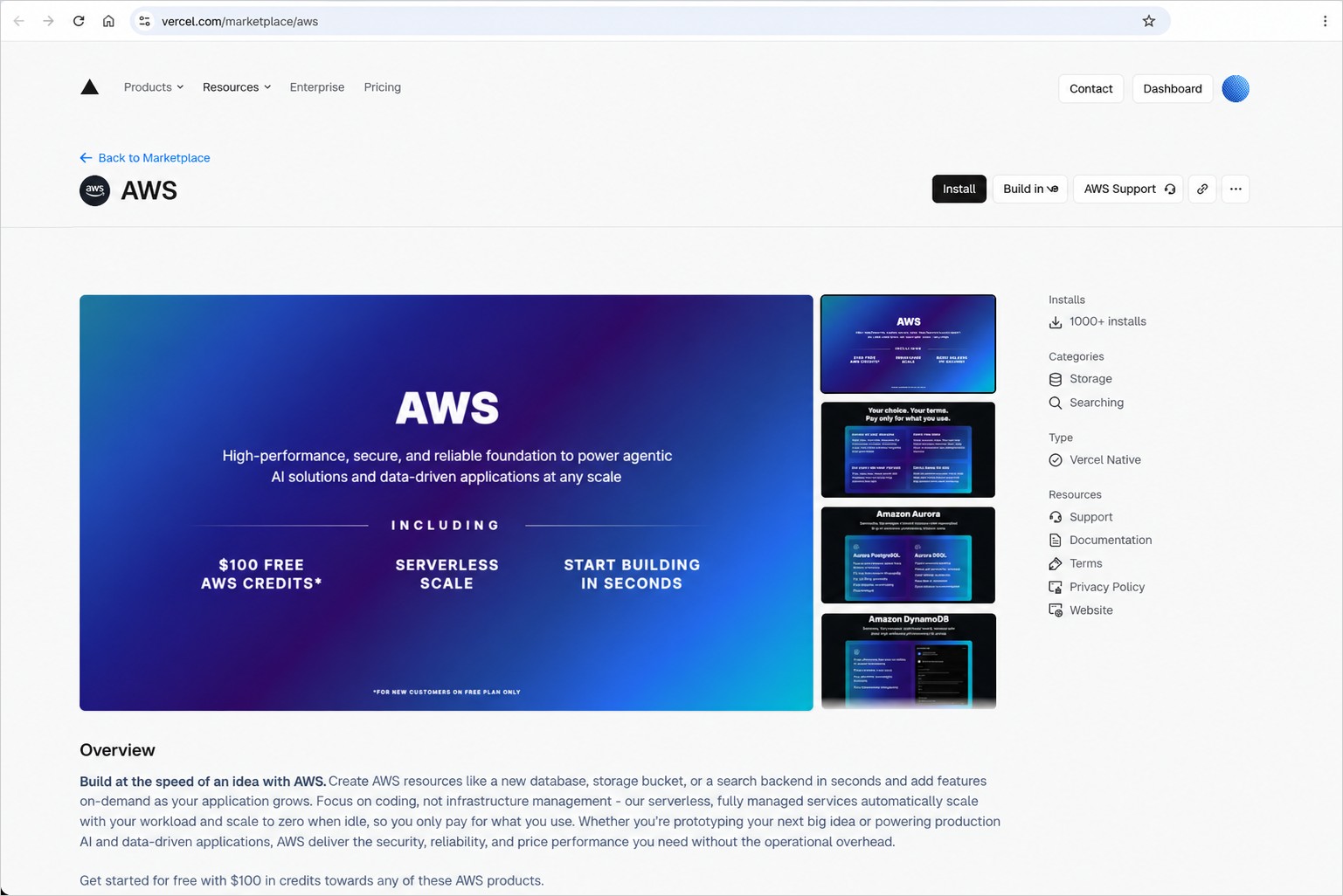
Initially, developers utilizing Vercel could connect managed database engines such as Amazon Aurora for high-throughput transactional workloads, Amazon DynamoDB for low-latency NoSQL data persistence, and Amazon OpenSearch Serverless for search capabilities. However, object storage, advanced analytics tables, and vector embeddings for generative AI workloads remained decoupled, requiring manual configuration scripts and static credential management.
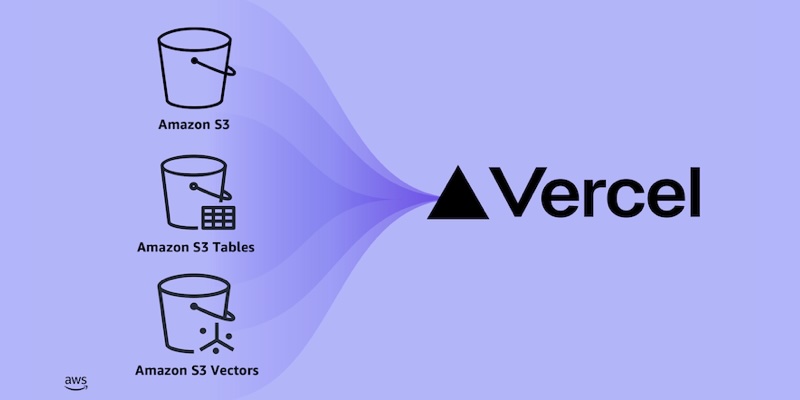
The strategic launch closes this architectural gap. By incorporating Amazon S3, S3 Tables, and S3 Vectors into the Vercel ecosystem, the partnership achieves a unified application stack. Developers can now manage everything from the database layer to object, vector, and open table storage within a single AWS account, receiving a consolidated monthly bill.
Comprehensive Storage Solutions for Modern Workloads
The newly integrated offerings cater to three distinct architectural paradigms critical to contemporary software engineering: everyday object storage, big data analytics, and generative AI semantic search.
1. General-Purpose Object Storage
Standard object storage remains the foundational bedrock of web applications, handling user uploads, media assets, static documents, and backup archives. Through the Vercel Marketplace, developers can instantly provision standard S3 general-purpose buckets. By leveraging the @vercel/functions/oidc module alongside the AWS SDK for JavaScript, applications securely interact with S3 via short-lived OIDC tokens exchanged with AWS Security Token Service (AWS STS). This token-exchange mechanism eliminates the security vulnerabilities associated with storing static access keys and secret keys inside environment variables.
2. Analytics with S3 Tables
Modern data-driven applications frequently require real-time analytical processing over massive datasets. Amazon S3 Tables provide purpose-built cloud storage optimized for analytics workloads, featuring fully managed Apache Iceberg tables. These tables automatically handle maintenance and data compaction, scaling efficiently as data volumes grow.
In a Vercel deployment, developers can integrate lightweight query engines such as DuckDB directly inside Vercel Functions. By attaching S3 Table buckets via their Amazon Resource Name (ARN), engineers can execute complex SQL aggregations—such as analyzing regional housing market trends or processing clickstream analytics—without managing dedicated analytical clusters.

3. Vector Search for Generative AI
As artificial intelligence agents, Retrieval-Augmented Generation (RAG) architectures, and semantic search engines become standard features in software design, specialized vector storage is paramount. Amazon S3 Vectors deliver cost-optimized vector storage natively integrated within S3 buckets. While S3 Vectors do not generate embeddings natively, they provide high-performance indexing and querying for pre-computed vectors. Developers can pair their preferred embedding models with S3 Vectors to build intelligent support bots, semantic document search interfaces, and multimodal AI systems seamlessly.
Streamlined Provisioning and Code Implementation
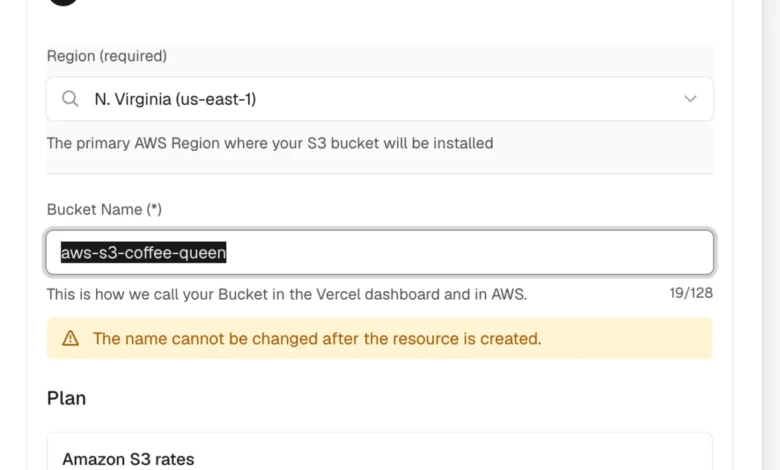
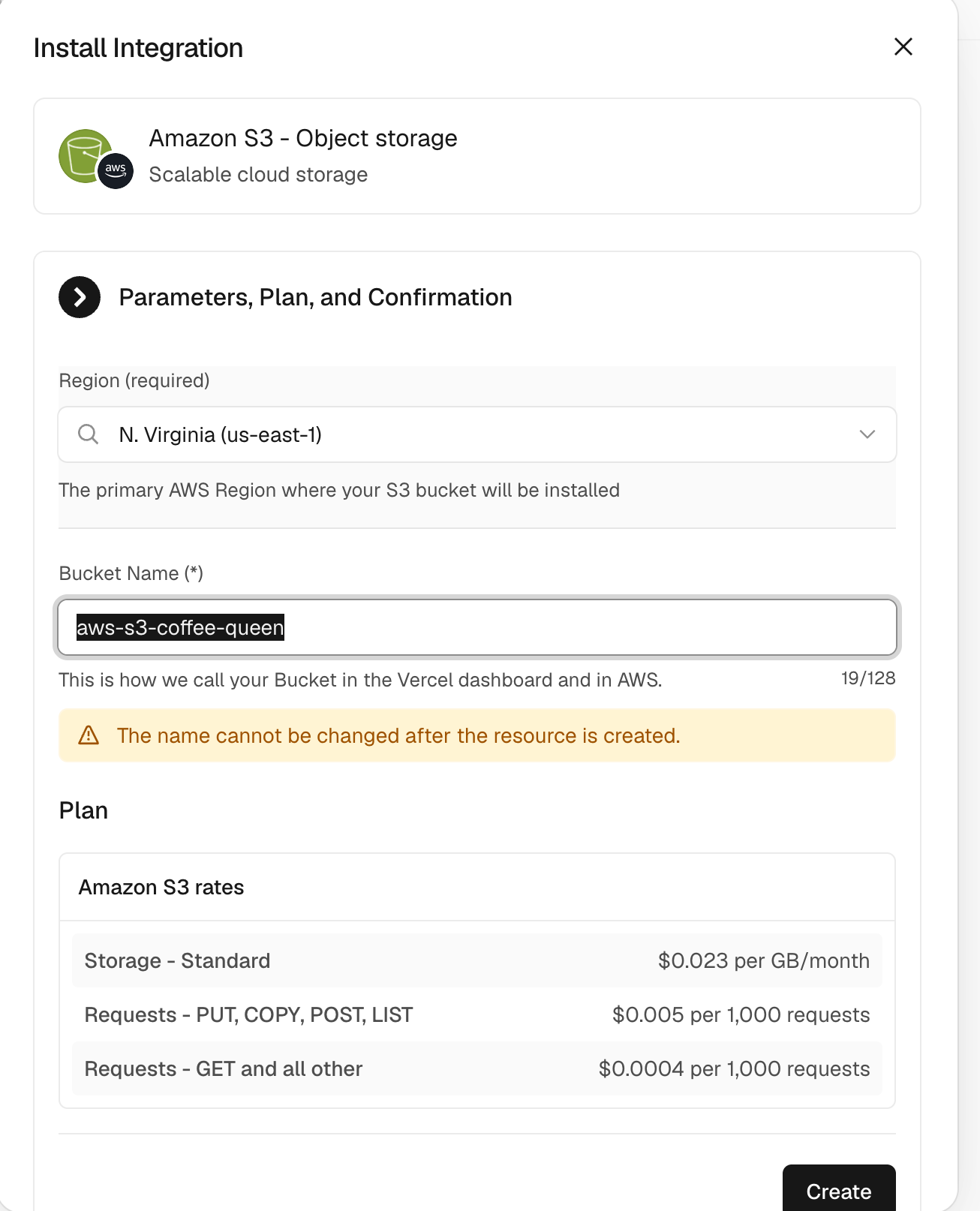
The provisioning workflow has been optimized for maximum operational efficiency. From the Vercel dashboard, engineering teams navigate to the Storage tab, select AWS, designate the appropriate S3 bucket variant, and specify an AWS Region. The platform handles the underlying infrastructure creation in seconds.
Once linked, the integration automatically injects necessary environment variables—including AWS_REGION, AWS_ROLE_ARN, and resource-specific identifiers—into the project. At runtime, the application authenticates securely using dynamic IAM roles rather than static credentials.
For example, implementing a file upload route in a Next.js application utilizes standard AWS SDK clients secured by Vercel’s OIDC credential provider:
import  S3Client, PutObjectCommand  from "@aws-sdk/client-s3";
import  awsCredentialsProvider  from "@vercel/functions/oidc";

const s3 = new S3Client(
  region: process.env.AWS_REGION,
  credentials: awsCredentialsProvider(
    roleArn: process.env.AWS_ROLE_ARN,
  ),
);

export async function POST(request)
  const formData = await request.formData();
  const file = formData.get("file");

  await s3.send(new PutObjectCommand(
    Bucket: process.env.S3_BUCKET_NAME,
    Key: file.name,
    Body: Buffer.from(await file.arrayBuffer()),
    ContentType: file.type,
  ));

  return Response.json( success: true );
Similarly, querying vector databases for AI-driven applications requires minimal boilerplate code when interfacing with the @aws-sdk/client-s3vectors library, enabling instantaneous similarity searches for AI agents and RAG implementations.
Natural Language Architecture with v0 by Vercel
A notable dimension of this release is its deep integration with v0, Vercel’s generative interface development tool. Developers can construct complex, fully functional cloud-backed applications using natural language prompts.
When a user requests features such as "a photo gallery where users upload images using AWS," "a support bot that answers questions from my PDFs," or "an analytics dashboard for clickstream data," v0 interprets the requirement, provisions the corresponding Amazon S3 resource (general-purpose buckets, S3 Vectors, or S3 Tables respectively), establishes the necessary environment bindings, and generates production-ready code. This capability significantly lowers the barrier to entry for junior developers and accelerates prototyping velocity for enterprise engineering teams.
Enterprise Implications and Account Flexibility
Industry analysts view the AWS-Vercel S3 integration as a significant milestone in reducing multi-cloud and hybrid-cloud operational complexity. By maintaining data residency and security within the developer’s native AWS account, enterprises retain full compliance oversight, auditing capabilities, and access to native AWS governance tools.
Teams can either initialize a new AWS account directly through the Vercel interface—benefiting from promotional incentives such as $100 in AWS credits valid for six months—or link their existing corporate AWS accounts. When linking an existing account, Vercel confines its automated provisioning scope to newly created buckets managed through the platform, preserving existing cloud topologies and billing structures.
Availability and Ecosystem Support
Amazon S3, S3 Tables, and S3 Vectors integrations are available immediately across all commercial AWS regions supported by Vercel. There are no additional platform fees imposed by Vercel for utilizing the integration; customers pay standard, usage-based Amazon S3 pricing.
To assist developers in navigating advanced configurations, troubleshooting, and API implementations, AWS has made available specialized tooling, including the AWS Model Context Protocol (MCP) Server and associated plugins for AI-assisted development environments. Feedback and technical discussions are actively monitored via community channels such as AWS re:Post for Amazon S3, ensuring continuous iterative improvement driven by real-world developer experiences.
Related posts: