Amazon DynamoDB Introduces Native Vector Search Capabilities to Eliminate Architectural Complexity for Developers

The landscape of cloud database management experienced a significant shift today with Amazon Web Services (AWS) announcing the general availability of native vector search in Amazon DynamoDB. This major update enables developers and enterprise organizations to store vector embeddings directly alongside their standard operational data within DynamoDB tables. By integrating this capability, AWS aims to eliminate the historical requirement of deploying, managing, and synchronizing separate specialized vector databases for applications that rely on semantic search, Retrieval-Augmented Generation (RAG), agentic memory, and advanced machine learning models.
The new feature is engineered to deliver high-performance similarity searches operating at single-digit millisecond latency while maintaining a recall accuracy of 99 percent or higher. Furthermore, the underlying infrastructure is built to scale horizontally without theoretical storage limits, supporting workloads encompassing trillions of vectors. Because DynamoDB operates as a fully managed serverless service, developers are relieved from the burdens of provisioning virtual servers, configuring manual patches, executing maintenance windows, or managing software updates. The service retains its familiar pay-per-request pricing model and serverless architecture, meaning vector indexes share the exact same operational foundation as the primary transactional data.
Background Context and Architectural Evolution
For years, the rapid proliferation of generative artificial intelligence and large language models created a distinct architectural challenge for software engineers. While traditional NoSQL databases like DynamoDB excel at high-throughput transactional processing and key-value operations, they were not originally designed to compute high-dimensional mathematical distances required for semantic understanding.

To bridge this gap, organizations building modern AI applications—such as recommendation engines, personalized user experiences, real-time anomaly detection systems, and conversational AI agents—were forced to adopt a multi-database architecture. Typically, this involved maintaining a primary operational database alongside a dedicated vector database.
This multi-store pattern introduced considerable engineering overhead. Development teams had to build and monitor complex data synchronization pipelines using change data capture (CDC) mechanisms, event streaming platforms, or scheduled batch jobs to keep vectors aligned with their source operational records. This dual-system approach not only increased data movement and storage costs, but also created severe engineering bottlenecks related to latency synchronization, cross-system failure modes, and licensing expenses.
By embedding vector search natively into DynamoDB, AWS has effectively bridged the divide between operational data storage and machine learning indexing. Developers no longer need to move data out of their primary database to achieve semantic retrieval capabilities. Instead, vectors are stored natively using standard data types, indexable through the familiar AWS Management Console, CLI, and Infrastructure-as-Code frameworks.
Technical Architecture and Implementation Workflow
From a technical standpoint, vector search in DynamoDB introduces a specialized index type that can be appended to any attribute containing vector embeddings. These embeddings are numerical arrays—typically generated by external foundation models such as Amazon Bedrock Titan Text Embeddings, Cohere Embed, or various OpenAI text embedding models—that mathematically encode the semantic meaning of text, images, or audio.

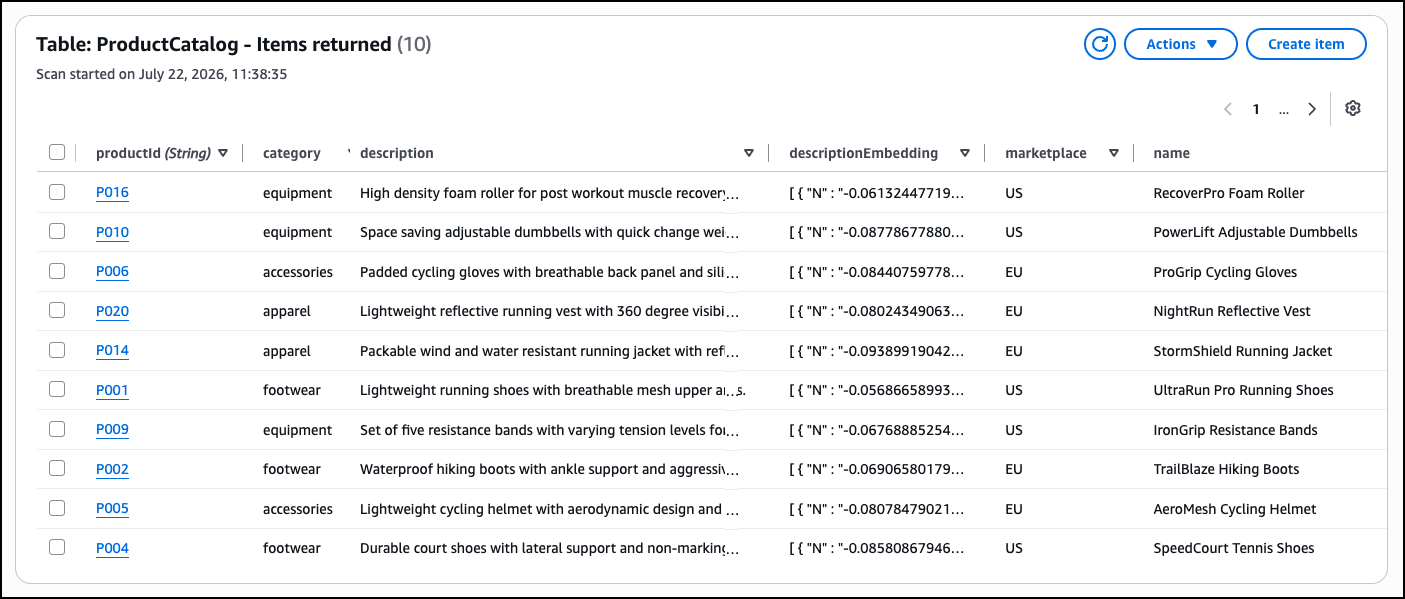
To implement the feature within an existing database, developers generate embeddings and store them inside standard DynamoDB tables utilizing the existing List data type. Each numerical float value of the vector is stored as an individual number element within the list, removing any requirement for schema migrations or novel proprietary data structures.
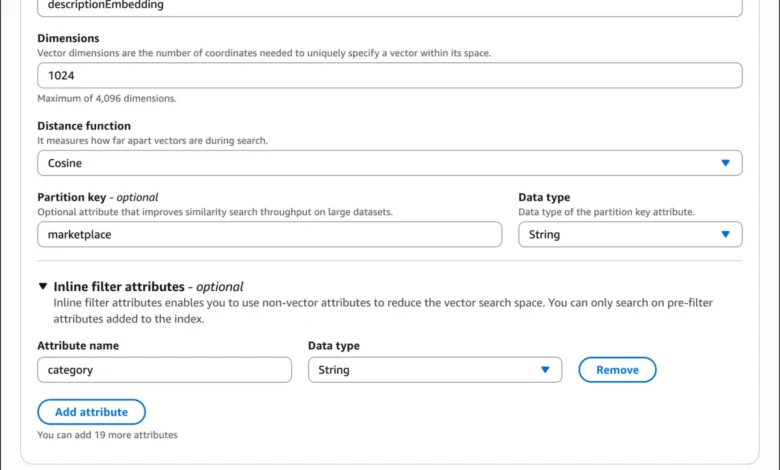
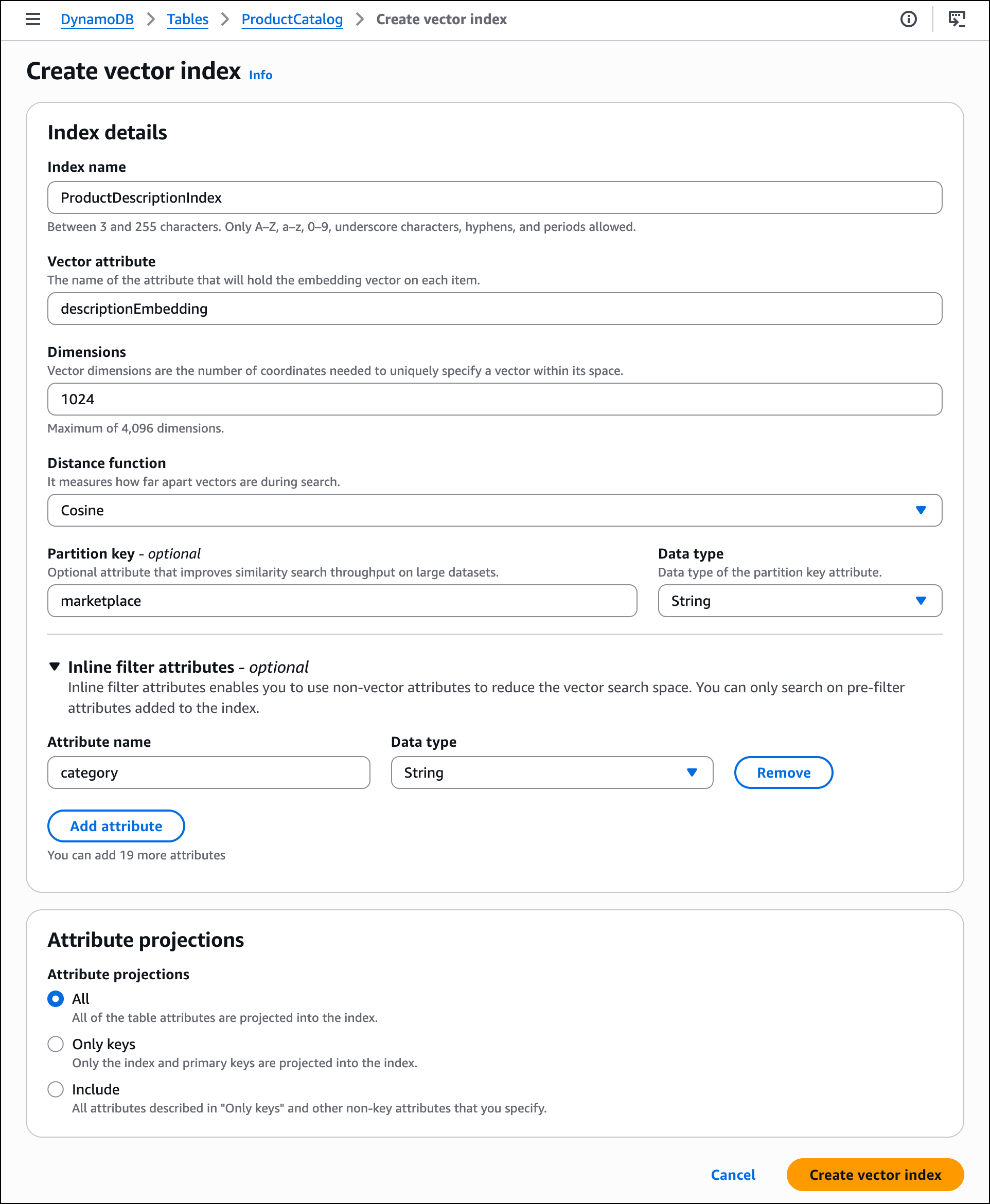
Once the data is populated, administrators create a vector index through the DynamoDB console or API. Configuration parameters include defining the index name, selecting the target vector attribute, specifying the number of dimensions (supporting up to 4,096 dimensions), and choosing a distance function. DynamoDB natively supports three primary distance metrics:
- Cosine Distance: Measures the angular difference between vectors, making it highly effective for comparing the semantic similarity of text documents regardless of their length.
- Euclidean Distance: Measures the straight-line distance between two points in vector space.
- Dot Product: Computes the projection of one vector onto another, frequently used in normalized embedding spaces.
Additionally, the architecture supports partition keys and inline filtering attributes. By assigning a partition key to the vector index, DynamoDB intelligently distributes vectors across internal partitions, allowing the system to scale out horizontally while restricting query scopes to specific subsets of data—such as filtering queries strictly by geographic marketplace or tenant ID. Furthermore, developers can apply exact-match inline filters on non-vector attributes during query execution, drastically reducing the search space and improving overall query efficiency.
Execution of the new functionality is handled via the dedicated SearchVectors API. Developers pass a query vector, a defined top-K result count (up to 100 results), and optional filter criteria. The service evaluates the index and returns the most semantically relevant records, paired seamlessly with their associated operational attributes, such as product names, pricing, and inventory identifiers, all within a single unified response.
Industry Implications and Market Analysis
Industry analysts view the introduction of native vector search in DynamoDB as a strategic consolidation move within the cloud data infrastructure market. As artificial intelligence transitions from experimental implementations to core enterprise production workloads, organizations face mounting pressure to reduce infrastructure sprawl and operational costs.
Maintaining disparate systems for operational transactions and vector similarity searches has long been cited by chief technology officers as a leading source of technical debt. By unifying these workloads under a single serverless pricing and infrastructure umbrella, AWS provides a streamlined pathway for enterprises to modernize existing applications without undertaking risky and expensive database migrations.
The capability is particularly advantageous for e-commerce platforms, content streaming services, financial institutions, and enterprise software providers utilizing autonomous software agents. In retail environments, for instance, shoppers can now execute natural language queries—such as looking for lightweight summer athletic gear—and receive highly accurate semantic matches drawn straight from foundational catalog tables, complete with real-time pricing and inventory checks.
Furthermore, the integration with the broader AWS ecosystem—including Amazon Bedrock and developer toolkits like the AWS Model Context Protocol (MCP) Server—positions AWS to capture a larger share of the generative AI application development lifecycle. Developers can interact with and test these vector capabilities directly through AI coding assistants and modern development environments, lowering the barrier to entry for building complex RAG architectures.
Availability and Deployment
AWS has confirmed that native vector search in Amazon DynamoDB is generally available immediately across all commercial AWS Regions, as well as AWS GovCloud (US) Regions. Organizations can review regional service rollouts through the AWS Capabilities portal, consult the Amazon DynamoDB Developer Guide for comprehensive technical documentation, and evaluate pricing structures directly via the official AWS DynamoDB pricing pages.
As enterprises continue to evaluate their long-term artificial intelligence roadmaps, the availability of serverless, low-latency vector search within established operational databases marks a pivotal maturation point in cloud data management, signaling a clear industry trend toward architectural simplification and integrated intelligence.