A Decade of Svelte: Reflecting on Ten Years of Web Framework Evolution and the Future of Agentic Development

It started with a single commit on November 26, 2016, a modest contribution that would eventually ripple across the landscape of modern web development. Ten years later, Svelte has transitioned from a niche experimental project into a cornerstone of the frontend ecosystem, marked by its recent third in-person Svelte Summit held in the historic city of Ljubljana, Slovenia. While the software development lifecycle is inherently iterative and perpetually unfinished, this milestone provides a critical juncture to evaluate how a project that began as a radical alternative to the Virtual DOM model has matured into a robust, enterprise-grade solution.
A Chronology of Innovation: From Compilation to Components
The history of Svelte is fundamentally a history of shifting paradigms. When Rich Harris introduced the framework in 2016, the frontend world was dominated by heavy client-side processing, characterized by the overhead of reconciliation algorithms and Virtual DOM diffing. Svelte challenged this status quo by moving the work from the browser to the build step. By compiling components into highly optimized, imperative vanilla JavaScript, Svelte minimized the runtime burden, offering developers a "disappearing framework" experience.
The trajectory of the project can be divided into several distinct phases:
- 2016–2018 (The Formative Years): Svelte 1 and 2 established the compiler-first approach, emphasizing a declarative syntax that felt more like standard HTML and CSS than the complex abstractions found in competing frameworks.
- 2019 (The Breakthrough): The release of Svelte 3 fundamentally altered the developer experience through its reactivity model. By utilizing simple assignments to trigger updates, the framework significantly lowered the barrier to entry for new developers.
- 2020–2022 (The Ecosystem Expansion): The introduction of SvelteKit provided a full-stack meta-framework, enabling server-side rendering, routing, and deployment configurations that mirrored the power of frameworks like Next.js, but with a smaller footprint.
- 2023–2024 (The Modern Era): The release of Svelte 5 introduced Runes—a new reactivity system designed to provide more explicit control over state, addressing the scaling requirements of large-scale, complex applications.
The Ljubljana Summit: A Gathering of the Community
The choice of Ljubljana for the tenth-anniversary summit was symbolic of the project’s global, distributed nature. Over two days, the conference served as a nexus for core maintainers, corporate contributors, and independent developers. Despite initial industry concerns that frontend framework conferences might be losing their relevance in an era dominated by AI-driven automation and "agentic" coding, the turnout and engagement levels proved otherwise.
The summit served as a stage for significant technical announcements. Among the most anticipated were advancements in toolchain interoperability. The integration of an MCP (Model Context Protocol) server within Svelte’s developer tools represents a strategic pivot toward AI-assisted development. This allows Large Language Models (LLMs) to interface directly with the Svelte development environment, providing context-aware suggestions and debugging capabilities that go beyond standard code completion.
Supporting Data and Market Position
Svelte’s growth is reflected in its sustained popularity on GitHub and its consistent high rankings in developer satisfaction surveys. According to the 2023 State of JS survey, Svelte remains among the most desired and "loved" frameworks, with a retention rate that suggests high developer satisfaction once the learning curve is navigated.
Furthermore, the framework has seen significant adoption in sectors requiring high-performance interfaces, such as financial dashboards and data-heavy visualization tools. The shift from Svelte 3 to Svelte 5 has been particularly significant for enterprise users. By introducing explicit reactivity, the framework has addressed criticisms regarding "magic" behavior, making the code easier to audit and debug in professional environments. The addition of the rsvelte initiative—a project aimed at facilitating concurrent development by AI agents—demonstrates that the maintainers are actively positioning Svelte as the preferred framework for the next generation of automated software development.
The Intersection of Human Expertise and Artificial Intelligence
A central theme of the anniversary summit was the role of the developer in the age of generative AI. While the industry is currently fixated on AI agents that can generate entire applications from natural language prompts, the consensus among the Svelte community is that human oversight remains the limiting factor in software quality.
The integration of tools like rsvelte suggests that the future of development is not necessarily the replacement of the developer, but the enhancement of their capabilities. By allowing fleets of AI agents to work concurrently on large-scale Svelte codebases, the project is attempting to solve the "coordination problem" that plagues AI-assisted coding. However, the sessions in Ljubljana underscored that the most critical aspects of software architecture—system design, accessibility compliance, and user-centric problem solving—require human intuition. The in-person gathering functioned as a reminder that the collaborative nature of open source, which relies on nuanced human communication, cannot be fully replicated by synthetic intelligence.
Implications for the Future of Frontend Engineering
The next decade of Svelte will likely be defined by the framework’s ability to remain "invisible." As browsers continue to evolve with new native APIs (such as signals), the need for heavy abstraction layers is diminishing. Svelte’s commitment to compilation ensures that it remains aligned with these browser-native improvements.
From a strategic perspective, the project faces several challenges:
- Framework Fragmentation: Maintaining a balance between the simplicity that attracted early adopters and the complexity required by large enterprises.
- AI Integration: Successfully navigating the transition to agentic development workflows without compromising the developer experience.
- Sustainability: Transitioning from a project-led model to a more institutionalized structure that can support long-term maintenance and security as the codebase grows in complexity.
The release of the "Unfinished Business" keynote, delivered by project lead Rich Harris, set the tone for this next era. The core message was one of continuity: the fundamental goals—performance, accessibility, and ease of use—remain constant, even as the tools used to achieve them shift from manual coding to human-AI collaboration.
Conclusion
The tenth anniversary of Svelte serves as a testament to the longevity of well-conceived open-source software. By focusing on the developer experience and performance, Svelte has secured a permanent place in the modern web stack. As the industry grapples with the transition to agentic coding, Svelte’s proactive integration of AI-ready tools positions it to be more than just a library; it is evolving into a platform for modern, machine-augmented development.
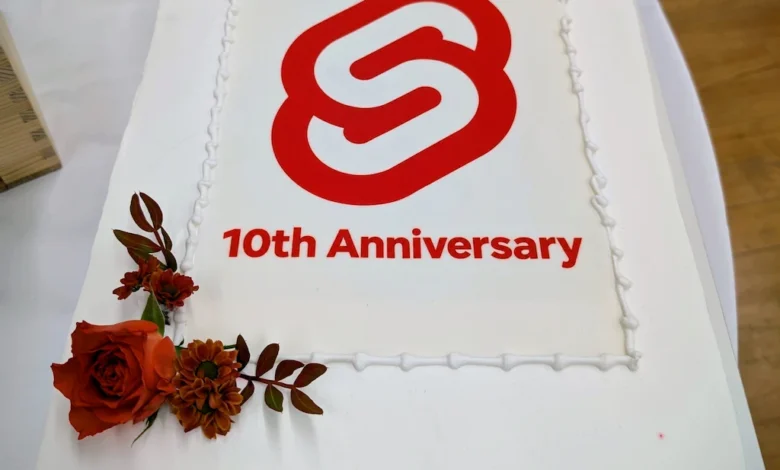
While the anniversary was celebrated with the tradition of a commemorative cake, the focus of the community remains firmly on the future. With the talks from the Ljubljana summit being published to the Svelte Society YouTube channel, the broader development community will soon have access to the strategies and insights that will define the framework’s second decade. As software is truly never "finished," the Svelte community appears prepared to embrace the ongoing evolution of the web, proving that even in a world of rapidly changing technology, the fundamental principles of clean, efficient code remain the highest priority.