AWS Weekly Roundup: Local Development Tools, Hardware Isolation, and Enterprise AI Updates Headline Major Cloud Infrastructure Releases

The landscape of cloud software engineering underwent a significant shift this week with a wave of major announcements from Amazon Web Services (AWS), aimed at streamlining local development, enhancing container workload security, and advancing artificial intelligence integration. Leading the release schedule is the official commercial introduction of the AWS Emulator, a tool designed to let developers and automated coding agents interact with AWS APIs locally without incurring cloud resource provisioning costs for every test cycle. Alongside this developer-centric tooling, AWS rolled out hardware-level isolation features for shared infrastructure, expanded token exchange protocols in Amazon Cognito, and integrated advanced third-party machine learning models into Amazon Bedrock. These updates collectively point toward an industry-wide push for tighter feedback loops, enhanced multi-tenant security, and more granular control over complex, agent-driven cloud applications.
Local Development and the AWS Emulator Launch
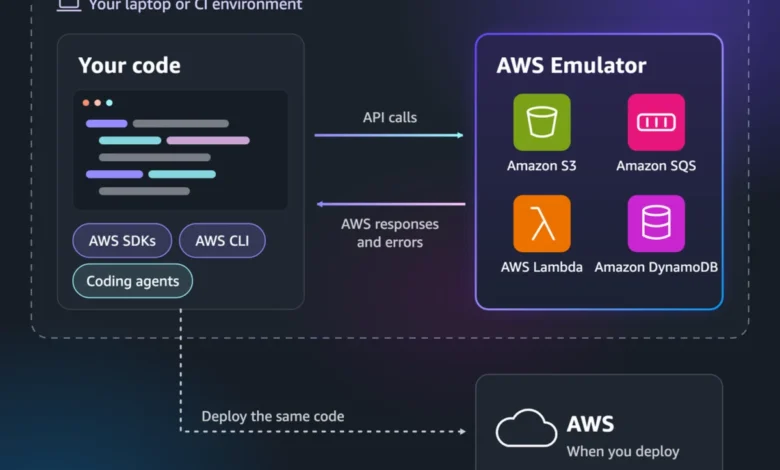
The centerpiece of the recent product launches is the AWS Emulator, which reached general availability last week following extensive beta testing and community feedback. Historically, testing applications that rely heavily on cloud-native primitives—such as Amazon DynamoDB tables, S3 buckets, or messaging queues—required developers to either mock these services locally using third-party emulation software or provision actual cloud resources via Infrastructure as Code (IaC) pipelines. While mocking libraries offer speed, they frequently fail to replicate the exact behavior, error codes, and eventual consistency models of true cloud APIs. Conversely, provisioning cloud resources per test cycle introduces latency, financial costs, and complexity in cleanup.
The AWS Emulator bridges this gap by offering a lightweight, local environment that runs natively on a developer’s machine or within a continuous integration (CI) pipeline. By pointing the AWS CLI or standard AWS SDKs to a local HTTPS endpoint, developers—and increasingly, autonomous coding agents—can execute normal API requests against an emulated backend. In standard test walks, an agent can provision an Amazon DynamoDB table, write data items, and perform read operations entirely offline, receiving immediate concrete feedback on its execution.
Engineers familiar with local testing tools will find the getting-started process straightforward. AWS has packaged the emulator to support standard Linux distributions, alongside Docker images configured for macOS and Windows environments. The open-source code is hosted on GitHub, allowing developers to inspect internal mechanics and contribute to community-driven fixes. However, cloud architects must note the technical limitations inherent in any local emulation layer. The current iteration of the AWS Emulator does not replicate Identity and Access Management (IAM) resource policies, cross-account permissions, or cross-Region replication behavior. Furthermore, AWS maintains a published fidelity matrix; unimplemented API calls currently return standard HTTP 501 Not Implemented errors. Consequently, security teams emphasize that while the emulator drastically accelerates the initial build-and-test loop, final validation against live AWS infrastructure remains mandatory before pushing applications to production environments.
Hardening Shared Infrastructure with Nitro Sandboxes
As organizations scale their containerized architectures using Amazon Elastic Kubernetes Service (EKS) and Amazon Elastic Container Service (ECS), the challenge of securing multi-tenant workloads on shared Amazon EC2 infrastructure has intensified. To address this, AWS introduced Nitro Sandboxes, a capability that brings hardware-level isolation directly to individual pods, tasks, and virtual machines.
Traditional container isolation relies on operating system-level virtualization, sharing the underlying kernel of the host EC2 instance. While effective for many standard microservices, high-risk workloads—such as multi-tenant SaaS applications, untrusted third-party build jobs, and autonomous coding agents executing generated code—demand stronger security boundaries to prevent potential container breakouts. Nitro Sandboxes leverage AWS Nitro System hardware to wrap individual workloads in a dedicated VM boundary, even when those workloads reside on the same physical EC2 instance.
The architecture supports two distinct operational modes: isolated mode and confidential mode. Isolated mode cleanly separates workloads from neighboring processes on the host, preventing resource contention and direct kernel exploitation vectors. Confidential mode adds a layer of cryptographic attestation and memory encryption, protecting data in use from unauthorized access by node operators or hypervisor-level inspection.
From an economic perspective, AWS has structured Nitro Sandboxes to minimize financial friction for enterprise adopters. There is no additional service fee to enable Nitro Sandboxes on supported EC2 instances, though standard infrastructure costs for EC2, applicable EKS Auto Mode, or ECS Managed Instances continue to apply. This architectural enhancement is expected to be widely adopted in regulated industries—such as finance and healthcare—where strict compliance mandates demand cryptographic guarantees of workload separation.
Expanding Enterprise AI and Agent Runtimes
Artificial intelligence infrastructure also received notable enhancements, particularly regarding agent-to-backend delegation and runtime efficiency. Amazon Bedrock announced that the next-generation AgentCore runtime is now the default environment for new agent deployments. This updated runtime significantly reduces cold-start latency, allowing agent sessions to initialize in under two seconds. Furthermore, the updated runtime scales dynamically up to 8 vCPUs and 32 GB of memory per session, scales down to zero when idle, and reduces memory billing costs by up to 68 percent compared to previous iterations, all while maintaining isolated microVM boundaries for every active session.
Complementing this runtime update is the introduction of native OAuth 2.0 token exchange support within Amazon Cognito. In complex enterprise environments, autonomous agents frequently need to call downstream backend services on behalf of an authenticated human user. Previously, developers either had to pass the user’s original access token directly—risking over-privilegement—or implement custom proxy services to handle credential translation.
With the new token exchange capability, applications can exchange a user’s primary token for a derived token explicitly scoped to a specific downstream service. This derived token features narrower permissions, a singular intended audience, and no refresh token, dramatically reducing the blast radius if an agentic workflow is compromised. Additionally, supplying an actor token automatically injects an act claim into the authorization chain, ensuring complete traceability and auditability regarding which intermediary agent initiated a specific backend transaction. The feature is immediately available across Essentials and Plus plans in all commercial AWS Regions.
In parallel with infrastructure updates, Anthropic’s flagship model, Claude Fable 5.2, is now generally available on AWS through Amazon Bedrock and the Claude Platform. Billed by Anthropic as its most capable model to date for rigorous technical workflows, Claude Fable 5.2 is designed for extended software engineering tasks, complex scientific research, and advanced quantitative finance calculations. Cloud administrators utilizing the model via Amazon Bedrock must account for specific data retention policies; traffic processed through the model is retained for up to 30 days exclusively for automated abuse detection, with temporary zero-retention exceptions available for qualified internal enterprise use cases.
Database, Search, and Operational Resilience Updates
Beyond developer tools and AI models, AWS rolled out significant feature updates across its data storage, caching, search, and observability portfolios to support high-throughput enterprise architectures.

In the caching and memory tier, Amazon ElastiCache Serverless for Valkey has added native support for combined vector, full-text, and hybrid search capabilities alongside server-side aggregations. This integration allows product discovery platforms, recommendation engines, and agent-memory retrieval systems to perform complex querying directly against fast-moving cache data without routing queries to persistent relational databases. The capability requires Valkey version 9 and is available immediately across commercial AWS Regions, AWS GovCloud (US), and the AWS European Sovereign Cloud.
For disaster recovery and operational continuity, Amazon OpenSearch Service introduced managed cross-Region disaster recovery for domains running version 3.7 or later. Administrators can now pair OpenSearch domains across two distinct AWS Regions within the same account, establishing recovery objectives of under one minute for data loss (Recovery Point Objective, or RPO) and under 20 minutes for recovery time (Recovery Time Objective, or RTO). While planned switchovers preserve transactional writes seamlessly, unplanned failovers may result in the loss of unreplicated data that was in flight at the moment of failure. The service simplifies what was previously a complex manual orchestration task, though engineering teams remain responsible for synchronizing cluster configurations and rerouting application DNS entries during a failover event.
Observability and log management also saw enhancements with the introduction of account-level log retention policies in Amazon CloudWatch. Platform engineering teams can now define centralized retention windows across all existing log groups or target specific groups matching designated name prefixes. When conflicting rules overlap, CloudWatch automatically applies the longest retention period, enabling organizations to enforce strict compliance baselines for security and audit logs without manually updating hundreds of individual log groups. The feature carries no additional service charge and is deployed across all commercial AWS regions, with the exception of Middle East (Bahrain) and Middle East (UAE).
Industry Implications and Broader Ecosystem Trends
The cumulative effect of these releases underscores a broader industry pivot toward developer autonomy, stringent workload isolation, and cost-optimized AI integration. By moving API emulation locally via the AWS Emulator and lowering the operational friction of agent runtimes through AgentCore, AWS is directly addressing the developer bottleneck in cloud engineering. As coding agents transition from experimental novelties to active participants in software development lifecycles, tools that provide rapid, isolated feedback loops will increasingly dictate engineering velocity.
Simultaneously, features like Nitro Sandboxes and Cognito token exchange reflect an increasingly mature cloud security posture. As multi-tenant container architectures and automated AI agents handle sensitive enterprise data, the demand for hardware-enforced boundaries and explicit, least-privilege credential delegation is no longer optional—it is a core requirement for enterprise cloud adoption.
Looking ahead, engineering organizations are expected to integrate these tools into their CI/CD pipelines and security reviews ahead of the upcoming AWS re:Invent conference, where further announcements regarding agentic workflows, serverless data architectures, and infrastructure automation are widely anticipated.