Amazon ECS Gateway: Simplifying Ingress Networking and Containerized Workload Scalability at Enterprise Scale

Managing containerized applications at massive scale has long presented operational bottlenecks for enterprise platform teams, particularly when configuring ingress networking. Historically, for every new microservice deployed on the Amazon Elastic Container Service (Amazon ECS), engineers were required to manually provision, configure, and wire together a complex web of infrastructure resources. This included Application Load Balancers (ALBs), AWS Certificate Manager (ACM) certificates, AWS WAF web access control lists (ACLs), and precise security groups. Furthermore, keeping these disparate resources synchronized as services scaled, underwent updates, or experienced lifecycle changes introduced significant overhead. This per-service operational friction frequently stifled deployment velocity, inflated administrative costs, and elevated the susceptibility to configuration drift across organizational environments.
To address these longstanding enterprise challenges, Amazon Web Services has officially announced the launch of Amazon ECS Gateway, a new account-level resource designed to fundamentally streamline ingress networking for containerized workloads. By automatically provisioning and managing the requisite underlying infrastructure directly within the customer’s account, ECS Gateway decouples infrastructure management from application development, providing a streamlined pathway for modern cloud architectures.
Architectural Overview and Separation of Responsibilities
The core philosophy behind ECS Gateway is the establishment of a clear, disciplined separation of responsibilities between centralized platform teams and distributed application development teams. In traditional architectures, developers often found themselves entangled in networking configurations, or alternatively, platform teams became bottlenecks as they processed ticket requests for every new endpoint.

With ECS Gateway, platform teams establish centralized control by defining gateways at the account level, determining networking constraints, security parameters, and associated VPC boundaries. Meanwhile, application teams are empowered to focus entirely on application logic by simply attaching a lightweight gateway connector to their service definitions.
From an economic and architectural standpoint, ECS Gateway optimizes resource utilization by implementing host-based routing via ALBs. Under this model, up to 25 distinct containerized services can securely share a single Application Load Balancer. Amazon ECS automatically governs the full lifecycle of this underlying infrastructure. The service provisions the initial ALB the moment the first connected service requires it, scales out by adding additional ALBs as capacity thresholds are reached, and gracefully removes them when workloads scale down or decommission. Upon successful provisioning, each service is instantly assigned a unique DNS hostname, delivering a fully realized, ready-to-use endpoint the moment deployment completes.
Implementation Mechanics: From Console Configuration to API Provisioning
Platform administrators can interact with ECS Gateway through multiple operational channels, including the AWS Management Console, the AWS Command Line Interface (AWS CLI), and modern programmatic interfaces such as the AWS MCP Server for AI-assisted coding tools.
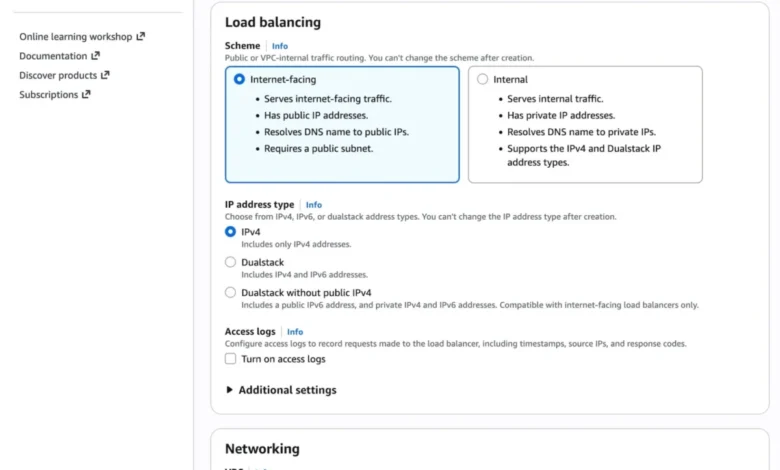
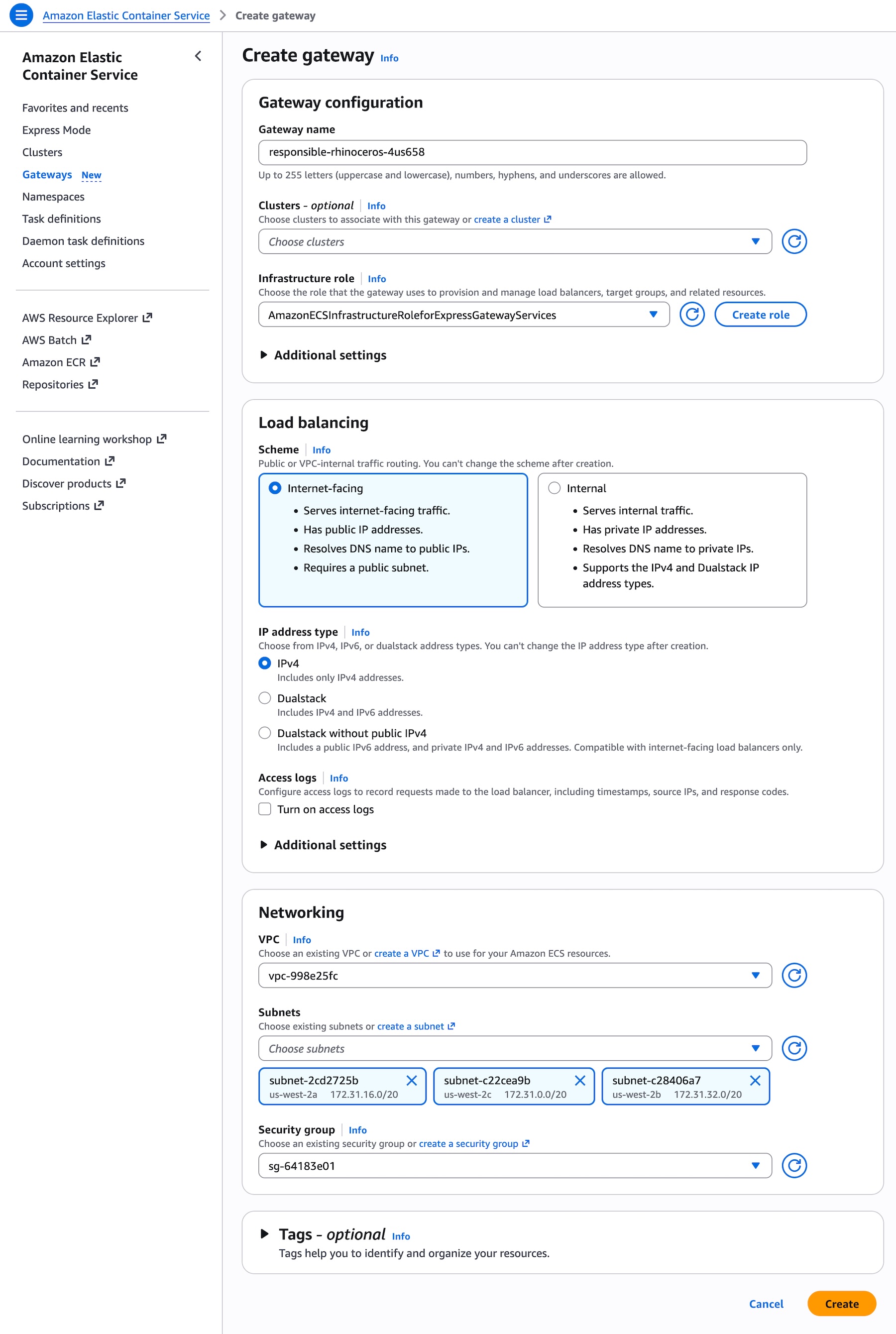
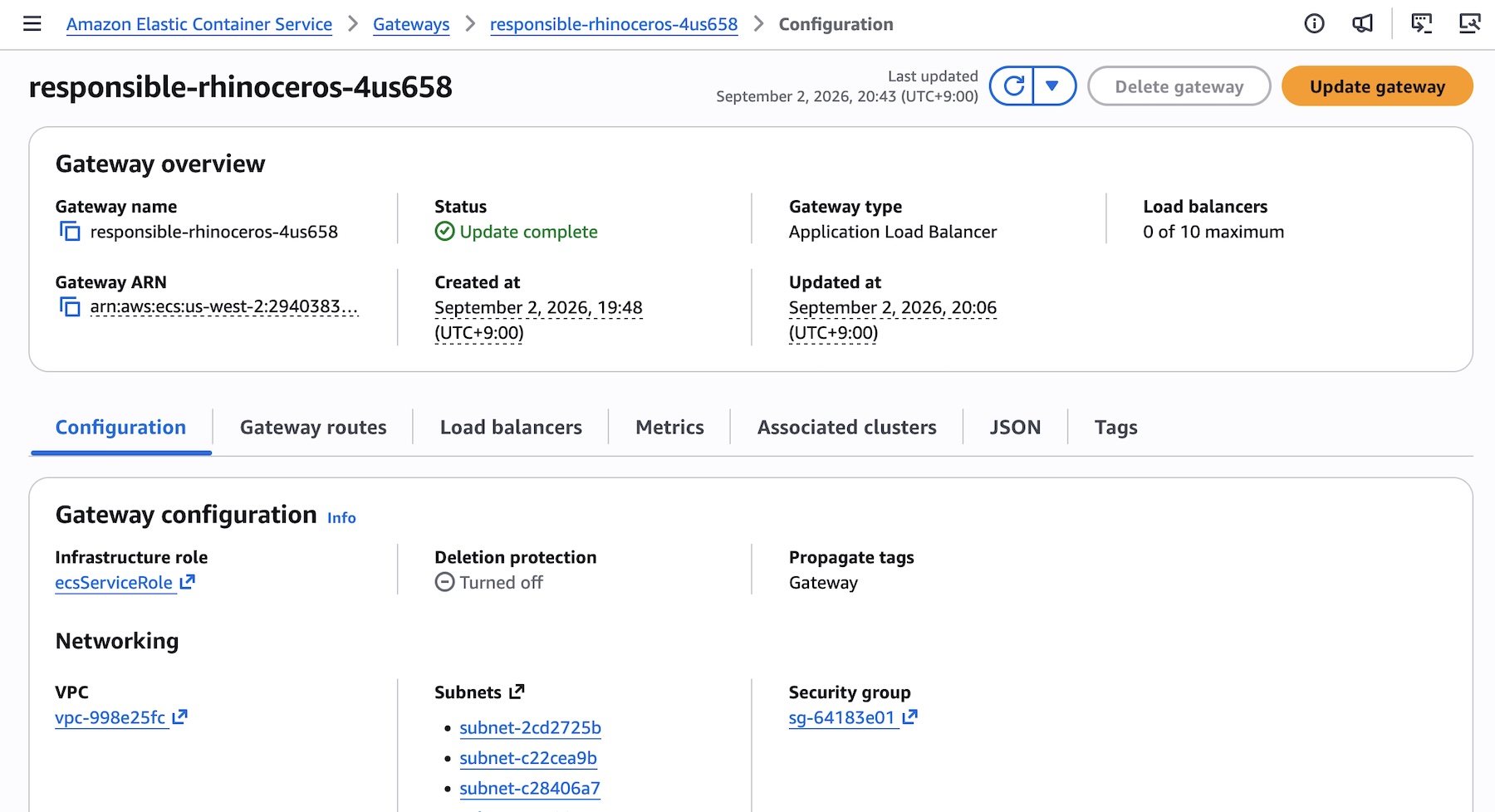
In the AWS Management Console, administrators begin by navigating to the ECS dashboard to create a new gateway. This process requires specifying a unique gateway name and designating an infrastructure role—an IAM role assumed by Amazon ECS to securely provision and manage underlying networking assets such as ALBs, security groups, and certificates. Administrators then select a load-balancing scheme, determining whether the traffic routing operates publicly or via a VPC-internal configuration.

Additional configuration parameters include defining listeners, ports, maximum load balancer scaling limits, and integrating AWS WAF web ACLs to shield web applications from malicious traffic. It is important to note that foundational parameters—such as the gateway name, routing scheme, associated VPC, subnets, IP address types, and initial listener protocols—are immutable once the gateway is established.
Alternatively, infrastructure-as-code and automation pipelines can utilize the AWS CLI. Creating a gateway programmatically is executed via the CreateGateway API call, as demonstrated below:
aws ecs create-gateway
  --name my-team-gateway
  --infrastructure-role-arn arn:aws:iam::123456789012:role/ECSGatewayRole
  --configuration '
    "HostSharedAlb":
      "networkConfiguration":
        "subnets": [
          "subnet-080779f9bd887757a",
          "subnet-03d5b2fead6bc6258",
          "subnet-0861210a397d31252",
          "subnet-06539e194023cb77a"
        ],
        "ipAddressType": "ipv4"
      ,
      "scheme": "internet-facing"

  '
Crucially, no infrastructure costs are incurred or resources provisioned at the moment of gateway creation. Actual infrastructure is only instantiated when a service explicitly connects via a gateway connector. Once established, administrators map the gateway to one or more ECS clusters using a many-to-many relationship model. A single gateway can span up to 10,000 clusters, while an individual cluster can support up to five distinct gateway associations. This flexibility enables organizations to segment environments, sharing a single gateway across development stages or assigning multiple specialized gateways—such as distinct public and private ingress points—to a single high-density cluster.
Incremental Adoption and Application Integration
For organizations operating mature, pre-existing container environments, refactoring production infrastructure can be a daunting prospect. Amazon designed ECS Gateway with incremental adoption in mind. Application teams can integrate the gateway connector into their service definitions using either the CreateService or UpdateService API operations.
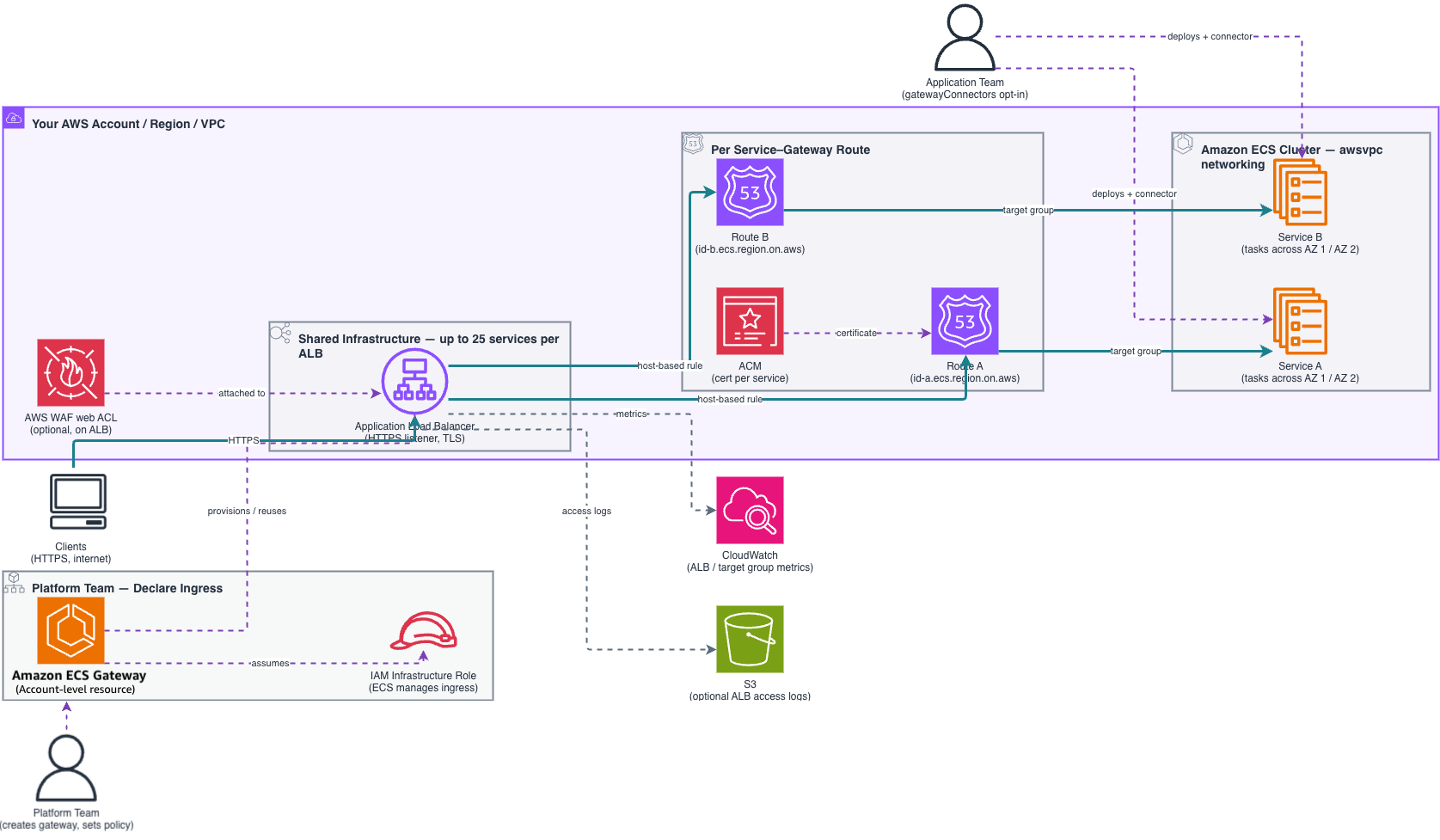
For legacy services already bound to dedicated load balancers, engineers can adopt ECS Gateway non-disruptively. By calling UpdateService to append a gateway connector, both ingress paths operate simultaneously. This dual-path capability allows engineering teams to thoroughly validate the new gateway routing and DNS endpoints before decommissioning legacy load balancer configurations.
The integration syntax within service definitions is streamlined, as illustrated in the following AWS CLI example:
aws ecs create-service
  --cluster my-cluster
  --service my-api-service
  --task-definition my-api-service:1
  --gateway-connectors '[ "portName": "api", "filters": "accessTypes": ["PUBLIC"], "healthCheck": ... ]'
At the exact moment of deployment, Amazon ECS evaluates the compatibility between the service and the cluster’s associated gateways. A gateway is deemed compatible if its access type aligns with the service’s connector filter, if it resides within the identical Virtual Private Cloud (VPC), and if it encompasses all Availability Zones utilized by the service’s configured subnets.
Once validated, Amazon ECS automatically provisions the necessary per-service resources behind the scenes. This orchestration engine generates an ACM security certificate, establishes a unique DNS hostname, constructs a listener rule to direct traffic for that hostname to the correct service target group, and establishes a strict service security group permitting inbound traffic exclusively from the ALB’s security group. If existing ALBs have reached capacity limits, ECS automatically provisions a new load balancer, respecting predefined maximum ceilings (maxAlbCount). When provisioning completes, the gateway route transitions to an ACTIVE status, and the application endpoint immediately begins accepting production traffic.
Economic Implications and Strategic Analysis
The introduction of Amazon ECS Gateway arrives at a critical juncture in cloud computing, where organizations increasingly scrutinize operational efficiency and infrastructure spend. By enabling up to 25 services to share a single Application Load Balancer without manual intervention, the feature directly addresses idle resource waste. In traditional microservice architectures, provisioning a dedicated ALB per service often resulted in low traffic utilization relative to fixed infrastructure costs. ECS Gateway optimizes density, significantly lowering baseline cloud expenditure for enterprise accounts.
Furthermore, the automation of certificate management, DNS mapping, and security group synchronization eliminates entire classes of human error. Configuration drift—a persistent security vulnerability where manual updates fall out of sync with compliance baselines—is mitigated because Amazon ECS maintains continuous reconciliation of the networking lifecycle.
Industry analysts note that tools reducing the cognitive load on platform engineers directly correlate with accelerated software delivery lifecycles. By removing networking configuration as a prerequisite blocker for feature deployment, development velocity is expected to improve across organizations leveraging containerized infrastructure.
Availability and Pricing Structure
Amazon ECS Gateway is generally available immediately across all commercial AWS Regions where Amazon ECS is supported.
Regarding financial structuring, Amazon has elected to provide ECS Gateway at no additional software or management service charge. Customers do not pay a licensing fee or management markup for utilizing the gateway orchestration layer. Instead, organizations incur costs solely for the underlying AWS infrastructure dynamically provisioned within their accounts in response to active service connections. This standard resource consumption pricing includes applicable Application Load Balancer hourly rates and data processing charges, Amazon CloudWatch logs and metrics generation, AWS Certificate Manager certificate usage, and standard inter-AZ data transfer fees.
Enterprise engineering groups can begin leveraging Amazon ECS Gateway immediately through the AWS Management Console, with comprehensive technical documentation and integration guides available via the official Amazon ECS Developer Guide. Feedback channels are active across AWS re:Post and traditional AWS Support pathways to capture initial enterprise deployment experiences.