GitHub Integrates ACCESSIBILITY.md Support to Bring Open Source Project Inclusion into the Mainstream

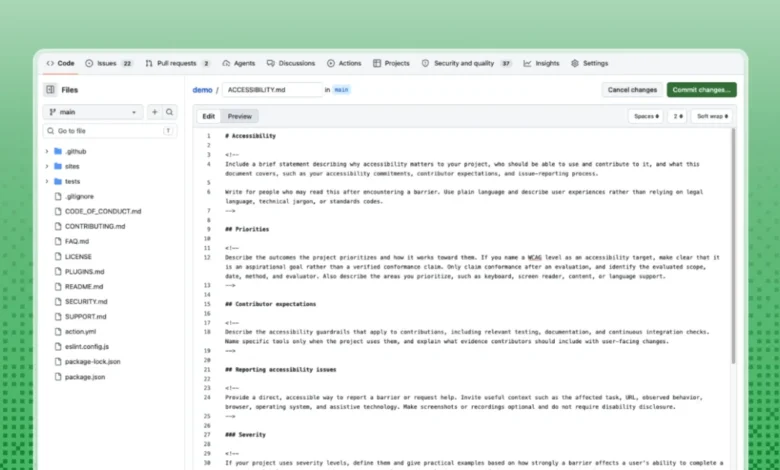
Digital accessibility has historically suffered from decentralization. For decades, developers, maintainers, and users attempting to understand a software project’s stance on inclusivity had to piece together fragmented clues scattered across issue trackers, outdated contribution guidelines, scattered audit reports, informal team chats, and disjointed user conversations. When this crucial information lacks a predictable, standardized home, end-users who encounter barriers are forced to hunt for answers, while project maintainers frequently lose vital context as contributors churn and project ownership shifts. In an effort to resolve this systemic friction, GitHub has officially introduced native repository support for ACCESSIBILITY.md files, establishing a permanent, highly visible standard for open-source and enterprise projects to declare their inclusion targets, known limitations, and reporting pathways.
The newly implemented feature surfaces these dedicated files directly onto repository overview pages and integrates them into GitHub’s broader community health framework. By elevating accessibility documentation to the same tier as code of conduct and contribution guidelines, the platform aims to shift accessibility from an afterthought to a core pillar of software development lifecycle management.
Architecture and Discovery: How ACCESSIBILITY.md Works
Under the hood, GitHub’s platform engineering team has configured the system to automatically recognize the ACCESSIBILITY.md file when placed in the root of a repository, within the .github/ configuration directory, or nested inside a project’s docs/ folder. Furthermore, to reduce administrative overhead for massive organizations managing hundreds of distinct repositories, projects can automatically inherit an accessibility statement from a centralized .github/ repository managed at the organization level.
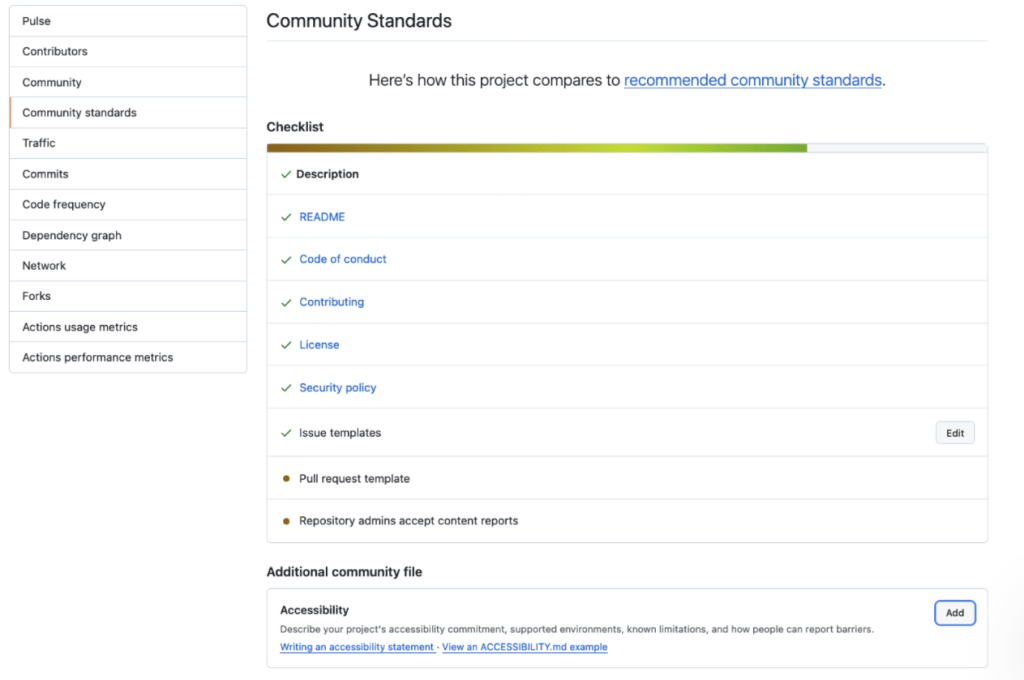
For public repositories, maintainers can easily initialize or propose a statement by navigating to the Insights tab, selecting Community Standards, and utilizing a streamlined starter document provided by the platform. To complement this documentation push, GitHub has also updated repository defaults so that all newly created repositories automatically include an accessibility issue label. While the ACCESSIBILITY.md file explains how a user can report a barrier and outlines what kind of response to expect, the accompanying issue label equips maintainers with an immediate mechanism to categorize, prioritize, and track accessibility-related remediation work.
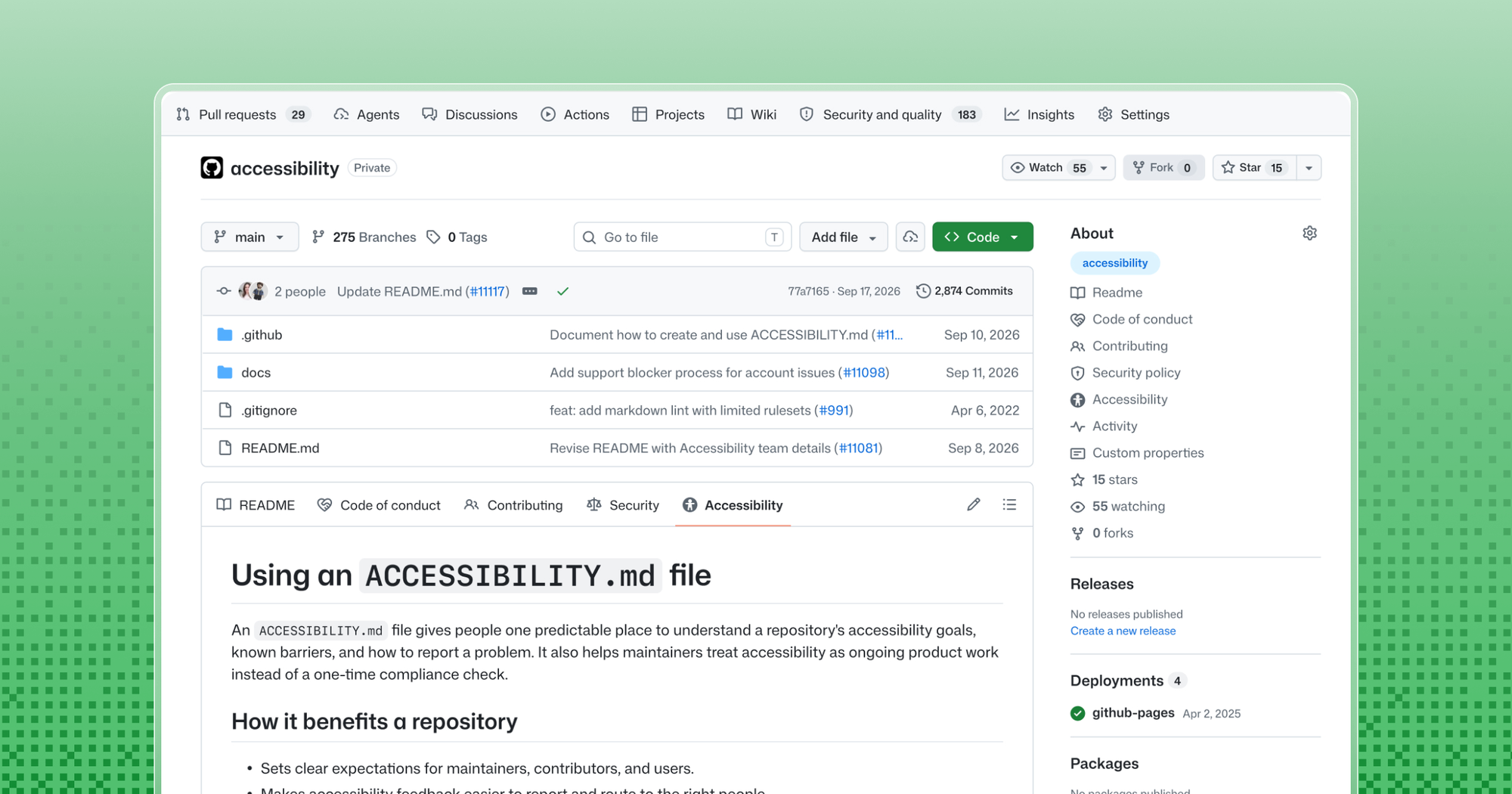
This structured visibility fundamentally changes how project health is evaluated. Prior to this update, finding information regarding screen reader compatibility or keyboard navigation often required auditing thousands of closed issues. Now, projects can explicitly lay out supported environments and known barriers before a user even clones the repository or installs the package.
Real-World Implementation: Case Studies from the Open Source Ecosystem
To demonstrate the versatility and practical application of the new format, several prominent open-source projects have already integrated ACCESSIBILITY.md files into their workflows, showcasing how different types of software can tailor the documentation to their specific maintenance constraints.
The GitHub CLI (Command Line Interface) team authored an accessibility statement that directly addresses the unique challenges of terminal-based software. Their document transparently details settings, known barriers, and practical workarounds. For instance, the statement explains why dense table outputs can be exceptionally difficult for screen reader users to parse sequentially. Instead of leaving users stranded, the document supplies a specific command line flag that formats pull request numbers and titles into a linear, single-item-per-line stream. Additionally, the CLI project leverages its accessibility file to set strict contributor expectations: developers submitting changes to command prompts or output logs are explicitly required to demonstrate their results with relevant accessibility settings enabled. This dual utility transforms the document into both a user manual for individuals requiring assistive technologies and a style guide for incoming contributors.
Similarly, the GitHub Annotation Toolkit addresses the complexities inherent in design-to-code pipelines. Its accessibility statement confronts a specific limitation within its Figma library, where annotations rely heavily on canvas positions, connecting lines, and matching numeric sequences to visually convey structural relationships. Because screen readers and raw access APIs cannot always deduce what those visual lines signify, the project’s documentation instructs collaborators on how to bridge the gap. It requires structured text descriptions that explicitly identify each annotated element, its intended semantics, its expected behavior, and its hierarchical ordering. By documenting these limitations alongside explicit calls for keyboard-only and screen-reader testing gaps, the project provides complete transparency regarding what has been formally verified versus what remains a work in progress.
Defining Scope: Pragmatic Documentation Over Unrealistic Compliance
A critical design choice behind GitHub’s implementation of ACCESSIBILITY.md is the conscious absence of a rigid, one-size-fits-all template. Software spans a massive spectrum, ranging from single-developer command-line scripts and documentation websites to massive, enterprise-scale web applications. Each of these formats carries vastly different user bases, technical risks, and maintenance capacities.
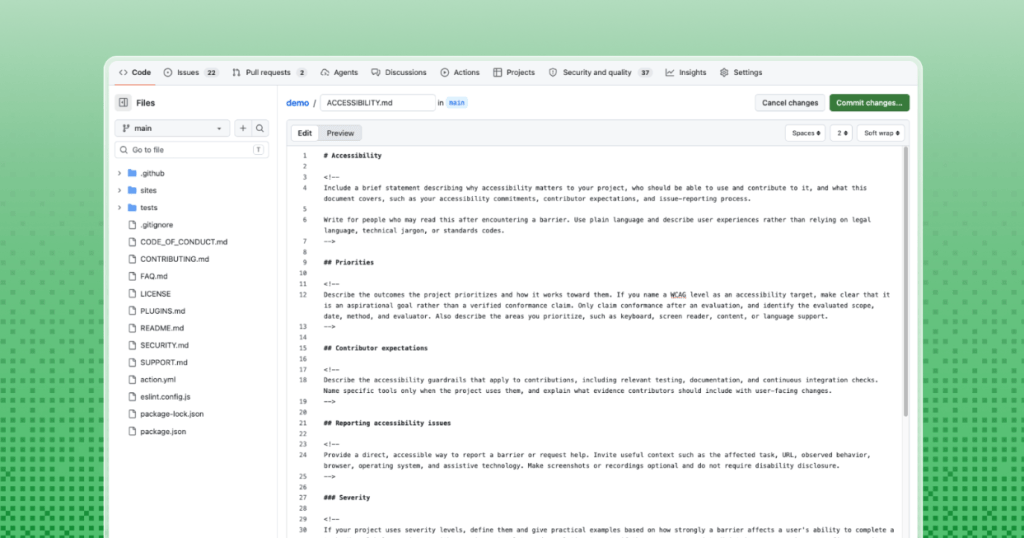
Accessibility specialists emphasize that maintainers should document what they can realistically sustain rather than drafting aspirational policies that quickly grow outdated. When outlining goals, projects often reference the Web Content Accessibility Guidelines (WCAG) version and compliance level they are targeting. However, GitHub and accessibility advocates stress a vital distinction: naming a target does not establish verified conformance. A formal conformance claim requires rigorous, methodical evaluation and must explicitly identify the evaluated scope, testing dates, evaluation methods, and the independent evaluator.
For most open-source communities, the most effective ACCESSIBILITY.md files focus heavily on human-centric communication. Plain language, descriptive hyperlinks, and clear, welcoming reporting pathways consistently outperform dense, legalistic, or standards-heavy prose.
Structuring Effective Reporting Pathways
When a user encounters a digital barrier, the friction of reporting it often deters them from contributing feedback entirely. The most successful accessibility statements streamline this process by lowering the barrier to entry while capturing the telemetry maintainers need to diagnose the bug.
Optimized reporting guidance explicitly invites contextual details that aid debugging, such as the specific task attempted, the affected page or view, the observed versus expected behavior, the browser, the operating system, and the assistive technology being utilized (such as NVDA, VoiceOver, JAWS, or specialized switch controls). Furthermore, inclusive projects design their reporting guidelines to make screenshots and screen recordings optional, while strictly avoiding language that requires a user to prove or disclose personal medical details regarding their disability.
To maintain trust, the statement should also calibrate expectations to match what maintainers can consistently deliver. Clear documentation outlines expected acknowledgement windows, the frequency of status updates, available interim workarounds, projected fix timelines, and an invitation for the reporter to participate in verifying the final patch once merged.
Broader Industry Implications and the Future of Open Source Inclusion
The integration of native ACCESSIBILITY.md support arrives at a time of tightening global regulatory scrutiny regarding digital products. While many open-source projects operate independently of commercial compliance mandates, enterprise consumers increasingly require software dependencies to meet rigorous accessibility standards to satisfy institutional procurement rules.
By providing a standardized repository home for these statements, GitHub is effectively reducing the friction of compliance documentation across the entire software supply chain. When organizations can effortlessly verify the accessibility posture of an open-source library, they can make more informed architectural decisions that protect end-users at every layer of the technology stack.
Jan Maarten, a designer and accessibility specialist at GitHub who helped spearhead the initiative, notes that normalizing these practices across the open-source community integrates accessibility directly into how software communities plan, build, report, and continuously improve their work. Rather than treating accessibility as an isolated audit phase or an emergency patch, the institutionalization of ACCESSIBILITY.md embeds inclusion into the foundational architecture of modern software development.