Building a Robust JSON Serialization Pipeline in Python for Complex Machine Learning Systems

In the contemporary landscape of machine learning engineering, the primary challenge often shifts from the refinement of algorithmic architectures to the intricate demands of data infrastructure. While the design of a neural network or a gradient-boosted tree occupies the intellectual center of a project, seasoned engineers frequently discover that the majority of their operational hours are consumed by "data plumbing"—the systematic cleaning, transformation, and movement of datasets across distributed systems. As machine learning models transition from localized development environments to production-grade microservices and cloud-based APIs, the ability to serialize and deserialize data with absolute reliability becomes a critical competitive advantage.
The standard library in Python, specifically the json module, serves as the industry-standard interface for data interchange. However, this utility is inherently limited by the constraints of the JSON specification, which natively supports only basic primitives: strings, numbers, arrays, objects, booleans, and null values. When machine learning pipelines require the transmission of more complex Python-native objects—such as datetime objects for audit trails, set structures for feature management, Path objects for file system abstraction, or Enum classes for categorical hyperparameter definition—the standard json.dumps() method fails, throwing a TypeError. This article details a comprehensive, three-step methodology for constructing a resilient serialization pipeline capable of handling custom data types, ensuring graceful error recovery, and managing schema migrations in evolving ML environments.
The Anatomy of Serialization Failures
To understand the necessity of a custom pipeline, one must first identify the friction points in standard data processing. Consider a machine learning experiment configuration. A typical configuration might include a unique identifier, a model type defined as an Enum, a set of features for selection, a Path object pointing to a training dataset, and a timestamp for experiment logging.
When a developer attempts to serialize this dictionary directly using the default JSON library, the execution halts. The json module lacks the intrinsic logic to map a Python set or a datetime object to a format that adheres to the JSON specification. This limitation forces developers into a choice: either convert all complex types into strings or dictionaries before serialization—a process prone to manual errors—or implement a robust, automated encoding architecture. The latter approach is preferred in high-scale environments where data integrity and consistency are paramount.
Step One: Architecting a Robust Custom Encoder
The first phase of building a resilient system involves subclassing the json.JSONEncoder. This approach allows for the extension of the serialization process by overriding the default() method. The objective here is not just to prevent errors, but to provide metadata that facilitates the reconstruction of the original object types.
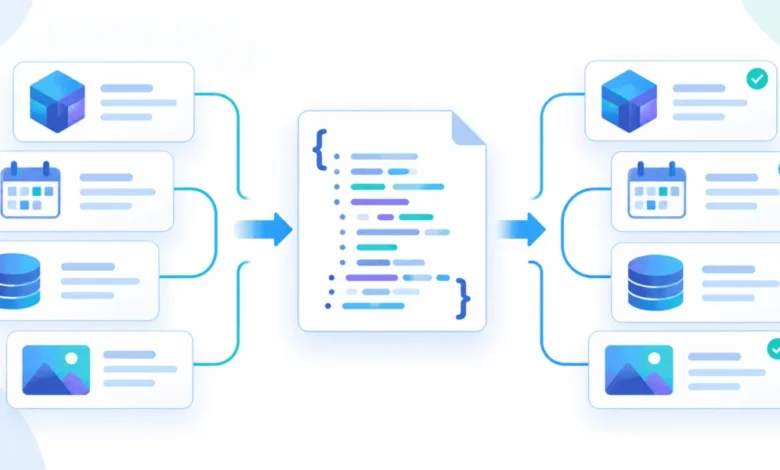
By implementing a RobustEncoder, an engineer can define explicit handling logic for various data types. For instance, a datetime object should be converted into an ISO-formatted string but wrapped in a metadata container, such as "__type__": "datetime", "value": "...". This tagging system is a sophisticated technique that ensures the downstream consumer of the JSON payload understands exactly what type of object was originally serialized, effectively bypassing the ambiguity inherent in standard JSON conversions. When applied to a set, the encoder converts the collection into a list while preserving the "set" label in the metadata, ensuring that the structural intent of the data remains intact throughout the transmission process.
Step Two: Implementing a Fail-Safe Decoding Mechanism
Serialization is only half of the requirement; the inverse operation, deserialization, must be equally robust. When data is received by a service or loaded from a persistent store, it must be reconstructed into its original Python types. This is achieved by utilizing the object_hook parameter in the json.loads() function.
The object_hook acts as a recursive filter. As the JSON parser traverses the nested dictionary structure, it passes each decoded dictionary to the custom robust_decoder function. This function inspects the dictionary for the existence of the __type__ key. If found, the function triggers the corresponding reconstruction logic, such as converting an ISO-formatted string back into a datetime object or transforming a list back into a set.
Crucially, this layer must be fortified with comprehensive exception handling. In distributed systems, data corruption or partial payload delivery is a statistical certainty. By wrapping the reconstruction logic in try-except blocks, the system can detect malformed data and log a warning rather than allowing the entire pipeline to crash. This "graceful failure" approach ensures that if a specific field is corrupted, the application can either fall back to a default value or isolate the error, maintaining the overall health of the production pipeline.
Step Three: Managing Schema Evolution and Versioning
A recurring challenge in the lifecycle of machine learning projects is the inevitable shift in configuration schemas. As projects mature, engineers frequently add new hyperparameters, deprecate legacy metrics, or restructure feature sets. A naive deserializer would fail when encountering a JSON object that lacks a newly introduced key or contains an obsolete field.
To mitigate this, a factory function should be introduced to act as a validation layer between the deserialized raw data and the application logic. This function performs three essential roles:
- Defaulting: It ensures that if a required key is missing—perhaps because the configuration was generated by an older version of the model—a sensible default value is injected.
- Migration: It handles the transformation of old keys into new formats, effectively versioning the configuration on the fly.
- Cleanup: It strips out deprecated fields that are no longer supported by the current model version.
This "load-and-validate" pattern transforms the raw JSON into a sanitized, typed configuration object, shielding the core machine learning logic from the volatility of external storage formats.
Implications for Machine Learning Engineering
The implications of building such a pipeline extend far beyond simple error prevention. In large-scale machine learning operations, the cost of "downtime" caused by data serialization errors is significant. When a model deployment fails because a Path object was improperly serialized or a timestamp was truncated, the resulting latency can derail time-sensitive training cycles or real-time inference requests.
Furthermore, this systematic approach to data handling aligns with the principles of MLOps, which emphasize reproducibility and auditability. By ensuring that metadata—such as exact timestamps and precise feature sets—is preserved through serialization, organizations create a reliable audit trail. This is essential for compliance, model debugging, and the long-term management of experiments.
The transition from "ad-hoc" scripts to production-ready pipelines requires a shift in perspective. Data plumbing is not a secondary concern; it is the foundational layer upon which scalable, reliable machine learning rests. By implementing custom encoders, robust decoders, and schema validation layers, engineering teams can minimize the operational overhead associated with data movement, allowing them to redirect their focus toward the iterative improvement of the models themselves. As the complexity of machine learning systems continues to increase, the adoption of these standardized, resilient patterns will remain a cornerstone of professional data engineering.