AWS Announces General Availability of AWS Continuum for Code Vulnerabilities to Streamline Cloud Security and Automated Remediation

Amazon Web Services (AWS) has officially announced the general availability of AWS Continuum for code vulnerabilities, a groundbreaking security service designed to identify, validate, and remediate application security flaws with unprecedented speed and context. As modern software development lifecycles accelerate and threat actors increasingly leverage frontier artificial intelligence models to weaponize vulnerability disclosures within minutes, enterprise security teams face an overwhelming surge of alerts. AWS Continuum aims to dismantle this operational bottleneck by cutting through the noise of traditional scanners, verifying exploitability, assessing real-world business impact, and autonomously generating targeted code patches delivered directly to repository pull requests.
The launch addresses a critical vulnerability management crisis that has plagued enterprise organizations for years. Traditionally, application security scanners generate thousands of alerts daily across large application estates. A significant portion of these findings turn out to be false positives, unreachable over the network, or already effectively mitigated by existing runtime controls. Furthermore, generic severity metrics fail to provide actionable context regarding resource accessibility. For instance, a critical-severity finding on a developer-only utility often presents identically in scanner logs to a medium-severity vulnerability residing on a service positioned just one step away from a core payment database. Consequently, confirming whether a specific vulnerability is truly exploitable has historically required hours of tedious manual investigation, while deploying a reliable fix often demanded days of cross-functional coordination between security, infrastructure, and application development teams.
Technical Architecture and Context Graph Integration
AWS Continuum overcomes these historical limitations by constructing a comprehensive, dynamic context graph that synthesizes data from two primary inputs: organization code repositories and live AWS environments. To establish infrastructure visibility, administrators deploy a lightweight AWS Continuum collector within the target AWS account and Region where applications execute. This collector aggregates granular resource details, including configurations from AWS Config and underlying network topologies, enabling the service to mathematically determine whether a specific vulnerability is genuinely reachable over the network and what assets a potential attacker could compromise from that vector.

By continuously mapping this data, Continuum develops an intricate understanding of the enterprise topology. It identifies critical business systems—such as customer data repositories, financial transaction pipelines, and authentication gateways—recognizes asset ownership, maps inter-service dependencies, and catalogs the sensitivity of data handled by each component. When a vulnerability is detected, Continuum evaluates its proximity and accessibility relative to these high-value systems, ranking the resulting issues based on real-world business risk rather than isolated static scores.
Automated Validation and Risk Assessment Methodology
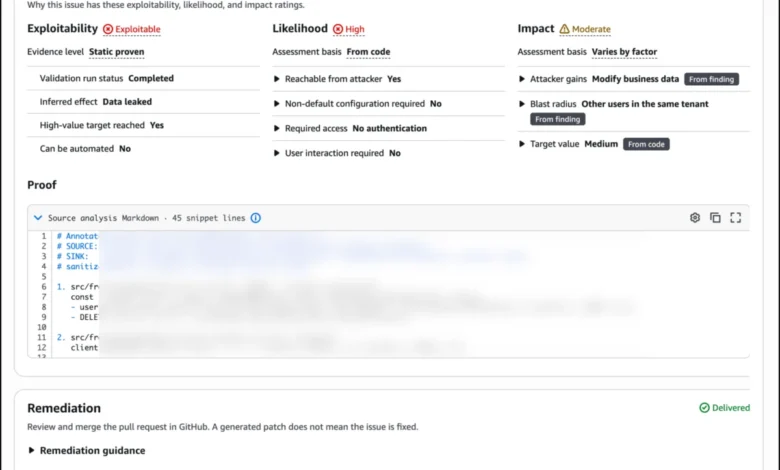
Unlike traditional static or dynamic application security testing (SAST/DAST) tools that merely output lists of potential flaws, AWS Continuum performs rigorous validation. The service evaluates each finding against the combined context of the source code and the surrounding cloud environment, assigning precise evidence levels. For vulnerabilities that can be safely reproduced, Continuum executes the potential exploit inside an isolated, secure sandbox environment. It then generates definitive proof-of-concept code, complete with step-by-step reproduction instructions, the exact attack path, supporting source code analysis, and a comprehensive blast radius assessment.
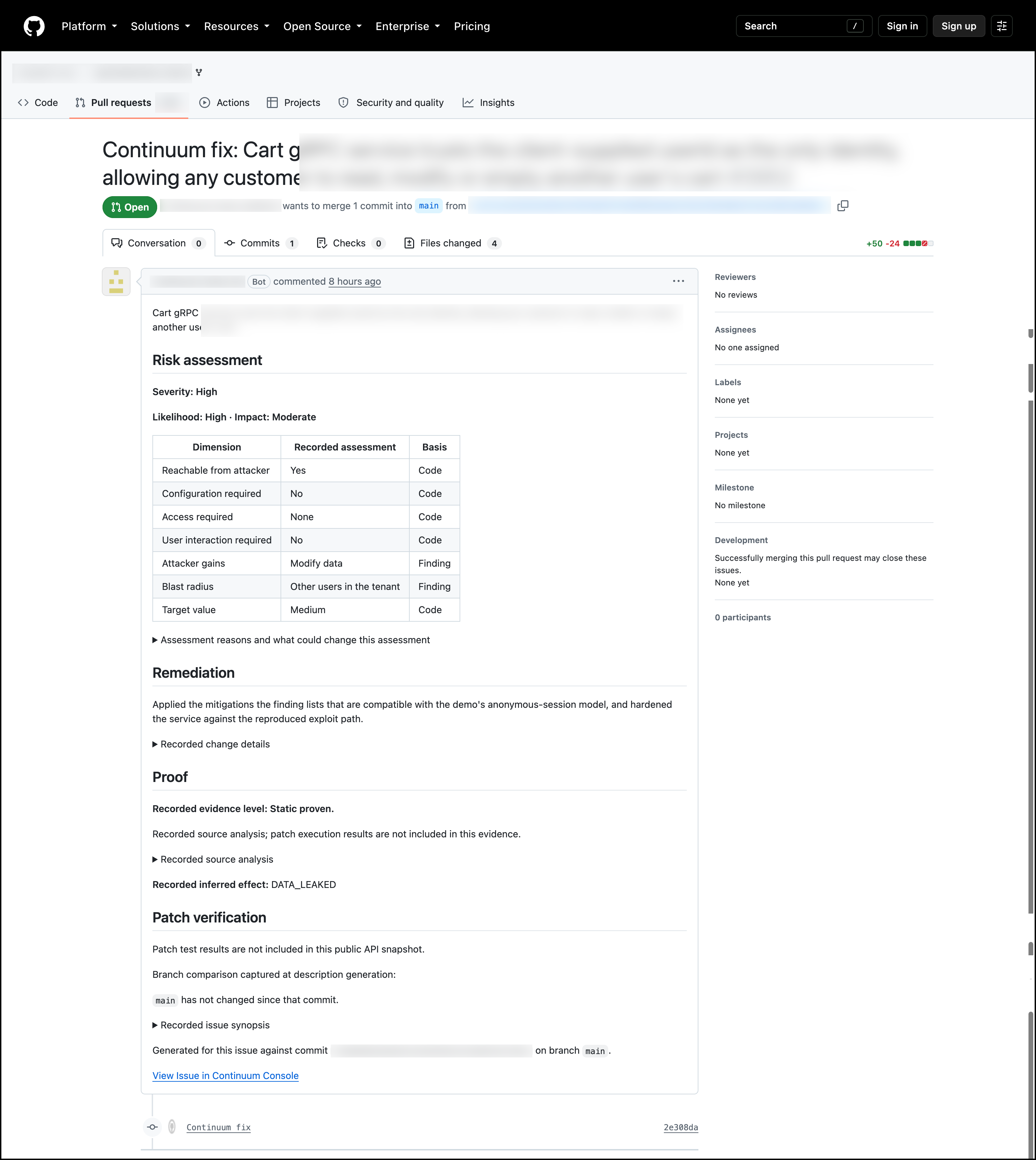
Once an issue is validated, Continuum formulates a precise remediation strategy. Depending on the nature of the flaw, the service generates a code patch, a dependency upgrade, or a configuration adjustment. This remediation is then packaged and opened as a pull request directly within the connected code repository, such as GitHub or an Amazon S3-backed source.
Critically, the initial operational model maintains human-in-the-loop oversight. Every generated fix requires explicit manual review and approval before merging, ensuring that engineering teams retain absolute control over their codebases. However, AWS has indicated that future updates will introduce configurable guardrails and confidence gates—such as automated test coverage checks, scope bounds, and historical success rates—allowing organizations to authorize Continuum to apply specific classes of remediation automatically.
Implementation and Deployment Workflow
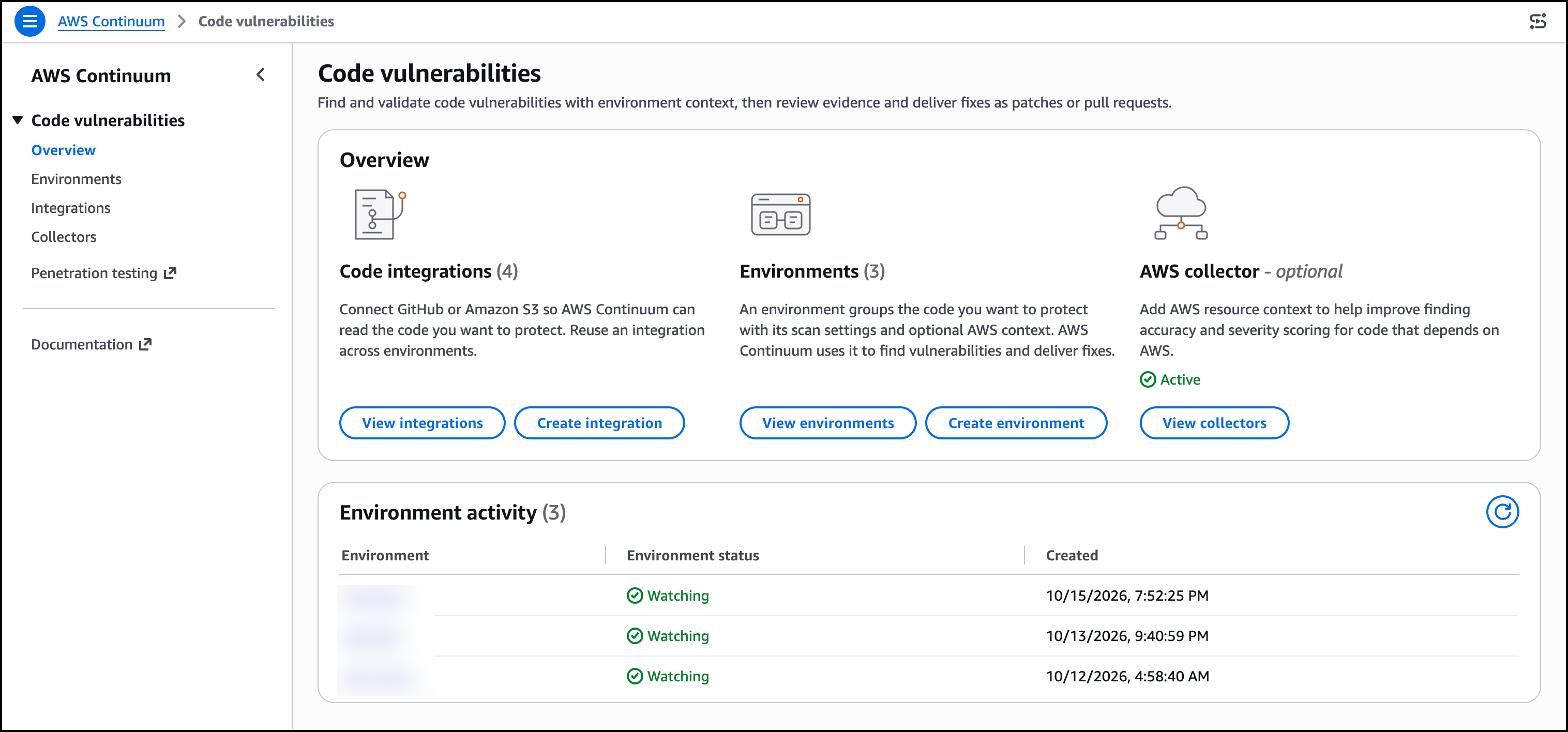
Getting started with AWS Continuum involves a straightforward configuration process within the AWS Management Console. Administrators navigate to the Code vulnerabilities section and establish environment connections by linking a code repository via GitHub integration or designating an Amazon S3 bucket. For S3 sources, the bucket must reside in the same AWS account and Region where Continuum is activated, and access is securely granted through an assumed AWS Identity and Access Management (IAM) role.
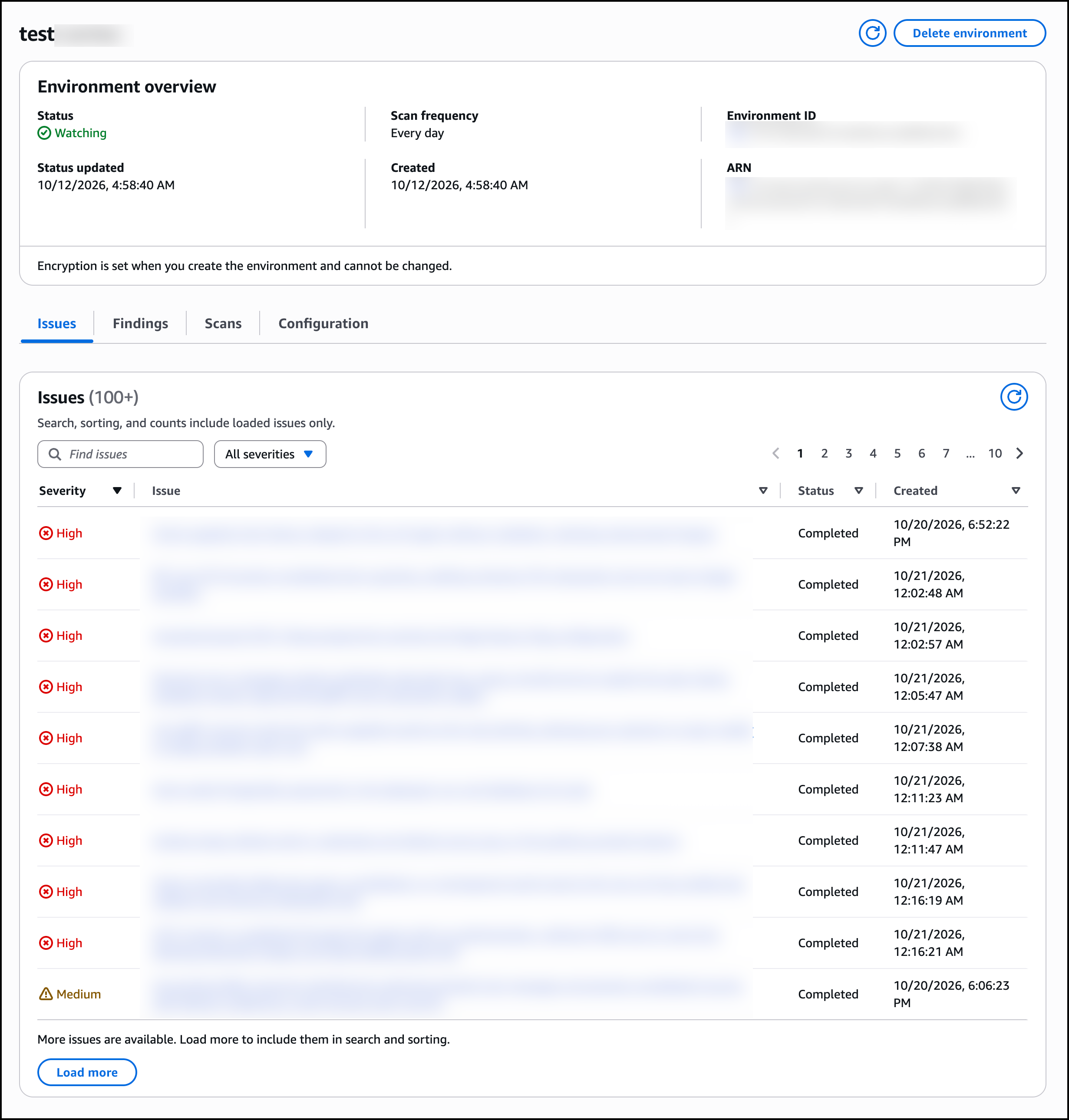
Once the code source is active, users can optionally attach AWS infrastructure context by authorizing a regional Continuum collector. The centralized Overview dashboard aggregates all code integrations, active environments, and collector statuses into a single pane of glass. Within the Issues tab, security personnel encounter a curated, prioritized list of validated vulnerabilities rather than raw scanner outputs. Each entry provides clear metrics regarding severity, creation timestamps, exploitability verdicts (such as "Static proven"), likelihood, and impact severity.
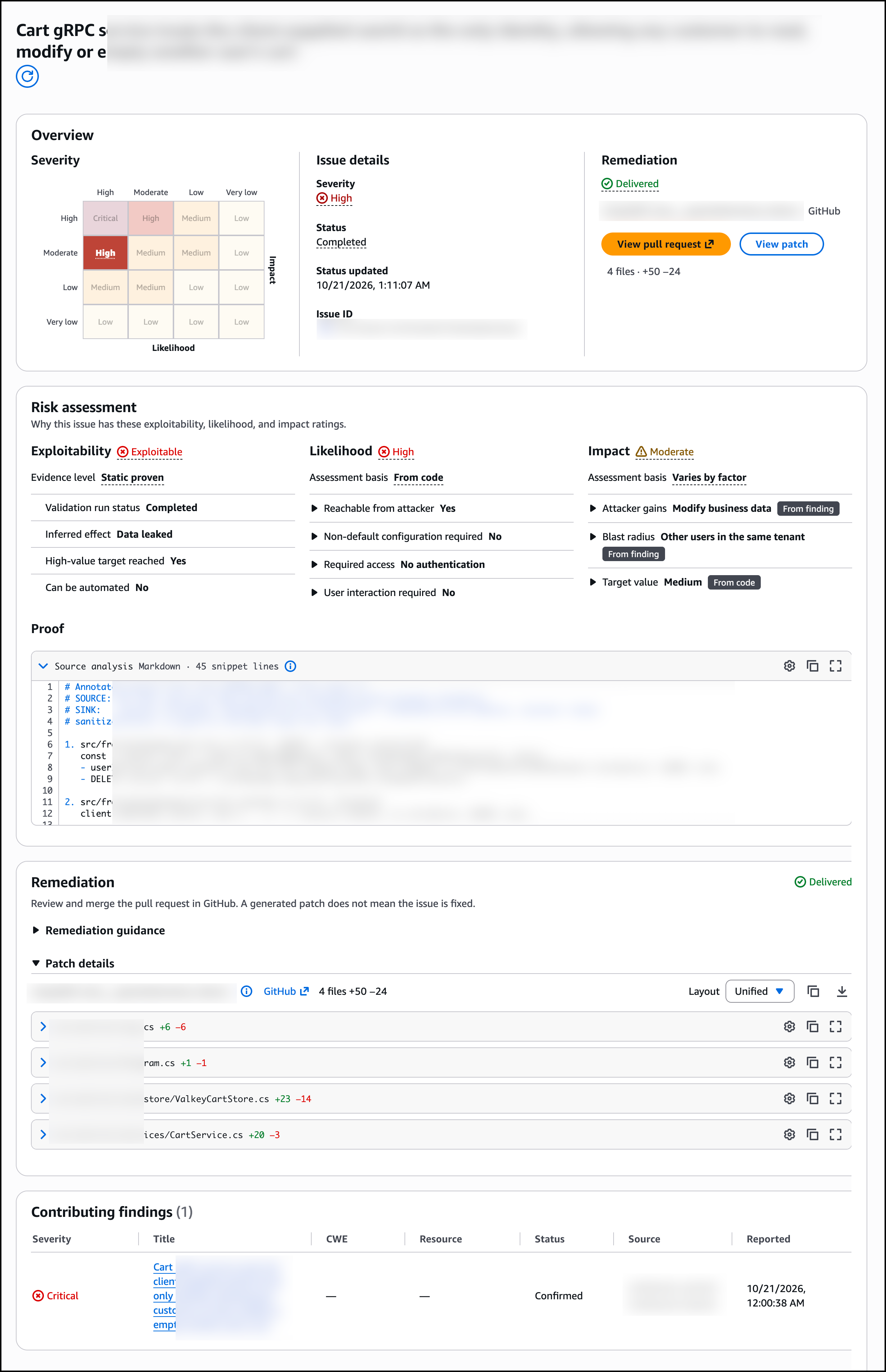
Embedded within each issue ticket, the Remediation section displays the exact changes prepared for deployment, detailing modified files, added and removed lines of code, and direct links to the resulting pull request. Because the pull request description carries over the comprehensive risk assessment, evidence, and proof gathered by the console, engineering reviewers can evaluate the proposed fix entirely within their native version control workflow. Furthermore, dedicated tabs for Findings, Scans, and Configuration allow teams to audit raw scanner telemetry, adjust scan cadences, execute on-demand evaluations, and fine-tune environment parameters.
Industry Implications and Broader Market Impact
The general availability of AWS Continuum arrives at a pivotal moment in cybersecurity history. As malicious actors increasingly industrialize artificial intelligence to discover and exploit zero-day vulnerabilities at machine speed, defenders have found themselves severely outpaced by the sheer volume of alerts. Industry analysts note that standard vulnerability patching cycles, which often span weeks or months, are fundamentally incompatible with modern threat landscapes where exploitation occurs within hours of disclosure.
By bridging the long-standing chasm between cloud infrastructure context and application-layer vulnerability management, AWS Continuum represents a fundamental shift toward automated, context-aware application security posture management (ASPM). Rather than forcing security engineers to manually cross-reference network configurations with code-level flaws, Continuum automates the entire investigative pipeline—from proof-of-concept validation to patch generation. This capability significantly compresses the mean time to remediation (MTTR) while drastically reducing alert fatigue.
Availability and Pricing
AWS Continuum for code vulnerabilities is available starting today in select cloud regions, specifically US East (N. Virginia) and US West (Oregon). Organizations interested in calculating potential costs and exploring tier structures can review the official pricing details on the AWS Continuum pricing page. Comprehensive setup instructions, prerequisite checklists, and advanced configuration tutorials are documented within the official AWS Continuum User Guide, providing developers and cloud architects with the resources necessary to integrate the service into their existing security operations pipelines.
Related posts: