GitHub Engineering Status Report: Navigating Infrastructure Overhauls, Database Migrations, and September Service Disruptions


GitHub has released its comprehensive engineering update detailing system performance, infrastructure overhauls, and service outages across August and September. The report provides a candid look into the platform’s ongoing modernization efforts, highlighting significant strides in database optimization and cloud migration alongside critical service degradations that impacted millions of global developers. Navigating the complex intersection of massive scale and architectural transformation, GitHub leadership continues to anchor its operational philosophy on a strict hierarchy: availability first, capacity second, and feature development third. This guiding principle underscores a period marked by aggressive infrastructure changes, missed deployment deadlines, and notable production incidents that tested the resilience of the world’s leading software development platform.
The dual-month overview illustrates an ambitious engineering agenda. Over August and September, GitHub engineering teams focused heavily on reducing shared-database pressure, introducing robust overload controls, creating vital operational headroom for GitHub Actions, expanding failure containment mechanisms for pull requests, and migrating intensive production workloads to Microsoft Azure. Despite these technical milestones, the period was punctuated by significant service incidents, a mandatory pause in regional capacity expansion, and a missed migration target that collectively demonstrated the immense complexity of modernizing a live, hyper-scale system without disrupting continuous global workflows.
By October 7, the migration to Azure showed tangible progress. Out of 160 total production services, 120 had been successfully deployed in the Central US region, while 13 out of 51 primary MySQL databases had completed their transition. Azure infrastructure successfully absorbed substantial workloads, handling 65.4% of read traffic for GitHub’s core application, 48.3% of Git read traffic, and an impressive 80.2% of stream-processing traffic. Because these metrics represent distinct workloads across diverse operational domains, they highlight a broad reliance on cloud infrastructure rather than a single point of failure, though engineers emphasize that these figures measure separate systems and should not be aggregated.
The journey toward regional migration was far from seamless. On September 11, GitHub was forced to abruptly pause its Central US deployments and traffic scaling initiatives. The halt was triggered by uneven capacity distribution across cloud availability zones, exposing potential vulnerabilities under peak loads. Although permanent traffic ramping resumed on September 18 following temporary relief measures, durable capacity optimization work remains ongoing, with an overarching goal to unlock all available regional capacity by the end of October. Furthermore, GitHub missed its aggressive September 30 deadline to have every production service fully deployed in the Central US region. Compounding these deployment friction points, a planned database failover encountered an automated emergency process that inadvertently disconnected Central US database copies, causing widespread customer disruption in that region. In response to the failure, engineers temporarily disabled the automated process during planned handoffs while redesigning more resilient recovery protocols.
Beyond the regional cloud migration, database engineering teams achieved critical victories in mitigating chronic performance bottlenecks. Most notably, 24 core authentication tables were successfully decoupled from GitHub’s oldest shared database. This architectural separation eliminated approximately one million queries per second from the database’s replicas, dramatically easing underlying strain. Concurrently, the database cluster supporting issues and pull requests underwent a massive hygiene sweep, purging roughly 980 million unnecessary edit-history rows. This aggressive pruning freed an estimated 1.8 terabytes of recoverable storage. As a direct result of these targeted database optimizations, weekly deadlocks plummeted by approximately 77% from their June peak. To prevent historical issues from recurring, continuous automated cleanup protocols have been established to suppress unbounded table growth.

System resilience also saw structural enhancements regarding fault tolerance and traffic management. GitHub successfully implemented failure containment strategies for pull request infrastructure, allowing half of sampled pull request traffic to maintain limited functionality even when a primary shared dependency experiences an outage. Real-world production data validated this architectural improvement when several read operations remained fully accessible during a subsequent shared-database incident. Additionally, dynamic database traffic routing was deployed to automatically provision capacity during unexpected traffic spikes. For instance, during a surge in pull request activity on September 23, one service group automatically scaled from 14 to 19 active instances without manual intervention. To protect the platform against catastrophic saturation, a new production overload control mechanism was introduced, empowering incident responders to reject lower-priority requests during traffic surges, thereby safeguarding high-priority API and web workflows. Comprehensive operator documentation and training for this new defense system have been fully completed.
GitHub Actions—a vital automation engine for millions of software repositories—also received substantial operating headroom through targeted architectural refinements. Production optimizations successfully reduced measured Redis operations by approximately 28% and cut relative CPU utilization by roughly 30%. In tandem, the deployment of a specialized infrastructure cache yielded dramatic efficiency gains across multiple performance indicators: Redis bandwidth consumption dropped by 84%, average response times improved by 66%, the median response time for primary inventory requests accelerated by 96%, and queued requests decreased by 95%.
Despite these quantitative engineering triumphs, leadership remains acutely aware that technical metrics are only meaningful if they effectively mitigate customer risk under genuine production conditions. High-profile disruptions—including the August 6 Actions outage, the August 17 github.com incident, the September failover complications, and the controlled regional capacity pause—serve as stark reminders that the platform’s monumental modernization effort is an ongoing endeavor.
Detailed Incident Breakdown: September 13 Edge Failure
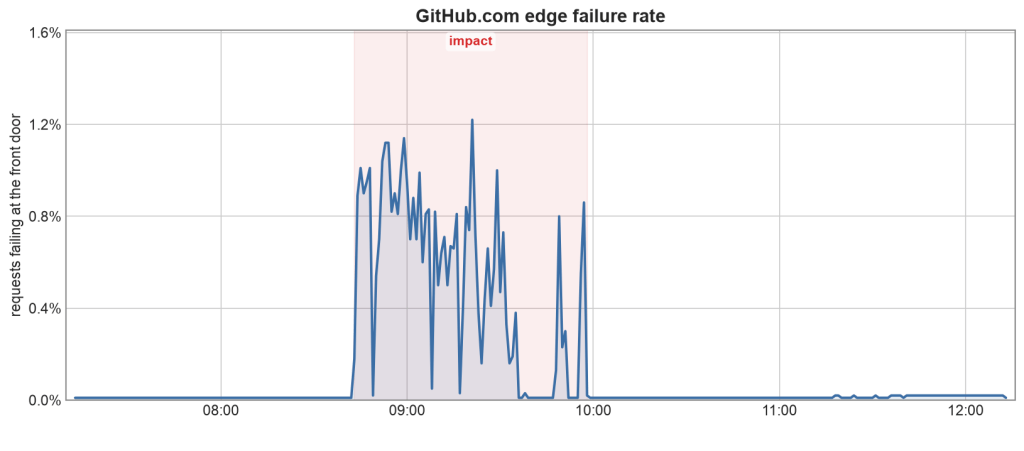
The fragility of complex interconnected systems was vividly demonstrated on September 13. At 09:16 UTC, GitHub experienced an edge failure incident that degraded services across GitHub.com for 1 hour and 28 minutes. During the peak of the incident, failure rates at the front door fluctuated sharply between 0.5% and 1.1%, briefly spiking to 1.2% before engineers successfully mitigated the underlying triggers and restored baseline stability by 10:00 UTC, with residual telemetry normalizing by 12:15 UTC.
An exhaustive post-incident investigation revealed a cascading chain of operational failures centered around database resource exhaustion. The root cause traced back to a routine background data-cleanup job that inadvertently generated excessive load on a shared database cluster. While the cleanup job was equipped with a built-in safeguard specifically engineered to throttle its write operations whenever database replicas began falling behind, the safeguard possessed a critical architectural blind spot: it failed to account for incoming transactional load on the primary database server. Consequently, the cleanup job continued executing unabated until the primary database server exhausted its maximum allowable connection limit. When the primary database ran completely out of available connections, legitimate user and application requests that depended on it failed to complete reliably.
Two compounding factors significantly exacerbated the incident’s impact and severely delayed recovery efforts. First, the application lacked rapid timeout configurations on critical database calls. Instead of failing fast and shedding load, request handlers hung indefinitely, waiting on the stalled database and tying up system threads. Second, an aggressive retry loop embedded within the token-creation service continuously re-transmitted write requests that were already failing. This relentless retry barrage kept the database in a state of continuous saturation, preventing it from shedding load and naturally recovering.
To prevent similar failures from recurring, engineering teams have initiated targeted remediation projects. These include redesigning background job safeguards to monitor primary database health alongside replica lag, implementing strict timeout thresholds across all database-dependent request handlers, and refactoring retry logic to incorporate exponential backoff and circuit-breaker patterns, ensuring that failing operations do not inadvertently paralyze core infrastructure during high-stress scenarios.
Detailed Incident Breakdown: September 28 Copilot Code Review Failure
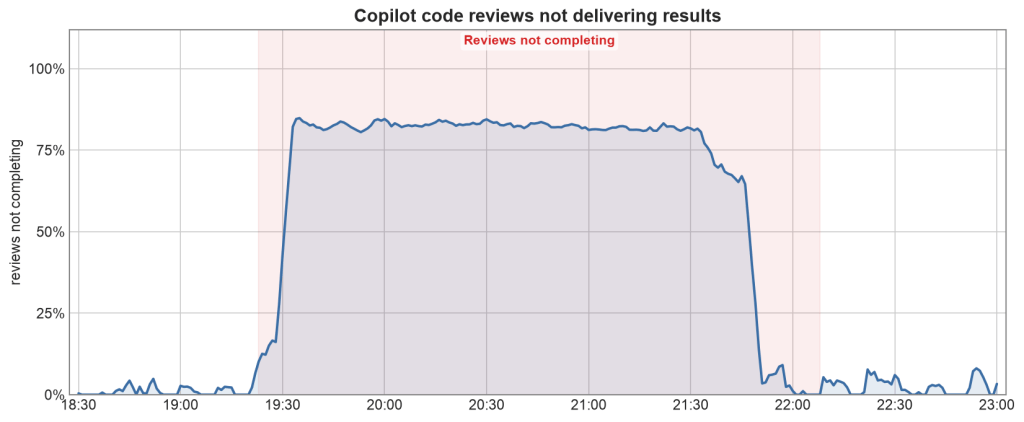
Just weeks later, on September 28 at 21:16 UTC, GitHub experienced a specialized service disruption affecting Copilot code reviews, which lasted for 52 minutes. During the peak of the incident, telemetry graphs indicated that the percentage of uncompleted code reviews surged from near 0% at 19:25 UTC to roughly 85% by 19:35 UTC. This severe degradation persisted for nearly two hours until engineers successfully reverted the problematic deployment at approximately 21:30 UTC, with performance metrics fully recovering by 21:50 UTC.
The incident originated from a functional split within the Copilot code review architecture. The review system relies on a dedicated microservice that generates two distinct versions of review results: a limited copy that intentionally excludes review comments, and a full copy that contains the complete, finalized review. Normal system behavior dictates that Copilot code reviews are posted exclusively using the full copy. However, a recent code deployment introduced a regression that caused the microservice to transmit the full review copy to only a select subset of customers, while dispatching the limited copy to all others.
As a direct consequence of this deployment bug, the Copilot code review system was unable to construct valid reviews for affected users, yet the pipeline erroneously reported that the underlying jobs had completed successfully. Because of a monitoring blind spot regarding output discrepancies, the missing review results went entirely undetected by automated telemetry. The incident was ultimately flagged only after a significant backlog of reviews remained incomplete for more than 30 minutes, breaching threshold limits and triggering automated alerts for first-responders.
Upon identifying the anomaly, responders quickly initiated a rollback of the offending change, restoring normal review generation capabilities. To eliminate the risk of similar blind spots in the future, engineering teams are expanding observability parameters to monitor the structural integrity and delivery rates of output copies, ensuring that asynchronous AI-driven features maintain rigorous feedback loops and immediate alerting when processing pipelines encounter internal logic mismatches.
Implications and Future Outlook
The engineering updates from August and September encapsulate the high-stakes balancing act inherent in operating a foundational pillar of the global software development ecosystem. GitHub’s transparent disclosures regarding missed deadlines, automated failover mishaps, and cascading database bottlenecks reflect a mature engineering culture dedicated to rigorous post-incident analysis and continuous architectural hardening.
As GitHub presses forward into the final quarter of the year, its primary objectives remain clear: completing the Central US Azure migration with enhanced stability, fine-tuning newly established database traffic controls, and expanding the preventative safeguards designed to protect core services against the unpredictable realities of hyperscale workloads. For the millions of developers who rely on the platform daily, these behind-the-scenes infrastructure overhauls—though occasionally punctuated by growing pains—are essential investments in building a more resilient, scalable, and secure home for the world’s software. Developers and organizations can monitor real-time platform status and read detailed post-incident reviews via the official GitHub Status Page, while ongoing technical deep dives continue to be published through the engineering section of the GitHub Blog.
Related posts: