Critical Memory Corruption Vulnerability in Google Brotli Decoder Exposes Global Infrastructure to Remote Code Execution

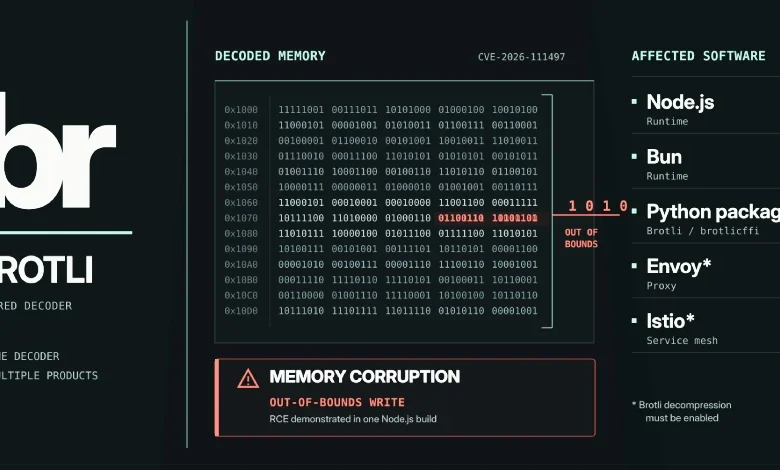
A severe memory-corruption vulnerability, cataloged as CVE-2026-111497, has emerged as a significant threat to modern web infrastructure. The flaw resides within the widely deployed Brotli compression decoder, a C-based library developed by Google. Because this library is integrated into a vast array of runtimes, proxies, and application frameworks, the vulnerability has created a broad attack surface that affects everything from high-traffic server proxies to client-side data processing tools.
The vulnerability stems from a flaw in how the Brotli decoder handles crafted, malicious compressed data. By supplying a specially formatted Brotli stream, an attacker can trigger a buffer overflow, allowing for the overwriting of memory beyond the allocated buffer boundaries. Depending on the architecture and the specific implementation of the software, this condition can lead to application crashes, memory leaks, or, in the most severe scenarios, the execution of arbitrary, attacker-controlled code.
The Scope of the Crisis: A Ubiquitous Dependency
Brotli is a ubiquitous data compression format designed for the web. It is favored for its high compression ratios and its ability to significantly reduce the size of web traffic, thereby accelerating page loads. However, because the core logic for decompressing these streams is implemented in C and distributed as a library, it is frequently embedded into higher-level languages and tools.
The impact of CVE-2026-111497 is amplified by the sheer diversity of affected software. Unlike a vulnerability in a single standalone application, this bug affects the "building blocks" of the internet. Major runtimes such as Node.js and the Bun JavaScript runtime are vulnerable. Infrastructure components like Envoy and Istio—which are cornerstones of cloud-native microservices architectures—are also susceptible. Furthermore, language-specific wrappers, including the Python Brotli and brotlicffi packages, extend the risk to the data science and backend development ecosystems.
Chronology of Discovery and Disclosure
The history of this vulnerability is characterized by a "silent fix" that preceded the realization of its security implications. According to records from OpenAI’s Codex Security team, who are credited with reporting the flaw, the underlying code issue was addressed in the Brotli source repository as early as February 27, 2026. At that time, the change was treated as a routine maintenance update rather than a security patch, as the potential for an exploit was not yet recognized.

It was not until October 21, 2026, that the issue was identified as a critical security vulnerability. This realization triggered a coordinated effort to notify maintainers of the various software packages that rely on the Brotli C library. On that same day, Node.js and Google released patches to address the flaw. Since the bug is localized within the specific copy of the decoder included in each software product, there is no "global" fix; each vendor and project maintainer has been forced to issue their own independent update to replace the vulnerable decoder logic.
Technical Analysis: How the Exploit Works
The mechanics of the vulnerability involve the exploitation of the decompression process. In a typical scenario, a web client sends a request to a server, or vice versa, with the "Accept-Encoding: br" header, indicating support for Brotli compression. If an attacker controls the source of the compressed data, they can craft a malicious Brotli stream that triggers the buffer overflow during the decompression phase.
The "Node2Shell" proof-of-concept, demonstrated by researchers at Imperva, illustrates the severity of the threat. In their testing, they were able to achieve remote code execution (RCE) on an unpatched build of Node.js 24.22.0. By targeting the fetch() API—a common method for retrieving resources—or by manipulating Express request bodies, the researchers showed that the decoder could be forced to execute arbitrary instructions. This is particularly concerning because many server-side applications automatically decompress incoming data without rigorous validation, making them "silent" targets.
The vulnerability is bidirectional. As noted by the OpenAI disclosure, an unpatched server can be compromised by a malicious client, and an unpatched client (such as a command-line tool like curl or a scripted HTTP client) can be compromised by a malicious server. This makes the threat pervasive across the entire lifecycle of a network request.
Official Responses and Industry Impact
The industry response has been varied, reflecting the complexity of the software supply chain. Google, which maintains the core Brotli library, assigned the vulnerability a CVSS 4.0 score of 9.2, classifying it as "Critical." Conversely, other organizations have been more conservative in their assessments. Red Hat, for example, assigned the vulnerability an "Important" rating with a CVSS score of 8.1, likely citing the difficulty of crafting a reliable, weaponized exploit that works across different memory management environments.
Despite the high severity rating, there have been no confirmed reports of in-the-wild exploitation. CISA (the Cybersecurity and Infrastructure Security Agency) maintained a status of "no" regarding active exploitation as of late October 2026. However, security experts warn that the publication of technical details, such as the Imperva Node2Shell research, often serves as a roadmap for threat actors, significantly increasing the probability of future attacks.

Mitigation Strategies and Challenges
The primary challenge in mitigating CVE-2026-111497 is the deep integration of the Brotli library. For organizations, simply patching a server is insufficient if they rely on downstream dependencies or containerized microservices that have not yet been updated.
- Software Updates: The only definitive resolution is to update to the patched versions of the affected software. For Node.js users, this means moving to versions 22.23.4, 24.22.1, or 26.12.1. Bun users must upgrade to version 1.4.4 or later.
- Infrastructure Audits: Organizations using Envoy or Istio should immediately verify if Brotli decompression is enabled. If it is not strictly necessary for business operations, disabling it is a viable temporary mitigation.
- Dependency Management: Python users face a unique challenge. Because packages like
brotliandbrotlicffiare often installed as transitive dependencies—meaning they are brought in by other packages without the user’s explicit knowledge—manual audits are required. Relying solely on automated vulnerability scanners may be insufficient, as these databases were slow to update their records following the October 21 disclosure. - Network Filtering: While Web Application Firewalls (WAFs) can provide some protection, they are not a silver bullet. As noted by Vercel, WAF rules may not cover the "internal" fetches that occur between server-side functions and other backend services. Therefore, defense-in-depth remains the most effective strategy.
Broader Implications for the Supply Chain
CVE-2026-111497 serves as a poignant reminder of the fragility of the open-source software supply chain. The fact that a critical vulnerability could exist in a core library for months—and even be partially addressed in code without the security community realizing the danger—highlights a systemic gap in how upstream dependencies are monitored.
The incident also underscores the danger of "vendor-in-vendor" dependencies. When a major project like Node.js includes a third-party library like Brotli, the burden of security falls on the downstream maintainers. When these maintainers do not have a transparent way to track security fixes from upstream, vulnerabilities can linger.
Moving forward, the industry is likely to see increased pressure for "Software Bill of Materials" (SBOM) transparency. By maintaining a clear inventory of all sub-components, organizations can more quickly identify if they are running a vulnerable version of a library that is buried deep within their application stack. Until such practices become the industry standard, incidents like this one—where a foundational, invisible component compromises an entire ecosystem—are likely to recur.
For now, the priority remains clear: organizations must audit their environments, identify instances where the vulnerable Brotli decoder is in use, and prioritize the deployment of patched versions. As the "proof-of-concept" phase transitions toward potential weaponization, the window for proactive remediation is rapidly closing.