Air Teams: Bring Your Best Agentic Workflows to the Whole Team – and Automate Repeatable Work

JetBrains has officially expanded its agentic development ecosystem with the launch of Air Teams, a comprehensive platform designed to transition AI-assisted programming from an individual productivity tool into a collaborative, enterprise-grade workflow. This release marks a significant milestone in the software development lifecycle, shifting the focus from solitary AI assistance to synchronized team-based automation. By providing shared environments, automated task execution, and centralized project management, JetBrains aims to eliminate the operational silos that have historically hampered the adoption of AI agents in professional engineering organizations.
The Evolution of Agentic Development
The introduction of Air Teams follows the debut of the standalone JetBrains Air application several months prior. During the initial rollout phase, JetBrains observed that while individual developers experienced measurable gains in velocity through AI-driven coding assistance, the broader engineering lifecycle faced new bottlenecks. The primary challenge identified by the company was not the lack of AI capability, but the lack of consistency across teams. Individual developers were creating bespoke prompts and localized agentic workflows that failed to scale, leading to a fragmented environment where institutional knowledge remained trapped on personal machines.
This development follows a broader industry trend where the focus of AI implementation has migrated from "Chat-based AI" (like early versions of Copilot) to "Agentic AI." Unlike passive assistants, agentic systems are designed to perform multi-step tasks, execute code, and make decisions within a defined scope. JetBrains’ strategic shift to a team-centric model acknowledges that for AI to become a core component of the software development lifecycle (SDLC), it must be integrated into the shared infrastructure of the organization rather than existing as an isolated, client-side utility.
Core Architecture and Functionality
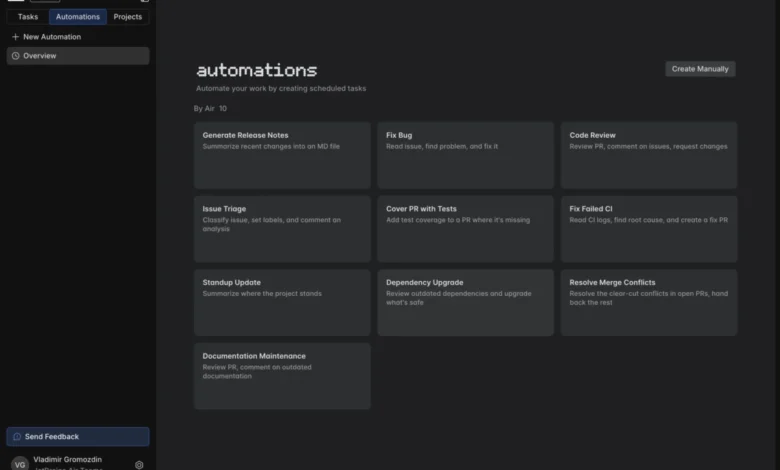
Air Teams is structured around four primary pillars that facilitate a shift from manual intervention to autonomous, team-managed operations: Automations, Shared Cloud Environments, Cloud Tasks, and Project Management.
Automations: Reducing Manual Orchestration
The most critical feature of the new platform is the implementation of "Automations." These are agentic workflows designed to handle high-frequency, low-variance tasks without constant human oversight. By shifting these processes to the cloud and triggering them via events—such as GitHub pull requests, Jira status changes, or periodic schedules—teams can ensure that maintenance tasks are performed consistently.
For instance, code reviews are no longer delayed by human availability; an agent can analyze incoming commits, provide inline feedback, and track the progress of revisions. Similarly, dependency management can be automated to ensure that projects remain secure and up-to-date, with the system capable of reverting changes if tests fail or build errors occur. This reduces the "babysitting" burden on senior engineers, allowing them to focus on architectural challenges rather than routine maintenance.
Shared Cloud Environments
A persistent challenge in team-based AI development is environment parity. If an AI agent operates on a developer’s local machine, it is limited by the specific configuration, toolchain versions, and credentials of that individual. Air Teams addresses this by moving the execution environment to the cloud. Teams can define a centralized, version-controlled environment setup—documented via a startup.sh script—that ensures every agent operates under the exact same conditions. By utilizing snapshot technology, JetBrains allows for the reuse of these environments, drastically reducing the time spent on "environment discovery" and troubleshooting configuration drift.

Cloud Tasks and Persistent Execution
Cloud Tasks represent the decoupling of development work from physical hardware. By offloading resource-heavy tasks—such as long-running builds, integration testing, or complex code refactoring—to the cloud, developers are no longer tethered to their workstations. This architecture enables an asynchronous workflow where a task initiated in an IDE can be monitored via a web browser or, eventually, a mobile device. This shift ensures that agentic work continues even when the developer is offline, effectively increasing the "compute hours" of a team without increasing individual working hours.
Strategic Implications for Engineering Management
The rollout of Air Teams signals a maturation of the AI-augmented software industry. According to internal data provided by JetBrains during the product launch, teams utilizing shared agentic workflows saw a significant reduction in the "wait time" associated with code reviews and dependency updates.
From a management perspective, the platform introduces a layer of governance that has been largely absent in the era of early-adopter AI tools. Project admins are now granted the authority to oversee the deployment of agents, manage AI credits, and assign roles, ensuring that AI-driven actions remain aligned with organizational security and quality standards. By utilizing service accounts rather than personal developer credentials, the platform ensures that critical automation workflows are not interrupted by personnel changes or the rotation of staff.
Chronology of the Air Ecosystem
- Initial Launch Phase (Mid-2025): JetBrains introduces the Air app as an individual-focused tool for agentic development, allowing early adopters to test the integration of AI agents within local IDE workflows.
- Feedback Integration (Q3–Q4 2025): The company identifies that the bottleneck for productivity is not individual coding speed, but the lack of shared context and the inability to hand off agentic tasks between team members.
- Platform Expansion (Early 2026): Development begins on the "Team Layer," focusing on cloud-based execution and centralized environment configuration.
- Air Teams Launch (Q3 2026): The official release of Air Teams for business customers, introducing the full suite of automations, cloud-based environments, and project management tools.
Analysis: Bridging the Gap Between AI and DevOps
The introduction of Air Teams can be viewed as an attempt to merge the worlds of Agentic AI and DevOps. By treating "Agentic Workflows" as code—versioned, reproducible, and triggered by events—JetBrains is essentially applying the principles of Continuous Integration/Continuous Deployment (CI/CD) to the AI agents themselves.
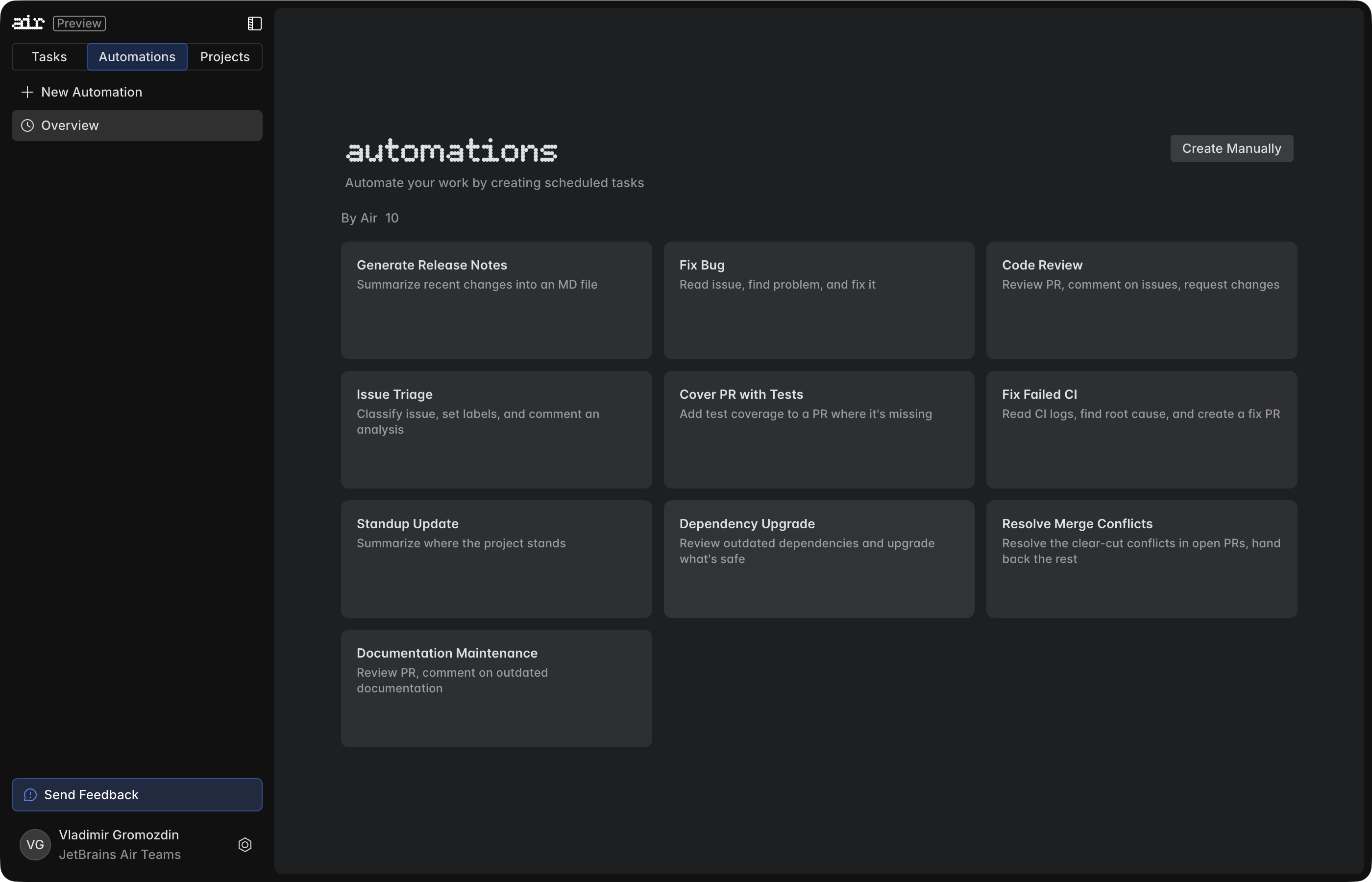
The platform’s reliance on "connectors" to tools like Jira, Linear, and Figma further suggests an intent to make AI agents active participants in project management, not just coding assistants. By bridging the gap between the task tracker (Jira) and the repository (GitHub), Air Teams creates a loop where an issue ticket can automatically trigger an investigation, a code fix, and a pull request, with minimal human intervention.
However, the efficacy of such a system will ultimately depend on the "quality of instructions." As organizations transition to this model, the role of the senior engineer will evolve into that of an "Automation Architect," tasked with refining the logic, guardrails, and triggers that define how these agents interact with the codebase. The risk of "AI noise"—unnecessary pull requests or redundant comments—remains a concern, and JetBrains has mitigated this by emphasizing human-in-the-loop controls where every agent-generated change must still be reviewed and merged by a human developer.
Future Outlook
JetBrains has confirmed that while Air Teams is currently exclusive to business customers, plans are in place to broaden access to individual users in the future. As the platform matures, the industry can expect further integration with existing JetBrains IDE suites and potentially expanded support for third-party cloud providers.
The move toward agentic team environments reflects a broader industry consensus: the future of software development lies not in the speed of the individual coder, but in the efficiency of the human-AI hybrid team. By standardizing the way agents work, communicate, and interact with the build environment, JetBrains is setting a new baseline for how software will be constructed in the coming decade. Organizations that successfully implement these automated workflows will likely see a shift in their engineering culture, moving away from repetitive, manual tasks and toward a model of high-level supervision and system architecture.
Related posts: