AWS Elastic Beanstalk Enters a New Era With Fully Managed Cluster Mode Powered by Amazon EKS

Fifteen years after its initial debut in 2011, Amazon Web Services (AWS) has announced a major evolution for its foundational application management platform. AWS Elastic Beanstalk, a service trusted by generations of developers to deploy full-stack applications without wrestling directly with low-level server architecture, is entering its next chapter. The cloud computing giant has officially launched a fully managed "Cluster Mode," a transformative architecture that bridges the operational simplicity of Beanstalk with the raw power, flexibility, and scalability of Amazon Elastic Kubernetes Service (Amazon EKS).
This release marks a monumental shift for a service that originally cut its teeth managing single-instance and auto-scaling Amazon Elastic Compute Cloud (EC2) environments for applications written in Java, .NET, Python, Node.js, PHP, Ruby, and Go. Over the past decade and a half, enterprise reliance on microservices and containerized workloads has exploded. Recognizing this paradigm shift, AWS has systematically re-engineered Elastic Beanstalk’s operational engine. The platform now takes comprehensive, lifelong operational responsibility for production environments, handling continuous deployment, horizontal and vertical scaling, live patching, deep monitoring, and infrastructure maintenance.
A Decade and a Half of Evolution: The Road to Cluster Mode
To fully understand the weight of this announcement, one must look back at the trajectory of AWS Elastic Beanstalk. When AWS introduced the service in 2011, cloud adoption was heavily anchored around monolithic or single-tier virtual machine deployments. Developers wanted a Platform-as-a-Service (PaaS) experience that abstracted away the complexities of provisioning load balancers, configuring security groups, and managing operating system updates. Elastic Beanstalk delivered precisely that, allowing engineering teams to upload source code or deployment bundles and leave the infrastructure plumbing to AWS.
However, the software development landscape changed dramatically with the rise of Docker, container orchestration, and microservices architectures. While Kubernetes quickly became the industry standard for managing containerized applications at scale, it also introduced a notoriously steep learning curve. Configuring clusters, managing control planes, writing complex YAML manifests, setting up ingress controllers, and maintaining role-based access control (RBAC) often diverted engineering teams away from building core business logic.
Recognizing this friction, AWS spent the years leading up to this release systematically modernizing Elastic Beanstalk’s core foundation. Key milestones in this modernization effort included the rollout of AI-powered environment analysis to diagnose runtime health issues and recommend automated fixes, as well as the introduction of official GitHub Action integrations allowing teams to deploy straight from CI/CD pipelines using concise YAML configurations. Furthermore, AWS rebuilt the underlying infrastructure to natively support OpenTelemetry-based observability, traffic-splitting deployments with automated rollbacks, advanced event-driven autoscaling, native secrets management via AWS Secrets Manager, and HTTPS by default through AWS Certificate Manager.
The introduction of Cluster Mode is the culmination of these multi-year engineering efforts, merging the streamlined Beanstalk developer workflow with the robust multi-tenant orchestration capabilities of Amazon EKS.
Architecture and Mechanics of Elastic Beanstalk Cluster Mode
The newly released Cluster Mode is specifically engineered for modern development teams and enterprises managing a diverse portfolio of applications and microservices. Under previous iterations of Beanstalk, each application or environment typically operated in relative isolation, often provisioning dedicated underlying infrastructure. While secure and straightforward, this model could become resource-intensive and cumbersome to manage as an organization’s portfolio expanded into dozens or hundreds of distinct services.

With Cluster Mode, multiple applications and microservices can seamlessly share a single, underlying infrastructure powered by Amazon EKS, all while being governed by a unified operational baseline. Because workloads share resources efficiently, the per-application cost profile naturally decreases as the portfolio scales, eliminating the administrative overhead typically associated with managing a sprawling fleet of individual clusters. Whether an enterprise operates ten distinct services or a hundred, administrators oversee them through a unified console experience, ensuring consistent operational guarantees, security policies, and compliance standards across every stack.
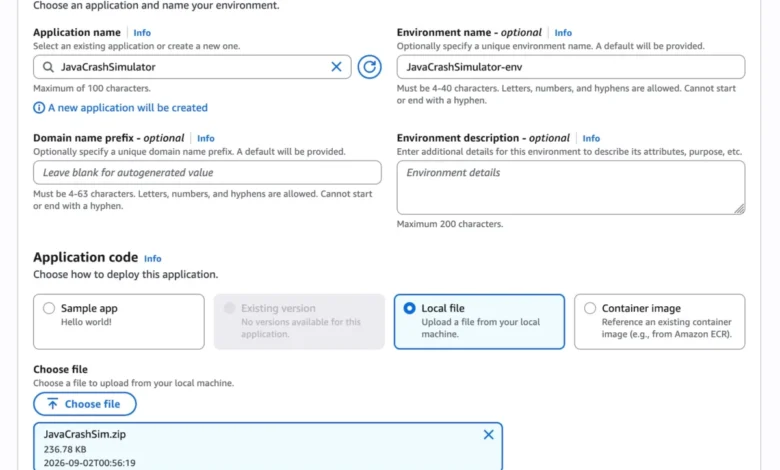
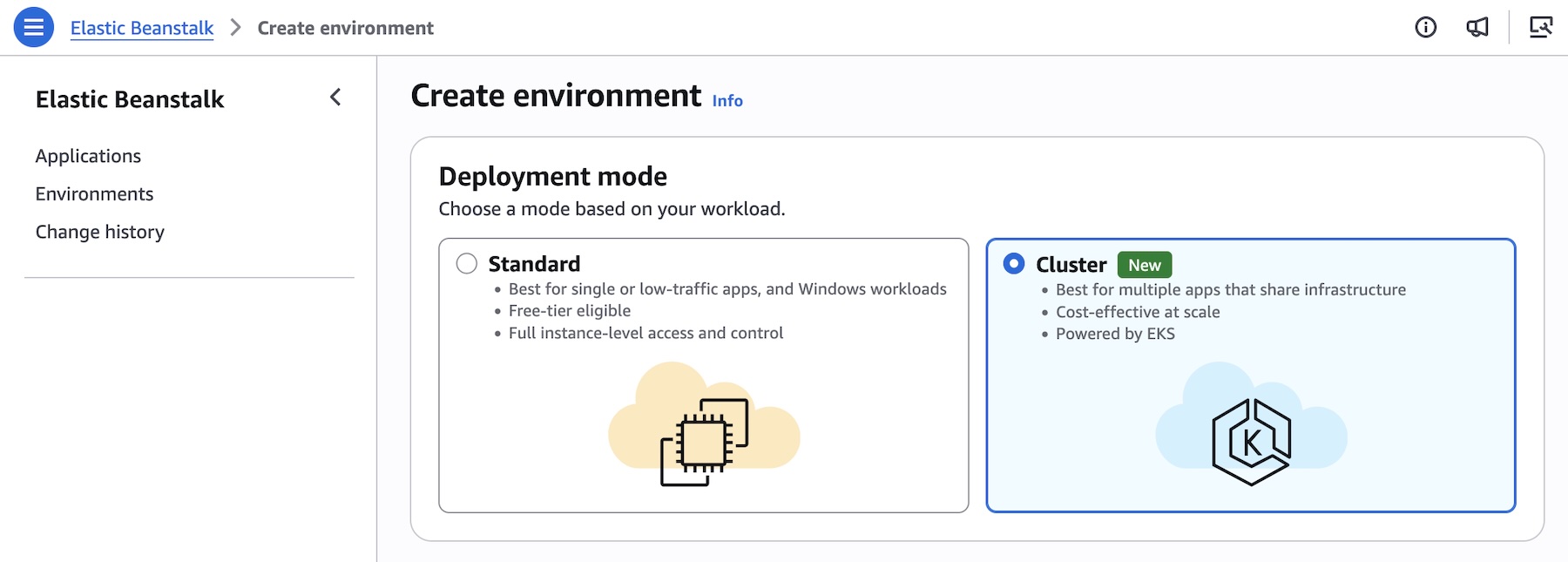
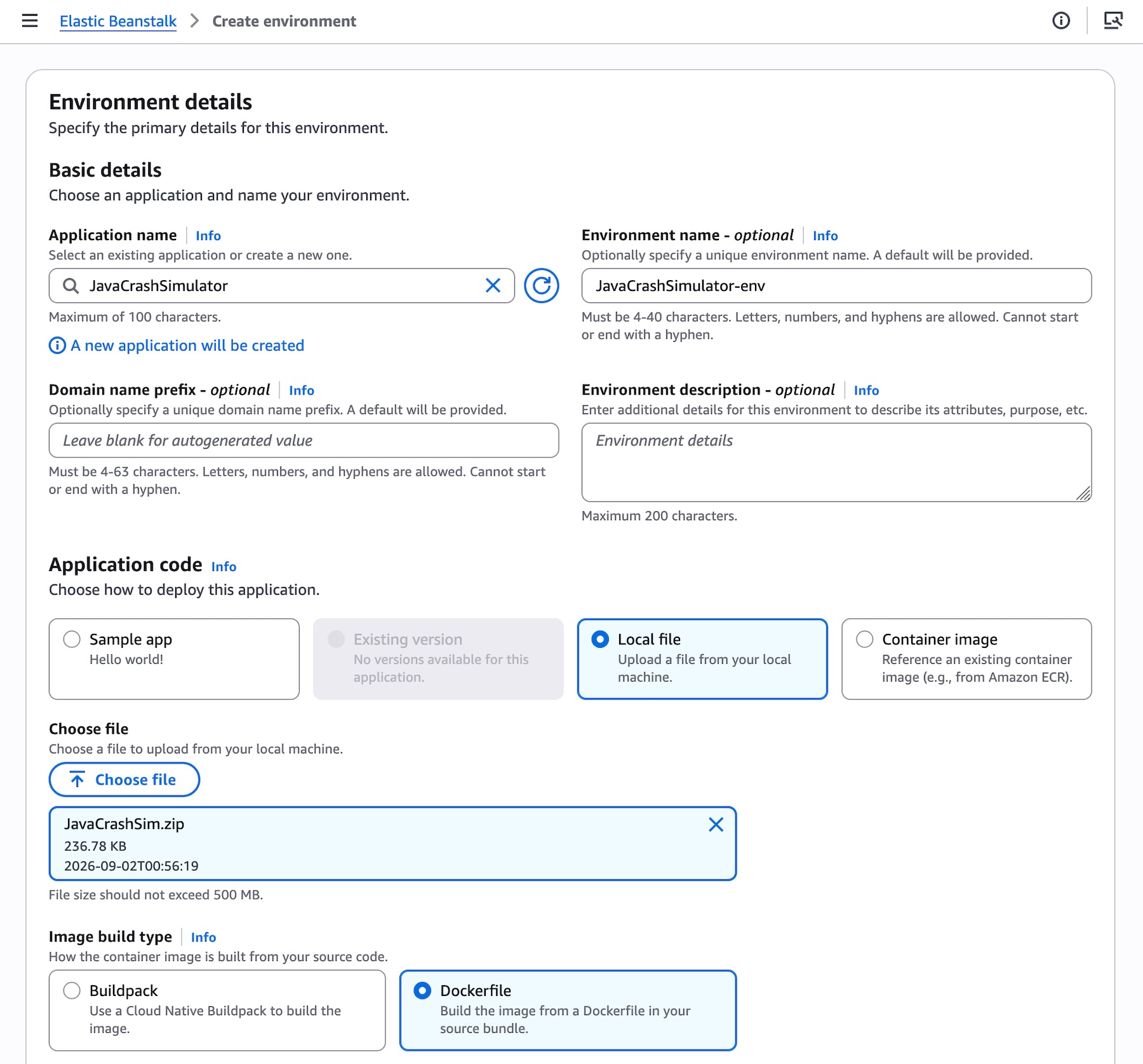
Getting started with Cluster Mode requires minimal friction. Through the AWS Management Console, developers navigate to Elastic Beanstalk, initiate a new environment creation workflow, and select "Cluster" under the deployment type configuration. The service accepts raw source code, Dockerfiles, or pre-built container images. For teams supplying source code directly via local file uploads, Beanstalk handles container image build options automatically.
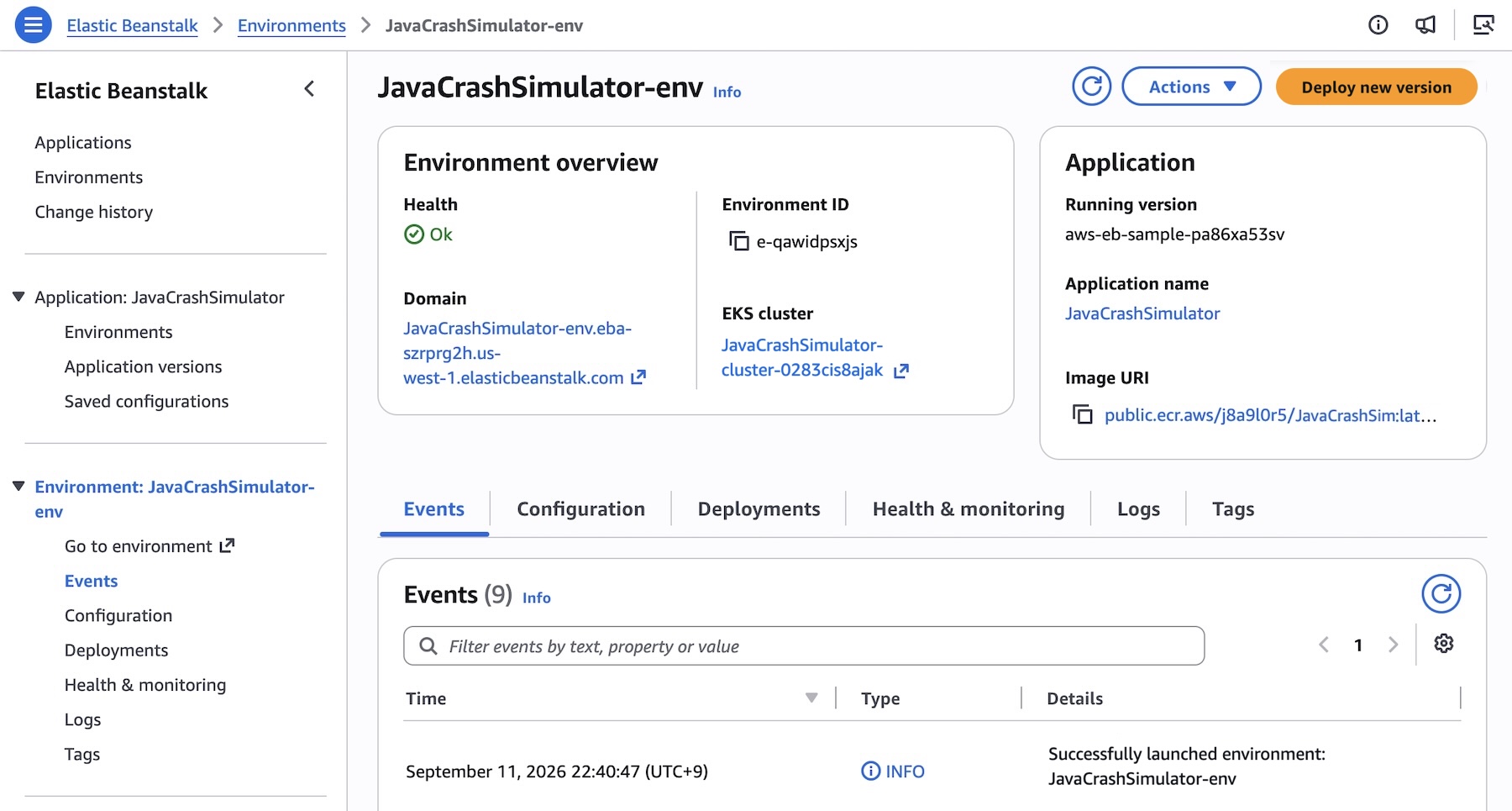
When deploying a new set of subnets for a Cluster Mode environment, the initial provisioning triggers the creation of the underlying EKS cluster—a process that typically completes in roughly ten minutes. Subsequent application deployments occur significantly faster because they safely leverage and reuse the existing EKS infrastructure. Beyond the graphical console, infrastructure-as-code practitioners and platform engineers can utilize the AWS Command Line Interface (AWS CLI), the specialized EB CLI, or standard AWS SDKs to automate deployments programmatically.
For example, development teams managing complex multi-service architectures can register pre-built container images stored in Amazon Elastic Container Registry (Amazon ECR) as distinct application versions using the CLI. By defining specific JSON configuration namespaces—such as setting up public internet interfaces via Application Load Balancers for frontend services while keeping internal microservices safely isolated—teams can orchestrate sophisticated deployments with precision. Options such as minimum and maximum replica counts, CPU allocations, memory limits, service ports, and custom health check paths are easily declared and applied via create-environment API calls.
Coexistence and Migration: Standard Mode Meets EKS
A critical consideration for enterprises evaluating the new Cluster Mode is how it impacts existing investments in legacy architectures. AWS has confirmed that Elastic Beanstalk Standard Mode, powered by traditional Amazon EC2 instances, remains fully supported, active, and robust.
Crucially, Standard Mode and Cluster Mode environments are designed to run side-by-side within the exact same Elastic Beanstalk application construct. This architectural decision affords engineering teams the flexibility to migrate legacy applications to Kubernetes-backed clusters incrementally, one environment at a time, at their own preferred pace. Built-in validation checks automatically verify compatibility before any alterations are executed, ensuring that no team is subjected to forced migrations or unexpected breaking changes.
While Cluster Mode shines for containerized microservice portfolios seeking shared resource efficiency and advanced orchestration, AWS notes that Standard Mode remains an optimal fit for specific monolithic workloads, specialized legacy dependencies, or environments tightly coupled to traditional operating system abstractions.
Industry Implications and Strategic Analysis
From an industry perspective, the launch of Elastic Beanstalk Cluster Mode represents a strategic bridge across the great divide between traditional PaaS simplicity and native container orchestration. For years, organizations faced a binary choice: embrace lightweight platform abstractions that eventually hit scaling or architectural walls, or dive headfirst into raw Kubernetes management, absorbing high operational costs and cognitive overhead.
By abstracting Amazon EKS behind the familiar, highly automated interface of Elastic Beanstalk, AWS is effectively democratizing Kubernetes for mainstream developers. Organizations that previously lacked the specialized platform engineering talent required to maintain production-grade EKS clusters can now harness Kubernetes-native benefits—such as rapid scaling, efficient resource density, and advanced traffic management—without hiring dedicated container operations specialists.
Furthermore, the integration of modern observability tools like OpenTelemetry, combined with AI-powered diagnostic analysis, addresses historical pain points regarding debugging distributed systems. When microservices fail or encounter performance bottlenecks in production, automated analysis reduces mean-time-to-resolution (MTTR), strengthening enterprise trust in managed infrastructure.
Pricing, Regional Availability, and Getting Started
AWS has structured the pricing model for Elastic Beanstalk Cluster Mode to remain transparent and consumption-based. There is no additional software licensing or markup fee levied directly by Elastic Beanstalk for using Cluster Mode. Instead, customers pay strictly for the underlying AWS resources consumed by their applications. This includes the standard Amazon EKS control plane fee, EKS Auto Mode compute resources, Amazon ECR storage and data transfer, and Amazon CloudWatch monitoring metrics. AWS explicitly notes that Cluster Mode environments are not eligible for the AWS Free Tier.
The service is generally available immediately across all commercial AWS Regions where Elastic Beanstalk is currently supported. Developers and platform architects seeking detailed regional roadmaps, API references, or troubleshooting guidance can also leverage modern AI developer tooling, utilizing the newly introduced AWS MCP Server and associated plugins to query documentation and manage deployments interactively.
With Cluster Mode, AWS has revitalized a cornerstone cloud service, ensuring that Elastic Beanstalk remains a vital, future-proof tool for modern software engineering teams navigating the complexities of containerized scale.