The intersection of artificial intelligence and physical design has taken a significant leap forward with the introduction of Axio Coder, an open-source desktop application developed by a working architect seeking to eliminate the repetitive friction points of modern engineering and drafting workflows. Unlike traditional coding assistants that operate exclusively within text files and source code repositories, Axio Coder introduces a novel paradigm of computer interaction. It leverages native operating system APIs to manipulate software interfaces directly, closing the loop between digital generation and visual verification. This development arrives at a critical juncture for the architecture, engineering, and construction (AEC) sectors, which have long sought reliable automation tools that can transcend the limitations of chat-based interfaces and integrate seamlessly into established Building Information Modeling (BIM) pipelines.
The Architectural Bottleneck and the Evolution of Coding Agents
In recent years, the rapid advancement of large language models has transformed software engineering. Coding agents can now generate entire repositories, refactor legacy codebases, and deploy complex backend infrastructures from simple text prompts. However, these tools remain fundamentally blind to the physical world of native desktop applications. For professionals outside of computer science—such as architects, civil engineers, and industrial designers—the daily reality involves working inside specialized computer-aided design (CAD) environments like AutoCAD, Rhino, ArchiCAD, and Revit. These legacy software suites frequently lack robust programmatic endpoints or accessible application programming interfaces (APIs) for real-time automation.

Consequently, design professionals have faced a persistent technological gap. While text-based agents excel at manipulating code and structured data files, they falter when confronted with graphical user interfaces that demand spatial awareness, visual feedback, and precise manual inputs. Recognizing this limitation, the creator of Axio Coder set out to build a tool that does not merely write scripts, but actively operates the computer alongside the human user. Released under the GNU Affero General Public License (AGPL-3.0), the project represents a grass-roots effort by a domain expert to solve specific, daily labor inefficiencies involving repetitive drafting, spreadsheet management, and multi-format model exports.
Navigating the Operating System: Beyond Pixel Guessing
The primary technical hurdle in developing software agents capable of using native desktop applications lies in how the agent interacts with the graphical interface. Historically, attempts to grant AI systems control over a desktop environment have relied heavily on visual approximations. These systems typically capture a screenshot of the user’s monitor, feed the image to a vision-language model, and attempt to deduce pixel coordinates to execute mouse clicks and keyboard strokes. This approach is notoriously brittle; minor variations in display resolution, theme color, font scaling, or window positioning can cause the agent to misclick entirely, rendering it unreliable for precision work.
Axio Coder bypasses the limitations of coordinate guessing by utilizing Windows UI Automation trees. In modern operating systems, every native control—ranging from buttons and sliders to text boxes and menu items—announces its metadata to the operating system, detailing its specific name, type, and current value. This underlying accessibility architecture is the same technology that empowers screen readers for visually impaired users. By tapping directly into this hierarchy, Axio Coder does not need to guess where a specific interface element is located. Instead, the agent queries the application directly, asking precise programmatic questions such as the exact location of a color-fill tool.

This methodology was successfully demonstrated during early testing phases where the agent operated Microsoft Paint. By communicating directly with the application controls, the agent systematically selected drawing implements, dragged cursors across designated coordinates, and executed complex multi-step routines. Crucially, this process incorporated a closed-loop verification mechanism: after executing a single stroke, the agent paused to visually re-examine the canvas before determining the subsequent action.
The Closed-Loop Paradigm: Generate, Look, Correct, Repeat
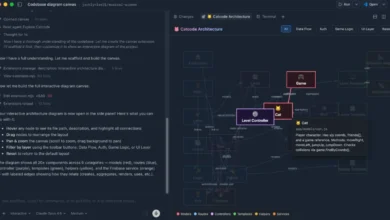
A fundamental differentiator between text-oriented AI assistants and spatial design agents is the necessity of visual feedback. While a software engineer can review lines of generated code syntactically, an architectural designer evaluates geometry through visual representation. Axio Coder integrates comprehensive visual perception capabilities into its operational core, allowing the system to inspect computer screens, rendered PDF documents, standalone reference images, and three-dimensional models projected from any arbitrary camera angle.
This sensory capability establishes a continuous operational loop that mirrors human professional workflows: generation, visual inspection, correction, and repetition. When tasked with creating a geometrical asset, the agent constructs the underlying structure, generates a visual rendering, analyzes the output against a provided reference design, and identifies discrepancies. If an error or deviation is detected, the agent autonomously formulates a correction, applies the modification, and re-evaluates the updated geometry. This iterative self-correction minimizes human oversight requirements during the tedious initial phases of spatial drafting.

Furthermore, the system’s utility extends beyond mere screen manipulation; it generates fully realized parametric models and exports them into industry-standard formats utilized globally by engineering firms. Rather than terminating its operation within a closed chat interface, Axio Coder outputs native engineering files including Industry Foundation Classes (IFC), Drawing Exchange Format (DXF), and Standard for the Exchange of Product Model Data (STEP) files. These outputs can be immediately ingested into enterprise BIM platforms such as ArchiCAD, allowing the automated geometry to become an active, editable component of a larger construction document set.
Technical Architecture and Current Limitations
Built as a single-user desktop application combining an Electron-based frontend with a robust Python backend, Axio Coder is intentionally tailored for individual professional deployment. The development team has maintained transparency regarding the current technical boundaries of the software. Because the agent relies on operating system automation hooks and active visual rendering checks, heavy and complex CAD geometry can occasionally exceed processing thresholds, resulting in temporary execution failures that require the agent to recognize the error and abort or backtrack the operation.
Additionally, developers emphasize that the tool is not designed to replace human judgment or specialized CAD software suites. Instead, it is engineered to absorb the repetitive eighty percent of foundational drafting and data entry tasks, freeing architects and engineers to concentrate on the final twenty percent of the workflow that demands creative oversight, regulatory compliance verification, and structural engineering judgment.

Broader Industry Implications and Future Outlook
The introduction of open-source, visually verified desktop agents signals a broader shift in how vertical software applications may be utilized in the coming decade. As AEC professionals face mounting pressures to increase project velocity while reducing overhead, tools that bridge the gap between natural language prompts and legacy engineering software are poised to gain significant traction.
Future development milestones for the Axio Coder project focus on expanding the agent’s autonomy, specifically enabling it to sequence operations across multiple distinct desktop applications without human intervention. This roadmap includes initializing a program, executing a series of drafting tasks, exporting data, visually verifying the result across software boundaries, and transitioning the asset to the next stage of the pipeline. By moving toward end-to-end parametric modeling derived from single reference images, the project aims to further diminish the friction of early-stage architectural conceptualization.
As the project continues to evolve within the open-source community under its AGPL-3.0 license, its long-term success will depend heavily on real-world stress testing by architects, structural engineers, and technical draftsmen. Industry professionals interested in evaluating the software, reviewing session histories with automated diff tracking, or contributing to its development can access the public repository via GitHub at github.com/Axidesk/Axio-Coder.