GitHub Introduces Project HydraFusion to Revolutionize AI Coding Agents Through Adaptive Multi-Model Orchestration

The evolution of artificial intelligence in software development has reached a new milestone with the introduction of automated runtime orchestration designed to optimize both performance and cost. GitHub has officially announced a research preview for Project HydraFusion, an advanced adaptive multi-model orchestration system built to deliver frontier-level intelligence directly inside developer workflows. Building upon the foundational success of its Auto model selection feature launched earlier in the year, HydraFusion moves beyond merely selecting a single static model for a given coding task. Instead, the newly unveiled architecture dynamically constructs execution plans that combine models from multiple providers, enabling systems to draft, critique, revise, and cascade across various tiers of intelligence behind the scenes.
As modern software engineering increasingly relies on autonomous AI agents capable of handling complex repository-wide tasks, developers frequently face a difficult trilemma: balancing output quality, operational latency, and token consumption costs. Historically, achieving top-tier coding performance required deploying the largest and most computationally expensive models for every query, regardless of complexity. Alternatively, relying exclusively on smaller, efficient models often led to a drop in accuracy when navigating multi-file dependencies, debugging tricky errors, or synthesizing comprehensive codebases. HydraFusion addresses this architectural bottleneck by treating workflow selection as an optimization problem, ensuring that routine prompts are handled swiftly while intricate programming challenges receive the full force of advanced reasoning capabilities only when strictly necessary.
The Mechanics of Adaptive Multi-Model Orchestration
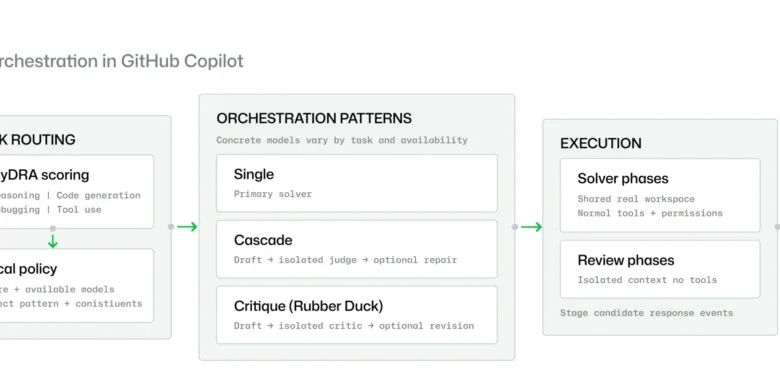
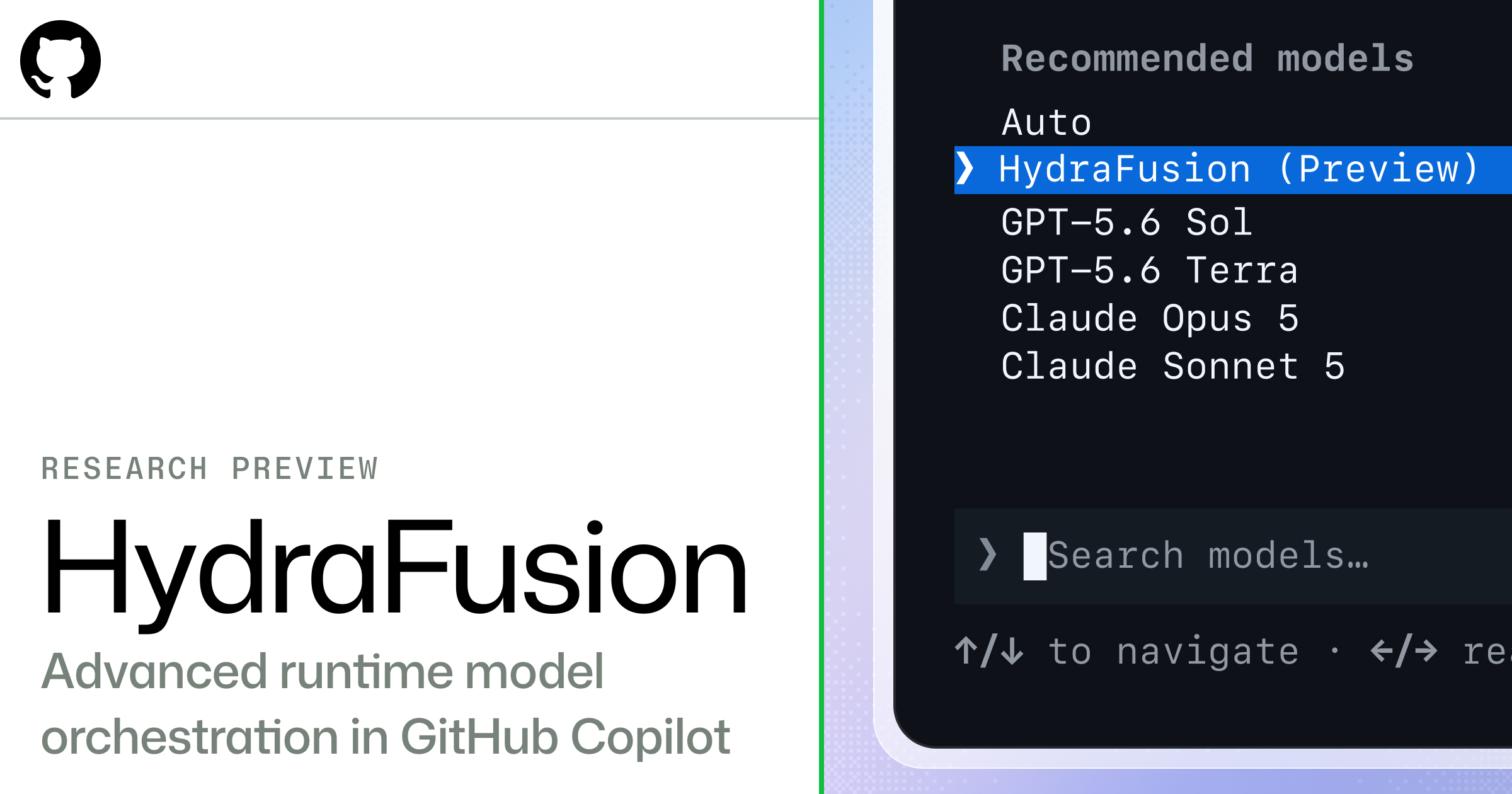
At its core, HydraFusion functions as an intelligent semantic router that operates seamlessly within the GitHub Copilot ecosystem. Developers interact with the system by selecting HydraFusion as they would any standard model, sparing them from the cognitive load of manually coordinating model handoffs. Beneath the user interface, however, the system evaluates incoming task signals—such as reasoning complexity, code generation requirements, debugging depth, and tool utilization—to deploy the most efficient execution pattern available.
For each user request, the runtime currently orchestrates one of three distinct execution patterns, each tailored to a specific quality-to-cost trade-off. The first configuration, known as the Single pattern, preserves maximum speed and operational efficiency when a solitary model possesses sufficient capability to solve the task directly. The second pattern, Cascade, assigns an efficient, lower-cost model to take the first attempt at a solution while maintaining an automated fallback path to more powerful inference engines if the initial output fails predefined acceptance gates. The third pattern, Critique, introduces an independent perspective into the workflow for programming tasks where critical review, peer analysis, and validation provide greater value than simply generating another unaided attempt from the same model.
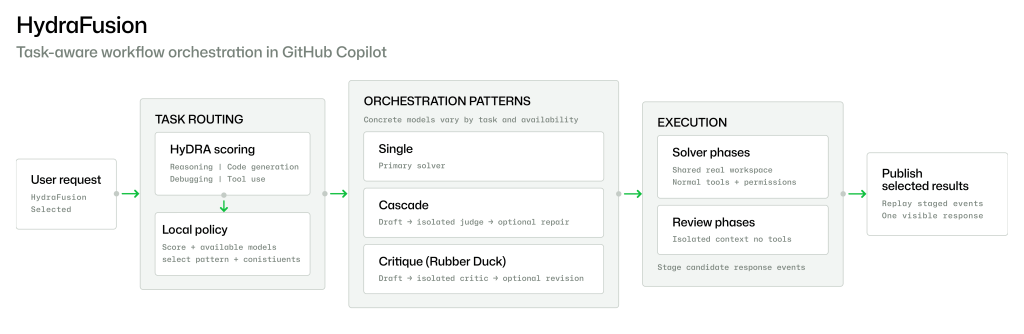
By dynamically routing tasks across local, cloud, and compound models, HydraFusion bridges the gap between raw computational expenditure and verified software quality. Internal system logging captures the specific role, execution outcome, cost, latency, and diagnostic telemetry of every invoked leg, allowing engineering teams to audit and understand complex multi-model interactions post-execution. Meanwhile, the end-user receives a singular, coherent response accompanied by a permission-aware change set ready for integration into their local repository state.
Rigorous Benchmarking and Comparative Performance
To validate the efficacy of Project HydraFusion prior to its public research preview, GitHub subjected its fixed routing policies to rigorous offline evaluations across three prominent agentic coding benchmarks: TerminalBench 2.1, DeepSWE, and CheckpointBench, an internal testing suite curated from actual GitHub Copilot usage sessions. In these controlled tests, HydraFusion was benchmarked directly against industry-standard models such as Claude Opus 5 and GPT-5.6 Sol under identical conditions, maintaining uniform task inputs, tool allocations, execution limits, pricing assumptions, and grading frameworks.

The evaluation metrics focused primarily on verified task quality—the percentage of tasks confirmed as correctly answered—and the complete estimated workflow cost, which accounted for every invoked leg including drafting, critique, revision, escalation, retry, and fallback. The results demonstrated that multi-model orchestration can achieve performance parity or superiority over monolithic frontier models while drastically reducing operational overhead.
On TerminalBench 2.1, which evaluates coding agents on complex, multi-step operations within terminal environments, HydraFusion improved verified task quality by 4.9 percentage points while achieving a remarkable 67 percent reduction in estimated workflow cost compared to Claude Opus 5. On DeepSWE, a demanding benchmark focused on repository-level software engineering tasks that require navigating large codebases and resolving cross-file dependencies, HydraFusion came within 1.5 percentage points of Opus 5 while cutting costs by 36 percent. Finally, on CheckpointBench—a multi-turn benchmark derived from replayable, immutable commits of real GitHub Copilot sessions—HydraFusion achieved near-identical quality to Opus 5 (falling short by a negligible 0.1 percentage points) while realizing a 65 percent decrease in total cost.
These quantitative findings underscore the viability of compound AI systems. Early internal feedback from engineering teams at Microsoft has mirrored these benchmark results, with principal software engineers noting that HydraFusion’s reasoning and task-solving capabilities frequently match or exceed those of standalone frontier models while operating at a fraction of the expense.

Chronology and Iterative Development of the Architecture
The development of HydraFusion followed an iterative, empirical methodology heavily informed by real-world developer behaviors. The engineering team shaped the system’s routing policies by analyzing how developers utilize GitHub Copilot during actual software engineering workflows. To ensure these patterns were fully reproducible, researchers curated CheckpointBench from authentic Copilot coding trajectories, establishing a standardized baseline that balanced language diversity, task type, and difficulty level.
Rather than relying on manual threshold tuning, the team employed beam search optimization across CheckpointBench, DeepSWE, and TerminalBench 2.1 to construct the optimal decision policy. This iterative refinement process spanned several weeks, utilizing automated performance tracking against frozen baselines to monitor improvements in quality, cost containment, and failure mode mitigation.

The progression of policy optimization was rigorously documented, though not entirely linear. For instance, between August 11 and August 25, technical challenges involving operational failures within the evaluation harness temporarily generated invalid runs. These anomalies were systematically identified, isolated, and excluded from the performance trend analysis. Once the evaluation infrastructure was corrected, subsequent HydraFusion configurations resumed their upward trajectory, ultimately reaching peak operating points by late August. This systematic hill-climbing approach ensured that the resulting orchestration framework was robust, stable, and capable of handling diverse programming paradigms.
Industry Implications and the Future of AI Coding Assistants
The launch of Project HydraFusion signifies a broader industry shift away from reliance on single, monolithic large language models toward modular, agentic runtime orchestration. As the frontier of artificial intelligence advances, the sheer number of specialized models available to developers continues to expand rapidly. Managing this proliferation manually introduces friction, forcing engineers to constantly evaluate which model is best suited for writing boilerplate code, debugging race conditions, or architecting system modules.

By automating semantic routing between local, cloud, and compound models, GitHub’s orchestration framework points toward a future where AI infrastructure operates invisibly as an adaptive utility. For enterprise organizations, the economic implications are profound. Software development budgets heavily factor in the API token costs associated with deploying massive frontier models across large engineering departments. By intelligently routing simpler queries to efficient models and reserving expensive reasoning engines exclusively for complex tasks, architectures like HydraFusion can democratize advanced AI assistance while preserving organizational profit margins.
Furthermore, the introduction of systematic critique and cascade patterns highlights a maturing approach to automated software verification. Rather than trusting a single generation pass, multi-model orchestration incorporates internal peer review mechanisms that catch logical errors, security vulnerabilities, and syntax discrepancies before the code ever reaches a human reviewer.
Scope of the Research Preview and Next Steps

As Project HydraFusion enters its public research preview phase, GitHub is actively encouraging developers to test the technology within their daily workflows. The initial release is optimized primarily for first-turn, single-prompt coding tasks executed in autopilot mode within supported environments such as the GitHub Copilot CLI and Visual Studio Code. Feedback gathered from this preview period will be instrumental in guiding the next phase of development, which will focus heavily on enhancing multi-turn performance during longer, highly iterative development sessions.
Developers interested in participating can evaluate the preview by submitting substantial, well-scoped programming tasks and providing feedback through the /feedback command in the Copilot CLI or via official GitHub Community discussion channels. Because HydraFusion remains an active research initiative, product behavior, model pools, pricing assumptions, and workflow configurations may evolve as the engineering team analyzes real-world telemetry.
The collaborative effort behind HydraFusion spans multiple research and engineering groups across GitHub and Microsoft. Key contributors include Principal Applied Scientist Aashna Garg, Partner Applied Science Manager Shengyu Fu, Partner Architect Carlos Castro, Research Scientist Siddharth Singha Roy, and Principal Software Engineer Andy Salerno. Their work underscores a shared conviction that the next major leap in artificial intelligence developer tools will not originate merely from building larger individual models, but from intelligently orchestrating a diverse ecosystem of specialized intelligence to solve complex human problems.