React Native Expansion Continues as Official Support for Meta Quest Devices is Announced at React Conf 2025

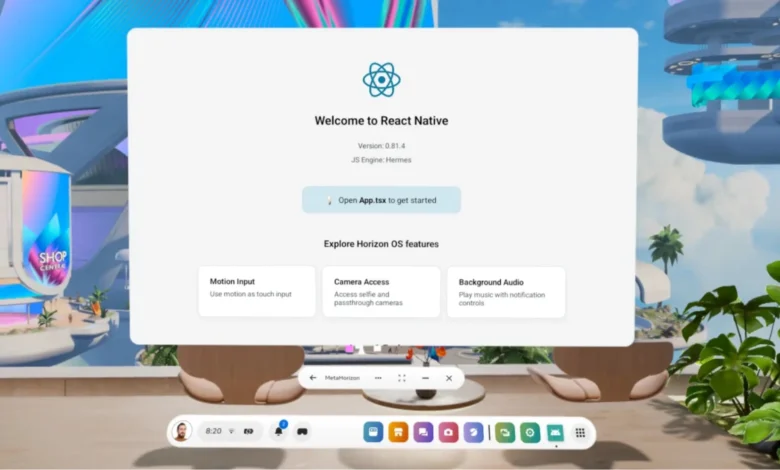
The technological landscape of cross-platform software development reached a significant milestone at React Conf 2025, where maintainers formally announced native support for Meta Quest virtual reality headsets within the React Native ecosystem. This announcement marks a major leap forward for the framework’s overarching "Many Platform Vision," first articulated in August 2021, which aimed to establish a cohesive codebase architecture capable of scaling seamlessly to novel device categories and hardware form factors without causing fragmentation within the broader developer community. Over the past several years, React Native has systematically evolved beyond its original mobile roots on Android and iOS to encompass desktop environments such as Windows and macOS, living-room interfaces like Apple TV, and web deployments via tools like react-strict-dom. The inclusion of Meta Horizon OS—the Android-based operating system powering Meta Quest headsets—brings spatial computing directly into the mainstream React Native development fold. By leveraging familiar tools, established abstractions, and existing build systems, developers can now deploy immersive virtual reality applications using the very same skills and patterns they rely on for traditional mobile and desktop software engineering.
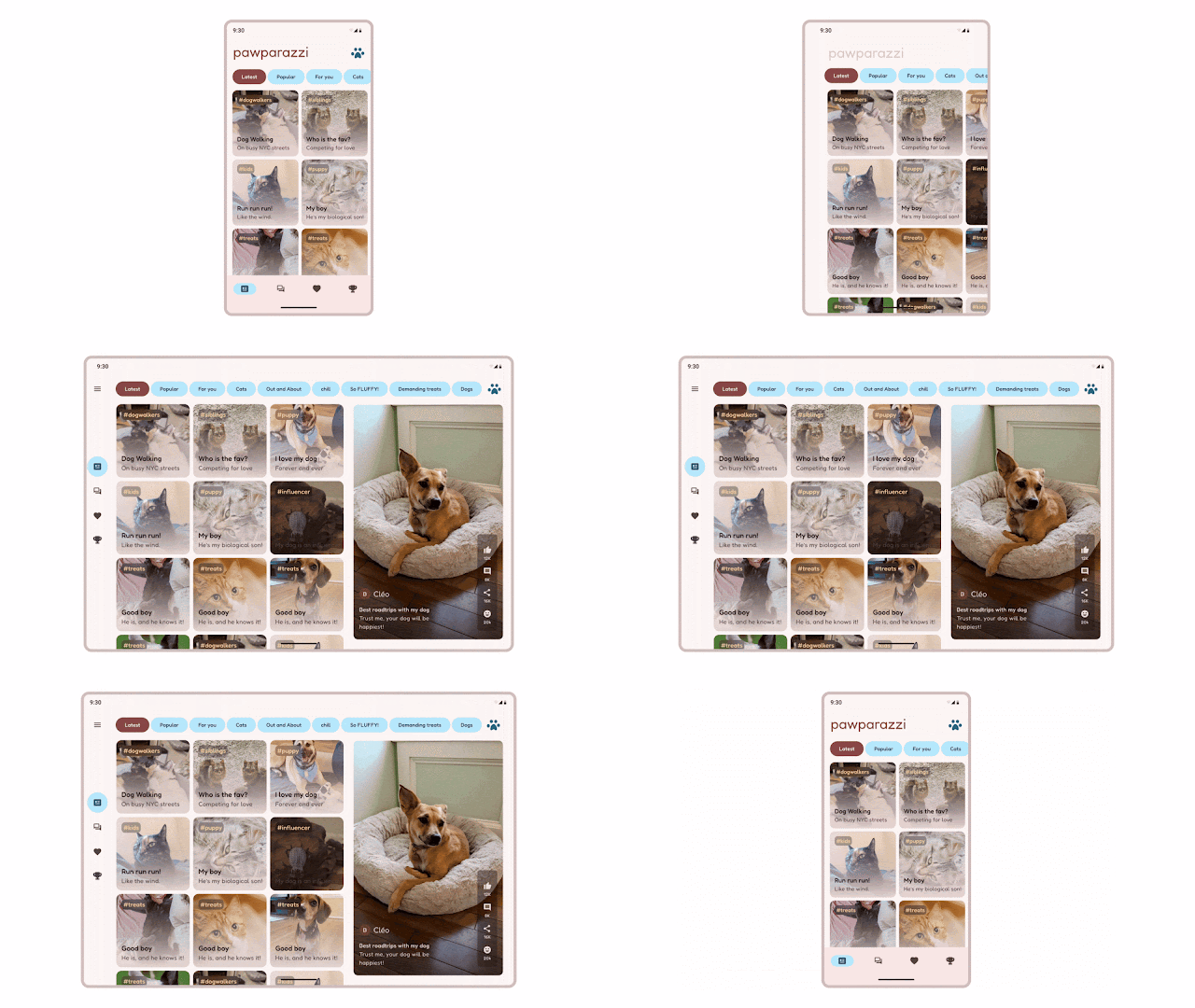
To understand the weight of this development, it is helpful to examine the chronological progression of React Native’s multi-platform strategy. When the core team published the Many Platform Vision manifesto in 2021, the industry was grappling with an increasingly fractured array of hardware devices, ranging from foldable phones and dual-screen laptops to smartwatches and televisions. Traditional approaches often forced engineers to abandon unified codebases when targeting specialized hardware, leading to duplicated engineering efforts and isolated software silos. React Native sought to counter this trend by hardening its core architecture—culminating in the modern React Native architecture featuring TurboModules and JSI—which decoupled platform-specific rendering layers from the JavaScript runtime. This modular design laid the groundwork for community-led ports and official extensions alike. The journey steadily absorbed Windows and macOS through Microsoft’s active contributions, expanded to television interfaces, and now culminates in spatial computing at React Conf 2025. Industry analysts view this progression as a calculated maneuver to maintain React Native’s dominance in enterprise software development, ensuring that companies investing in cross-platform strategies do not need to rewrite their stacks when exploring emerging mediums like mixed and virtual reality.
At a technical level, the integration with Meta Quest relies heavily on the fact that Meta Horizon OS is fundamentally constructed upon the Android Open Source Project (AOSP). Because Meta Horizon OS shares its underlying DNA with standard Android, all existing Android tooling, build pipelines, command-line interfaces, and debugging protocols function with minimal friction. Developers already accustomed to building Android applications will find that a substantial portion of their current workflow—including Gradle build configurations, JavaScript debugging sessions, and performance profiling—carries over naturally to the Quest environment. Rather than forcing the creation of an entirely isolated runtime or a brand-new proprietary framework, Meta Quest builds natively upon Android’s tried-and-tested foundation and integrates smoothly with React Native’s established core abstractions. This architectural choice prevents ecosystem fragmentation, allowing platform-specific spatial capabilities to be layered onto projects cleanly without disrupting the developer experience.

Adopting this workflow in practice involves adapting standard project setups to accommodate the unique hardware profiles of head-mounted displays. For early-stage development, rapid prototyping, and interface design, developers can utilize Expo Go, running their development servers locally and launching applications directly inside the headset via the Expo Go client for Meta Horizon OS. As projects mature and demand native modules, custom device sensors, or deeper hardware integrations, teams transition seamlessly to Expo development builds. Project configuration for Meta Horizon OS is streamlined through specialized tooling, notably the expo-horizon-core plugin. By integrating this plugin into standard configuration files such as app.json or app.config.js, developers can automatically inject required metadata—including specific Horizon application IDs, default window dimensions like 1024×640 pixels, targeted device families including Quest 2, Quest 3, and Quest 3S, and customized orientation rules. Furthermore, modifying package scripts to handle distinct build variants, such as questDebug and questRelease, ensures that developers can cleanly separate their mobile Android outputs from their spatial VR builds within a single repository.
Despite the high degree of shared architecture with mobile Android, engineers targeting Meta Quest must account for several critical platform-specific distinctions. Most notably, Meta Horizon OS operates without Google Mobile Services (GMS), meaning applications lack direct access to Google Play Services, the Google Play Store, and specific proprietary APIs. Developers must audit their dependency trees to eliminate assumptions about Google-dependent libraries, referencing official Meta documentation for lists of unsupported packages. Additionally, the physical reality of a head-mounted display renders certain common mobile hardware assumptions obsolete. Cellular capabilities, SMS integrations, GPS location tracking, and various restricted Android permissions are entirely absent or prohibited on VR headsets. To bridge these gaps smoothly, ecosystem contributors like Software Mansion have introduced specialized drop-in replacements, such as expo-horizon-location and expo-horizon-notifications, allowing applications to gracefully handle environment-specific logic without crashing. Developers can also utilize runtime utilities provided by ExpoHorizon.isHorizonDevice and ExpoHorizon.isHorizonBuild to construct robust, platform-aware code paths that dynamically adjust functionality depending on whether the application is running on a smartphone, a tablet, or a virtual reality headset.
Beyond technical configurations, designing user interfaces for spatial computing requires a fundamental shift in user experience (UX) paradigms. Unlike traditional mobile devices that rely primarily on direct touch input, Meta Quest applications are predominantly controlled via physical controllers, advanced hand-tracking algorithms, or optional paired mice and keyboards. Controllers act more like spatial pointing devices, introducing interaction patterns that closely mirror web and desktop environments—such as hover states, focus rings, and pointer-based navigation. Consequently, user interface elements must be designed with larger hit targets, generous spacing, and typography optimized for legibility across varied spatial distances. React Native’s flexible layout engine and component model provide a resilient foundation for these challenges, though developers must actively avoid touch-only design assumptions to ensure that applications remain intuitive and accessible when navigated via remote pointers or bare hands.
The broader market implications of bringing official React Native support to Meta Quest are profound for both independent creators and enterprise software vendors. By lowering the barrier to entry for spatial application development, Meta and the React Native community are effectively opening the virtual reality ecosystem to millions of web and mobile developers who were previously deterred by the steep learning curve of proprietary native VR engines like Unreal or Unity. Enterprises that maintain existing customer-facing applications in React Native can now repurpose substantial portions of their business logic, state management, and user interface components to launch companion VR experiences, virtual showrooms, collaborative workspaces, and training simulators with minimal incremental cost. As spatial computing hardware continues to shed its niche status and transition toward mass adoption, frameworks that bridge the gap between traditional 2D web-mobile skills and 3D immersive environments will likely capture an outsized share of developer mindshare, cementing React Native’s position as a truly universal multi-platform engine.