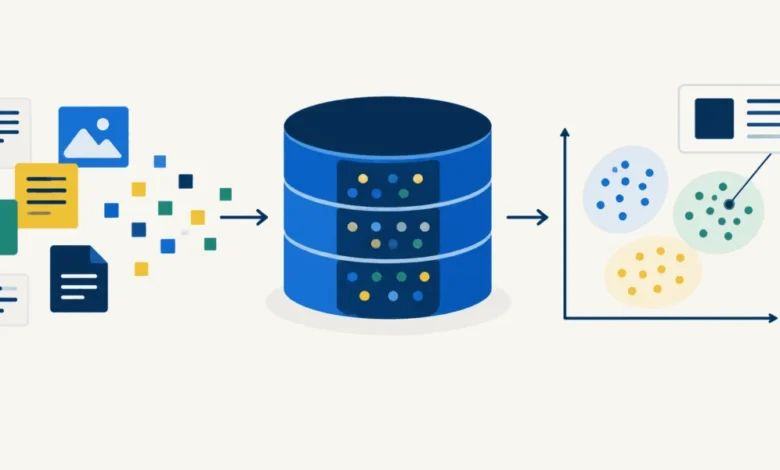
The Evolution of Information Retrieval
Traditional databases rely on keyword matching, a system that requires the user to know the exact terminology used in a document. If a user searches for "energy supply for a cell," a keyword database might return documents containing those specific words. However, it would likely fail to surface a document that discusses mitochondria as the "powerhouse of the cell" unless the term "energy" or "supply" was explicitly mentioned.
Vector databases represent a paradigm shift. They operate by converting text into high-dimensional vectors—arrays of numbers that capture the semantic essence of the content. When a query is submitted, it is similarly transformed into a vector. The database then performs a mathematical operation, typically a dot product or cosine similarity, to find the documents whose vectors point in the same "direction" as the query. This ensures that the search engine understands concepts, synonyms, and context, providing a more intuitive user experience.
A Ten-Step Technical Chronology
The tutorial provides a systematic, modular approach to building this engine. The process begins with environment setup, where developers install essential libraries like sentence-transformers and numpy.
- Setup and Initialization: The initial phase involves creating the scaffolding for the project. By implementing display helpers, the developer creates a transparent interface to observe how data enters the system and how it is retrieved.
- Indexing the Corpus: The second step demonstrates the encoding process. Using a pre-trained model—such as the
all-MiniLM-L6-v2—documents are converted into a fixed-dimensional vector (384 dimensions in this instance). A critical observation here is the efficiency of the storage; the size of the index is determined by the number of documents and the dimensionality of the model, not the length of the text itself. - Semantic Search Mechanics: Steps three and four serve as a proof-of-concept. By performing queries that share zero words with the retrieved results (e.g., searching "superheroes" and receiving results about Iron Man or the Hulk), the developer validates that the database is truly performing semantic mapping.
- Metadata Filtering: Advanced search functionality requires precision. The tutorial introduces metadata filtering, which allows users to narrow search results based on categorical tags. This step highlights the importance of keeping metadata and vectors in lockstep, preventing data corruption during indexing.
- Persistence and Scalability: In the final stages, the guide covers the serialization of the database to disk, ensuring that the index can be saved and reloaded. The closing steps analyze the performance of the system as it scales from 25 to 100,000 documents, demonstrating how the computational overhead grows linearly with the volume of the data.
The Mathematics of Meaning
At the heart of this implementation is the concept of normalization. By scaling each embedding vector to a length of one, the calculation of cosine similarity becomes a simple dot product. This reduction is significant because it transforms a complex linguistic problem into a high-performance linear algebra operation. The ability of modern CPUs to handle matrix multiplication at scale is what makes vector databases viable for real-time applications.
Industry experts have noted that while the implementation shown in the tutorial is simplified, it captures the exact same logic used by high-end, commercial vector databases such as Pinecone, Milvus, or Weaviate. The difference between a scratch-built Python script and a production-grade database lies primarily in features like distributed storage, hardware-accelerated indexing, and real-time updates—not in the underlying retrieval algorithm.
Broader Implications for Artificial Intelligence
The rise of the vector database has profound implications for the development of AI applications, particularly in the field of Retrieval-Augmented Generation (RAG). RAG is a technique that allows an LLM to access proprietary or external data by querying a vector database, effectively providing the model with a "knowledge base" that it can reference before generating an answer.
This architectural pattern helps mitigate the "hallucination" problem common in LLMs, as it anchors the model’s responses in verifiable, indexed data. By understanding how to build a vector database from scratch, developers gain a foundational understanding of how to manage the data pipelines that power modern, enterprise-ready AI agents.
Analysis of Computational Efficiency
The tutorial’s performance benchmarks provide a clear look at why vector databases are so effective. When scanning 100,000 vectors, the search time remains in the single-digit millisecond range. This performance is largely due to the optimization of matrix operations in NumPy, which offloads the heavy lifting to highly efficient C and Fortran code.
For developers, this reinforces a key lesson: the bottleneck in vector search is rarely the mathematics itself, but rather the data architecture, memory management, and the quality of the embedding model used. As the corpus grows, the primary challenge shifts from simple search to the implementation of Approximate Nearest Neighbor (ANN) algorithms—such as HNSW (Hierarchical Navigable Small World) or IVF (Inverted File Index)—which allow for sub-linear search times by trading a marginal amount of accuracy for a massive increase in speed.
Conclusion: The Future of Data Retrieval
The accessibility of these tools marks a democratization of AI infrastructure. Previously, the ability to build, maintain, and query a semantic search engine was restricted to companies with massive engineering resources. Today, with libraries like NumPy and Sentence-Transformers, any developer can build a local, private, and high-performance vector database in an afternoon.
As organizations continue to integrate AI into their workflows, the ability to architect efficient information retrieval systems will become a core competency for software engineers. This tutorial serves as a vital bridge between the high-level concepts of machine learning and the practical, gritty realities of software engineering, providing a roadmap for anyone looking to build the next generation of intelligent, data-driven applications. By understanding the atomic steps of vectorization, storage, and retrieval, developers are better equipped to leverage the full power of modern AI without relying on "black box" solutions.