Four New Linux Kernel Vulnerabilities Discovered by Security Researcher Enable Local Privilege Escalation

A security researcher has publicly disclosed working exploit code for four distinct vulnerabilities within the Linux kernel, each capable of granting a local user root access—the highest level of administrative authority on a machine. While the Linux kernel maintainers have successfully patched these flaws over the past several weeks, the public availability of exploit code necessitates immediate attention from system administrators, security teams, and individual users running legacy or unpatched kernel versions.
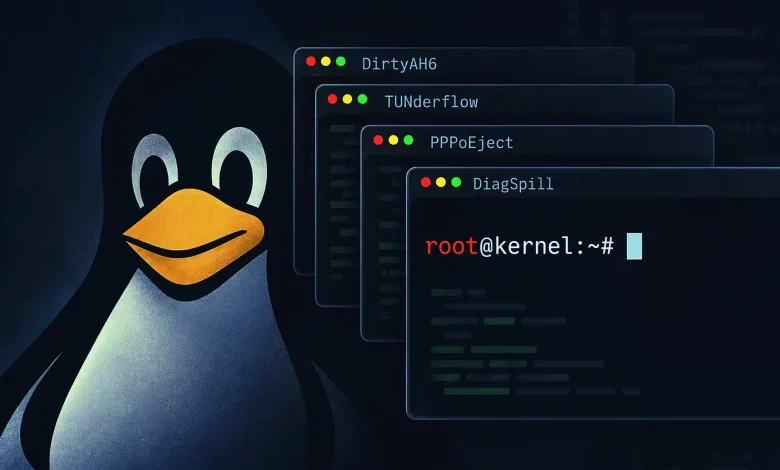
The vulnerabilities, collectively identified by researcher Asim Manizada, have been dubbed DirtyAH6, TUNderflow, PPPoEject, and DiagSpill. These flaws represent a significant development in the ongoing efforts to harden the Linux kernel, as they were identified using advanced, AI-assisted diagnostic methodologies. The disclosure comes after a period of coordinated responsible disclosure, during which Manizada worked closely with the Linux kernel security team and major distributions to ensure that patches were prepared and disseminated before the technical details became public knowledge on September 18.
Chronology of Discovery and Disclosure
The discovery of this quartet of vulnerabilities began in mid-July 2026, when Manizada first identified the issues and initiated the standard responsible disclosure process. By notifying the Linux kernel security team, the researcher ensured that the core maintainers had adequate time to analyze the underlying memory-safety bugs and develop robust fixes.
Following the initial reporting phase, the Linux kernel security community engaged in a rapid development cycle to integrate the necessary patches. This period of quiet remediation is a hallmark of the collaborative nature of open-source security, where the primary goal is to minimize the "window of exposure" between the identification of a flaw and the availability of a defensive update. On September 18, following the successful distribution of these fixes to the primary Linux repository and major downstream maintainers, Manizada published a comprehensive technical write-up, detailing the mechanisms of the exploits to foster transparency and allow security professionals to test their environments for potential weaknesses.
Technical Breakdown of the Flaws
All four vulnerabilities are rooted in memory-safety errors within the kernel’s complex networking stack. These types of bugs are particularly dangerous because they allow an attacker with local, low-privileged access to manipulate kernel memory, potentially overwriting critical data structures to execute arbitrary code with root privileges.

The vulnerabilities are categorized as follows:
- DirtyAH6 (CVE-2026-80844): Affecting the IPsec AH6 (IPv6) component, this flaw requires unprivileged user namespaces. It represents a potential risk to systems acting as IPv6 routers or gateways that employ transport mode Authentication Headers.
- TUNderflow (CVE-2026-81000): Located within the TUN/TAP virtual network device implementation, this vulnerability also necessitates the availability of unprivileged user namespaces to trigger the exploit.
- PPPoEject (CVE-2026-68121): This flaw resides in the Point-to-Point Protocol over Ethernet (PPPoE) handling. Like the others, it relies on the presence of unprivileged user namespaces, a feature commonly enabled by default in many modern distributions to support containerized workloads.
- DiagSpill (CVE-2026-74469): Unique among the quartet, DiagSpill does not require user namespaces or elevated privileges. It targets the SCTP (sctp_diag) networking module. If the SCTP module is loaded—which is a common configuration for high-performance networking—the system may be vulnerable.
The Role of User Namespaces and System Configuration
A critical factor in the exploitability of these vulnerabilities is the presence of "unprivileged user namespaces." Introduced as a powerful feature to facilitate sandboxing and containerization, user namespaces allow an unprivileged user to act as a privileged root user within their own isolated environment. While this is essential for modern software deployments, such as Docker or Kubernetes, it also broadens the attack surface for local privilege escalation (LPE) exploits.
For the majority of these flaws, an attacker must first possess a low-privileged account on the target machine. By leveraging the unprivileged user namespace feature, the attacker can gain the network-related privileges required to reach the vulnerable code paths. The exception, DiagSpill, highlights the danger of enabling unnecessary kernel modules. By simply having the SCTP module loaded, a system becomes exposed to this flaw, demonstrating the importance of the principle of least privilege—not just for users, but for the entire kernel subsystem.
Implications for Enterprise and Cloud Security
The publication of these exploits raises the risk profile for multi-user systems, shared hosting environments, and cloud infrastructure. In a multi-user server scenario, a malicious actor who gains a foothold through a standard user account could utilize these exploits to break out of their user sandbox and achieve full control over the host operating system.
Furthermore, the potential for container escapes is a significant concern for cloud-native architectures. While Manizada did not construct a formal container escape demonstration, he noted that the underlying memory corruption could theoretically allow an attacker to bypass container isolation. This emphasizes the necessity for defense-in-depth strategies, such as using hardened kernels, enforcing seccomp filters, and employing Mandatory Access Control (MAC) systems like SELinux or AppArmor to limit what even a compromised root user can perform.
AI-Assisted Vulnerability Research
A noteworthy aspect of this discovery is the methodology employed by Manizada. By utilizing an AI-assisted process to map kernel memory handling and reason about layout vulnerabilities, the researcher was able to uncover flaws that had remained hidden for over a decade. The underlying code errors identified range from 10 to 21 years old, illustrating the "long tail" of technical debt that persists within complex, mature codebases like the Linux kernel.

The inclusion of an "Assisted-by" line in the kernel’s fix commit for DirtyAH6 marks a significant milestone in the intersection of artificial intelligence and cybersecurity research. This follows a growing trend of AI being used to audit large, complex projects, which has led to a series of high-profile disclosures throughout 2026. While the technology accelerates the discovery of bugs, it also underscores the vital importance of the human-led verification and patching processes that follow.
Mitigation and Remediation Strategies
The primary defense against these vulnerabilities is to update the system kernel to a version that includes the respective patches. Because different Linux distributions maintain their own kernels, users should not rely solely on the mainline version numbers from the Linux kernel project. Instead, they should consult the security advisories issued by their specific distribution—such as Debian, Ubuntu, Red Hat, or SUSE—to confirm that the relevant patches have been backported and deployed.
For organizations that cannot perform an immediate update, the researcher suggests the following mitigation strategies:
- Restrict User Namespaces: If not strictly required for business operations, administrators can disable unprivileged user namespaces to eliminate the attack vector for DirtyAH6, TUNderflow, and PPPoEject. This can often be achieved by adjusting kernel parameters via
sysctl. - Unload Unused Modules: Reducing the kernel’s attack surface is a fundamental security practice. If the SCTP module is not required for network functionality, unloading it will protect the system from the DiagSpill vulnerability.
- Monitor for Anomalies: Because these exploits are tuned to specific kernel builds and are known to cause system instability or crashes, monitoring logs for kernel panics or unexpected process terminations can serve as an early warning sign of attempted exploitation.
Conclusion
The discovery of the DirtyAH6, TUNderflow, PPPoEject, and DiagSpill vulnerabilities serves as a stark reminder of the persistent security challenges inherent in complex kernel development. As the Linux ecosystem continues to evolve, the integration of AI-driven research methods is likely to surface more historical vulnerabilities, necessitating a robust and rapid response from both maintainers and system administrators.
Ultimately, the security of a Linux-based environment rests on the agility of its patching cycle. With working exploit code now in the public domain, the window for remediation is closing. Organizations must prioritize the audit of their server fleets, ensure that kernel versions are up to date, and adhere to the principle of minimizing the active attack surface through configuration hardening. The collaborative effort between the security researcher and the Linux kernel maintainers highlights the strength of the open-source model in addressing critical security threats, provided that the end-users remain diligent in applying the necessary defenses.