GitHub Unveils Project HydraFusion: A Runtime Orchestration Preview Aimed at Rebalancing AI Coding Costs and Performance

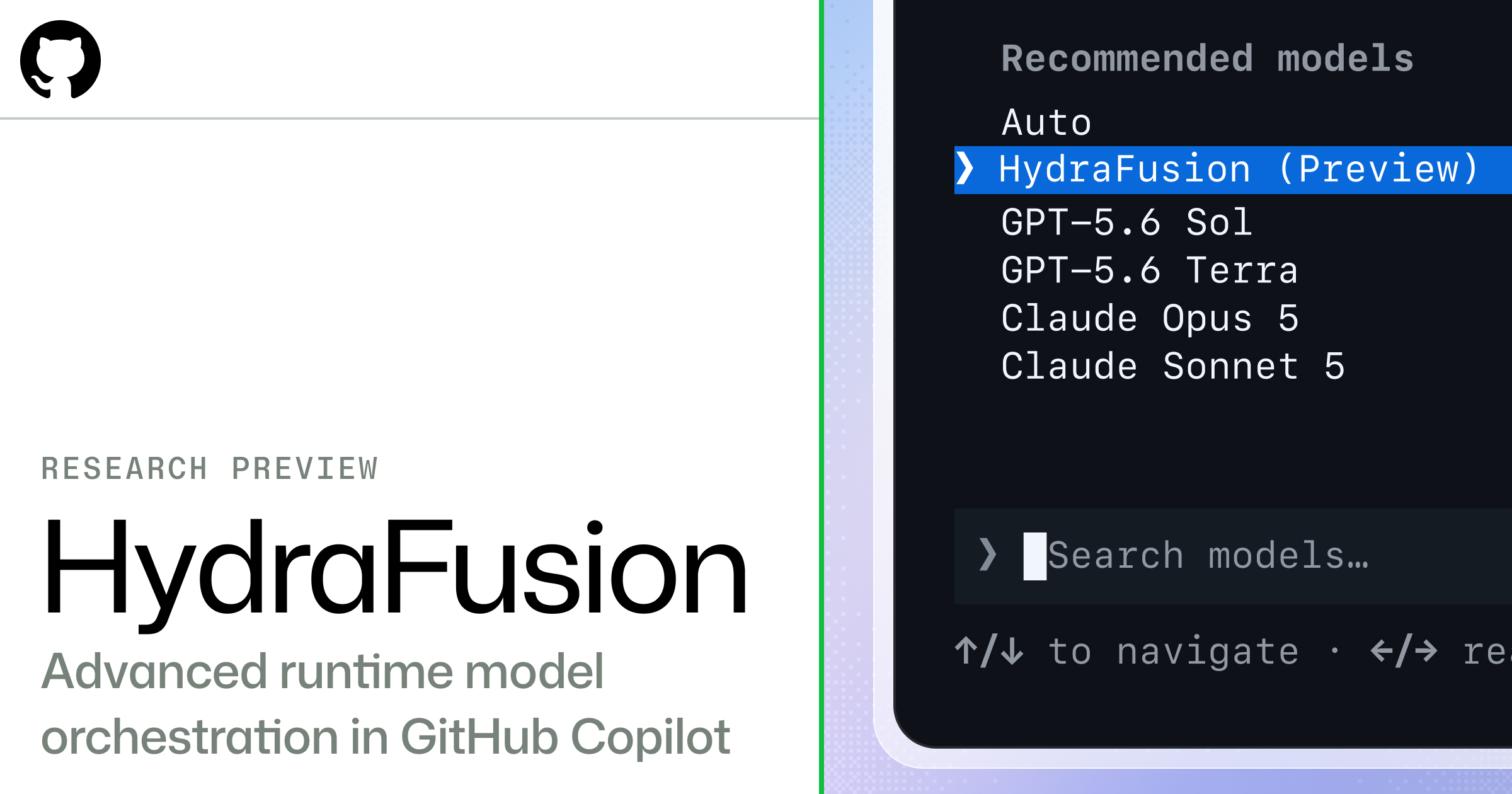
GitHub has officially announced the launch of Project HydraFusion, a new research preview designed to bring advanced frontier intelligence and automated runtime orchestration to the developer ecosystem. Building upon the auto model selection features introduced earlier this year, HydraFusion seeks to solve a persistent challenge in AI-assisted software engineering: the tension between achieving elite code quality and managing mounting computational overhead. By constructing dynamic execution plans that route tasks across multiple model providers, the system aims to optimize performance, cost, and latency transparently behind the scenes.
The introduction of HydraFusion represents a significant evolution in how developer platforms handle complex workloads. Rather than relying on a single large language model for an entire task—an approach that frequently incurs high latency and unnecessary costs for simpler sub-tasks—HydraFusion treats workflow selection as a sophisticated optimization problem. For developers utilizing GitHub Copilot, the feature functions like any standard model choice, masking the intricate multi-step routing process while delivering superior, context-aware outcomes.
Background Context and Strategic Evolution
The genesis of HydraFusion stems from a broader industry shift toward compound AI systems. Historically, developers manually coordinated multiple models by assigning a specific task to one system, requesting a peer review from another, and escalating critical or failed tasks to a more expensive, frontier-grade model. While effective, this manual pipeline management introduces friction into the development workflow.
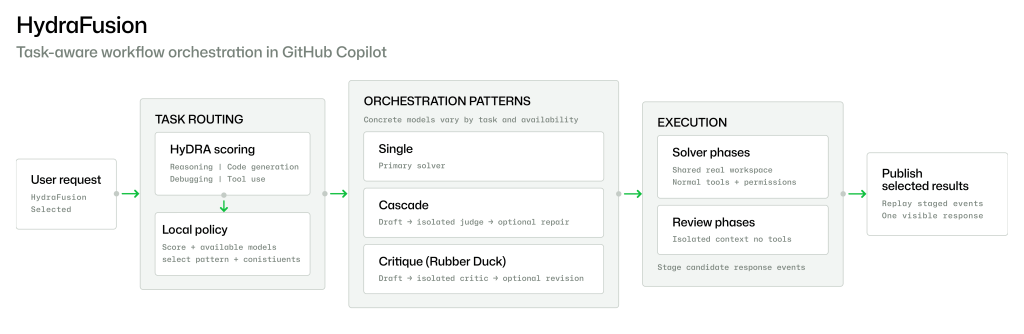
GitHub’s overarching strategy involves automating semantic routing across local, cloud, and compound models to bridge the gap between human engineering workflows and automated execution. As artificial intelligence models advance at a rapid pace, the challenge has shifted from merely accessing capable models to orchestrating them efficiently. HydraFusion addresses this by evaluating capability signals—including reasoning, code generation, debugging, and tool utilization—to determine the most efficient execution pattern required to meet predefined quality bars without wasting compute cycles.
Core Architecture and Execution Patterns
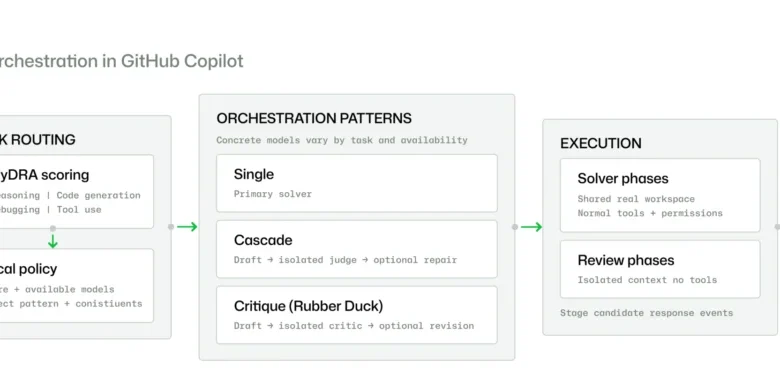
At the core of HydraFusion’s architecture lies an adaptive orchestration engine that evaluates incoming requests and selects the least complex workflow capable of fulfilling the developer’s requirements. For each request, the system currently dispatches execution through one of three primary patterns, each engineered to balance a specific quality-to-cost trade-off:
- Single: Designed to preserve processing speed and maximize efficiency when a single, well-suited model can resolve the assigned task directly.
- Cascade: Implements a tiered approach where a highly efficient, lightweight model makes the initial attempt, with an automatic escalation path to more powerful inference engines if the candidate fails to clear predefined acceptance gates.
- Critique: Introduces an independent peer-review model to evaluate outputs for tasks where external critique yields higher accuracy than a secondary unaided generation attempt.
This dynamic approach ensures that additional model calls are only invoked when empirical signals suggest they will meaningfully improve the final outcome. Furthermore, the runtime infrastructure records comprehensive telemetry for every leg of the execution—including assigned roles, final outcomes, cost metrics, latency figures, and operational diagnostics—allowing engineers to audit the workflow post-execution while the developer receives a single, cohesive, and permission-aware change set.

Benchmarking Results and Quantitative Performance
To measure the efficacy of HydraFusion, GitHub subjected its fixed routing policies to rigorous offline evaluations across three prominent agentic coding benchmarks: TerminalBench 2.1, DeepSWE, and CheckpointBench, an internal benchmark curated from real GitHub Copilot sessions. In these evaluations, HydraFusion was compared against established baselines such as Claude Opus 5 and GPT-5.6 Sol, utilizing identical task inputs, execution limits, pricing assumptions, and grading conditions.
The results demonstrated that HydraFusion can deliver competitive or superior task quality while dramatically reducing estimated workflow costs. On TerminalBench 2.1, which tests coding agents on complex, multi-step terminal environments, HydraFusion improved verified task quality by 4.9 percentage points while achieving a 67% reduction in estimated costs compared to Claude Opus 5.

On DeepSWE, a benchmark focused on challenging repository-level software engineering tasks that require navigating large codebases and managing cross-file dependencies, HydraFusion came within 1.5 percentage points of Opus 5 while cutting costs by 36%. Meanwhile, on CheckpointBench—which mirrors production sessions by utilizing immutable commits and real repository trajectories across varied languages and difficulty levels—HydraFusion achieved near parity with Opus 5, trailing by a mere 0.1 percentage points while driving down costs by 65%.
Chronology and Iterative Development
The development of HydraFusion was an iterative process informed heavily by real-world usage data. To ensure reproducibility, engineers curated CheckpointBench from actual GitHub Copilot coding-session trajectories, mapping out the common patterns of developer interactions.

Rather than manually adjusting performance thresholds, the team utilized beam search methodologies to construct optimal decision policies. Candidate configurations were continuously measured against a frozen baseline across CheckpointBench, DeepSWE, and TerminalBench 2.1. This iterative hill-climbing process allowed the routing policies to adapt organically to the nuanced demands of software engineering.
The optimization timeline experienced standard engineering hurdles. Notably, between August 11 and August 25, two separate operational failures within the evaluation harness generated invalid run data. These anomalies were promptly isolated, excluded from the performance trends, and corrected. Following the fixes, subsequent iterations of HydraFusion achieved their highest recorded operating performance points by late August.
Industry Statements and Reactions

Internal testing among engineering groups at Microsoft and GitHub has yielded strong initial praise, particularly regarding the system’s reasoning capabilities. A Principal Software Engineer at Microsoft noted during early evaluations that the reasoning and task-solving throughput of HydraFusion performed at or above the level of standalone frontier models like Opus, but at a fraction of the operational overhead.
The collaborative nature of the project has also drawn recognition from internal leadership. The development effort brought together specialized teams across GitHub and Microsoft, including researchers, applied scientists, product managers, and UI/UX designers who unified disparate components into a streamlined developer experience. Key contributions came from the GitHub Copilot CLI, Copilot API, and VS Code engineering teams, who successfully navigated complex infrastructure challenges to package the research preview for customer deployment.
Implications and Future Outlook

The launch of Project HydraFusion marks a pivotal step toward the maturation of AI-driven software development tools. By shifting the paradigm from static model selection to dynamic, multi-model orchestration, the platform addresses the economic and technical constraints that have historically limited the deployment of autonomous coding agents in enterprise environments.
During the initial research preview phase, GitHub is prioritizing first-turn, single-prompt coding tasks where developers can leverage Copilot in autopilot mode. Subsequent phases of the preview will focus on expanding capabilities to handle complex, multi-turn interactions and extended, iterative coding sessions.
As the AI model landscape continues to evolve, HydraFusion’s architecture is designed to seamlessly ingest newly released models into its pool, automatically routing them to the tasks for which they are best suited. While product names, availability, and specific workflow behaviors remain subject to refinement based on telemetry and user feedback gathered through the Copilot CLI and GitHub Community channels, HydraFusion establishes a clear blueprint for the future of agentic coding: combining frontier-level intelligence with intelligent runtime efficiency to build more sustainable, scalable developer tools.