For the better part of the last three years, the technology sector has been locked in an aggressive race to integrate artificial intelligence into every facet of the digital ecosystem. From enterprise software suites to consumer-facing applications, the "AI-first" mandate has become a primary driver for corporate strategy. However, emerging data suggests a widening disconnect between the aggressive deployment of these tools and the actual requirements of the end-user. While executives often view AI as an inherent value proposition, market feedback and adoption metrics indicate that users are increasingly resistant to tools that disrupt established workflows without providing clear, reliable utility.
The current state of AI implementation is characterized by a "bolt-on" methodology, where companies insert generative capabilities into existing platforms, often resulting in fragmented user experiences. This trend has prompted a reevaluation of what constitutes true innovation in the workplace. The consensus among design experts and workplace productivity analysts is that the industry is currently prioritizing the speed of feature delivery over the quality of user integration.
The Evolution of the AI Integration Era
The timeline of this push began in earnest with the public release of large language models in late 2022. By early 2023, the industry shifted from experimentation to full-scale commercialization. Organizations scrambled to incorporate chatbots, automated drafting tools, and predictive analytics into their service offerings, hoping to capture market share and demonstrate technical prowess to shareholders.
By 2024, the initial novelty began to wane. Data from organizations such as the IBM Institute for Business Value and various industry consultants began to highlight a persistent "adoption gap." While companies were successful at launching these features, they were largely unsuccessful in fostering long-term retention. By 2025, the focus shifted toward "agentic" workflows—AI systems capable of performing multi-step tasks—but these, too, have struggled to gain traction among users who remain wary of the reliability of autonomous systems.
Quantifying the Productivity Gap
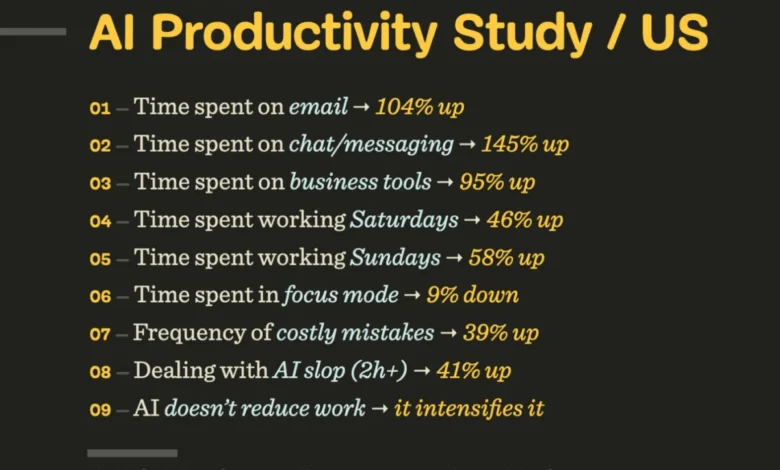
Contrary to the narrative that AI automatically reduces labor, recent studies suggest that the integration of these tools can, in some cases, intensify the workload. A 2026 productivity study revealed that while AI is intended to streamline operations, it often adds layers of administrative friction. The report noted that users experienced a 104% increase in time spent on email management and a 145% increase in time spent navigating messaging platforms as they coordinated with AI systems.

Furthermore, the "AI slop" phenomenon—the time spent verifying, editing, and correcting AI-generated content—was cited as a major deterrent. Users reported a 41% increase in time dedicated to managing these errors. The technical debt that many companies hoped AI would resolve has instead been compounded, as employees are forced to act as editors and auditors for output that lacks the nuance of human judgment.
The Value Proposition Crisis
The fundamental error in current AI deployment lies in the misidentification of AI as a standalone value proposition. A Business Model Canvas analysis, frequently cited in design circles, posits that AI should be relegated to the category of "Key Activities and Key Resources" rather than being marketed as the product itself. When a company markets a product as "AI-powered," it implies that the intelligence is the benefit, rather than the outcome of the work being performed.
Users evaluate tools based on consistency, predictability, and efficiency. When a feature behaves unpredictably—hallucinating data or failing to replicate a task reliably—the "AI" label becomes a liability rather than a selling point. The current market response suggests that if a non-AI tool performs a task flawlessly, it will consistently outperform a superior-tech AI tool that operates inconsistently.

Socio-Economic Implications and Labor Trends
The anxiety surrounding AI is not merely about job replacement; it is rooted in the perceived loss of agency. When software forces a user to adapt their mental model to fit the machine’s constraints, it creates a psychological burden. The Washington Post and other outlets have tracked the impact of automation across various sectors, finding that while white-collar roles in software development and public relations face high exposure to automation, roles requiring physical presence and high-level human intuition remain largely resilient.
There is a growing call from industry observers for an "AI-second" design philosophy. This approach suggests that AI should function as an invisible, ambient utility that handles the most repetitive, mundane tasks—such as data entry, scheduling, and basic formatting—allowing the human operator to focus on higher-order decision-making. By moving the AI to the background, organizations can better align their technology with human cognitive patterns.
Official Perspectives and Market Responses
Industry leaders are beginning to acknowledge the necessity of a pivot. In recent dialogues, designers have emphasized that successful integration requires deep empathy for the end-user. The goal is not to replace human effort but to augment it. Organizations that have successfully navigated this transition are those that focus on specific, high-friction pain points rather than blanket automation.

For example, companies that utilize AI to automate the processing of complex documentation while keeping human oversight as a mandatory final step have reported higher satisfaction rates than those that deploy "autonomous agents" without clear human guardrails. This collaborative model—often referred to as "Human-in-the-Loop" (HITL)—is becoming the standard for enterprise-grade applications.
Future Outlook: Toward Human-Centric Design
As the market matures, the competitive advantage will likely shift away from those who have the most powerful models toward those who have the best interface design. The "AI-first" era was defined by technical capability; the next era will be defined by usability.
Design patterns for the future will require a departure from the "chat-box" interface, which has become a default for many developers. Instead, more intuitive interfaces that anticipate user intent without requiring constant prompting are expected to lead the market. The ultimate goal for developers should be to create systems that do not feel like an intrusion but rather a seamless extension of the user’s existing workflow.

The persistent demand from the workforce is clear: they do not want to manage AI; they want to be unburdened by it. They seek to delegate the "taxing" physical and mental labor to machines so that they can reallocate their time toward work that is uniquely human—creative problem-solving, strategic analysis, and meaningful interpersonal engagement.
As organizations move into the next phase of the AI rollout, the lessons of the past three years provide a roadmap. Technology is most effective when it is invisible. By focusing on utility, reliability, and the preservation of human agency, companies can move beyond the current disillusionment and toward a future where AI serves as a quiet, effective tool rather than a disruptive force. The transition from "AI-first" to "AI-second" is not just a design preference; it is a prerequisite for long-term viability in an increasingly automated economy.