Bridging the Gap Between Operational Performance and Cloud Security with AWS DevOps Agent and Wiz Integration


The traditional divide between site reliability engineering (SRE) and cloud security operations has long served as a primary bottleneck in enterprise incident response. When an on-call engineer receives an alert for a CPU spike or an unexpected API latency anomaly, the immediate challenge is not just resolution, but classification. Determining whether an event stems from a routine scaling error or a malicious security breach often requires manually correlating data across disparate platforms, a process that can consume critical minutes or hours during an active incident.
To address this, AWS has announced a strategic integration between the AWS DevOps Agent and Wiz, a leader in cloud-native application protection. By leveraging the Model Context Protocol (MCP), this collaboration allows the AWS DevOps Agent to autonomously query the Wiz Security Graph, effectively merging operational telemetry with deep security posture intelligence. This development marks a significant shift in how DevOps teams handle triage, moving from reactive manual investigation to automated, context-aware incident resolution.
The Anatomy of the Modern Incident Response Bottleneck
In modern cloud environments, the signals for an operational failure and a security compromise frequently overlap. A sudden spike in Amazon EC2 CPU utilization, for instance, could indicate an inefficient database query or a memory leak—classic operational concerns. Conversely, that same spike might be the result of a unauthorized cryptominer or a data exfiltration script running in the background.
Under existing workflows, an engineer must first acknowledge an alert in a monitoring tool, then navigate to a security dashboard to check for vulnerabilities, and finally cross-reference these findings with recent deployment logs. This context-switching is not merely an inconvenience; it is a measurable drain on Mean Time to Resolution (MTTR). In high-stakes environments, where every second of downtime costs thousands of dollars in revenue or risks customer data exposure, the inability to instantly distinguish between a "performance bug" and a "security incident" creates a critical window of vulnerability.
The Integration Mechanism: Leveraging the Model Context Protocol
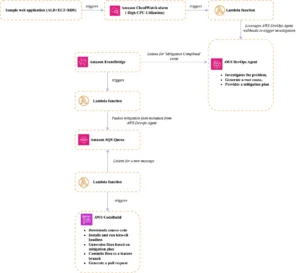
The integration relies on the Model Context Protocol (MCP), an open standard that enables AI-powered agents to interact with various data sources and tools without requiring bespoke, brittle point-to-point connectors. In this architecture, the AWS DevOps Agent acts as the central intelligence, capable of learning resource relationships, reviewing CI/CD pipelines, and analyzing code repositories.
When an alert triggers an investigation, the AWS DevOps Agent now automatically invokes the Wiz MCP server. This process is seamless and occurs during the agent’s initial triage phase. By querying the Wiz Security Graph, the agent can instantly determine if an affected resource has known, exploitable CVEs, if it is publicly exposed, or if there are anomalous runtime behaviors associated with the identity or container in question.
Crucially, the integration is designed for security and efficiency. The agent sends specific resource identifiers to the Wiz endpoint to retrieve findings; it does not share operational telemetry or proprietary application logs with the security platform. This ensures that the investigation remains localized while benefiting from the global security intelligence maintained by Wiz.
Categorizing Risk: Three Scenarios in Triage
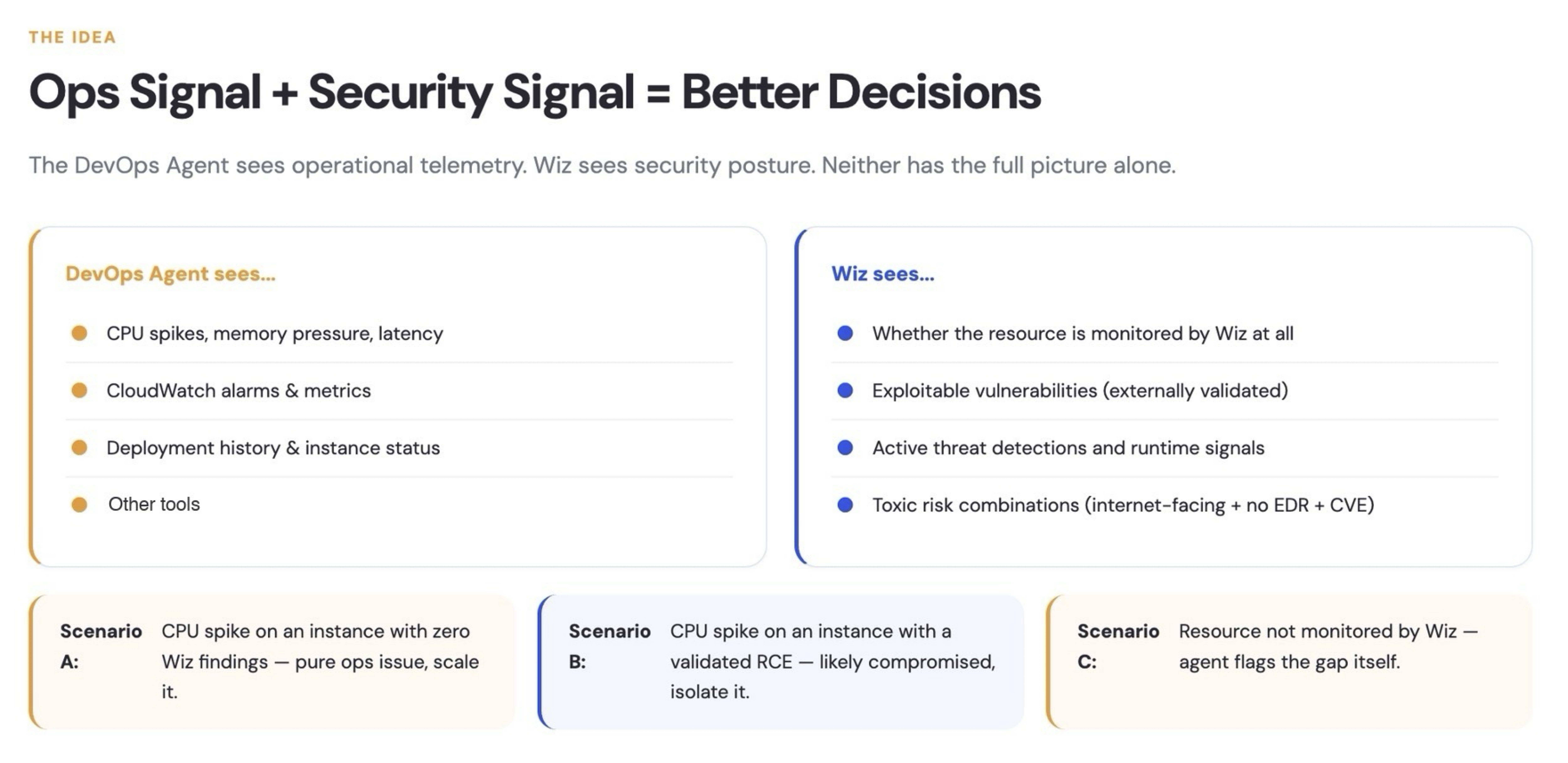
The practical value of this integration becomes evident when observing how it alters the decision-making process in real-time. By applying automated logic to the data returned via MCP, the AWS DevOps Agent can categorize incidents into three distinct paths:
- Standard Operational Issues: If the agent queries Wiz and returns no security findings—and the resource is confirmed to be under active security coverage—the system flags the event as purely operational. This allows the engineer to focus exclusively on scaling, code optimization, or infrastructure tuning without the distraction of a potential breach.
- Confirmed Security Compromises: If the query reveals a "toxic combination"—such as an internet-facing resource with a known remote code execution (RCE) vulnerability and an absence of endpoint protection—the agent upgrades the alert. It can provide immediate, actionable intelligence, including suggested remediation steps from the Wiz Green Agent, thereby allowing the engineer to isolate the asset before a breach matures.
- Coverage Gaps: In instances where a resource is not currently monitored by Wiz, the agent identifies this as a "coverage gap." This provides a secondary benefit: it alerts the organization to infrastructure that has drifted outside of their security governance, enabling teams to remediate visibility issues long before an incident occurs.
Supporting Data and Industry Implications
Industry analysts have noted that the "time-to-context" is currently the most significant variable in cloud incident management. According to recent industry benchmarks, the average time spent manually gathering context during a high-severity incident accounts for nearly 60% of the total resolution time. By automating the correlation of security and operational data, the AWS DevOps Agent and Wiz integration aims to reduce this time-to-context by an estimated 40% to 50% for complex, multi-layered cloud environments.
This integration reflects a broader industry trend toward "DevSecOps maturity," where security is no longer an external audit function but an integrated component of the runtime monitoring stack. By democratizing access to complex security graph data, organizations can empower SREs—who may not have deep expertise in threat hunting—to act with the precision of a security analyst.
Official Perspectives on the Partnership
"The goal of this collaboration is to eliminate the ‘security vs. operations’ silos that have persisted for too long," noted a representative involved in the project. By allowing the agent to "see" the security context, organizations are effectively putting their existing security investments to work. The integration does not require engineers to learn new tools or workflows; rather, it amplifies the existing DevOps Agent’s capabilities, providing a richer, more accurate diagnostic report at the start of every alert.
For security teams, the benefit is equally clear: they are no longer the final bottleneck in the triage process. Because the DevOps Agent can handle the initial, high-volume operational alerts and filter out those with no security impact, security personnel can focus their limited time on high-fidelity, validated incidents that truly require their specialized skill set.
A Roadmap for Implementation
The implementation process is designed for modularity. Organizations already utilizing the AWS DevOps Agent can register the Wiz MCP server at the account level. Following registration, administrators can allowlist specific Wiz tools—such as list_vulnerability_findings or list_threats—to define the depth of security information the agent is permitted to pull.
Once configured, the agent executes these queries as part of its automated evidence collection. The results are fully auditable, with every MCP tool call logged in the investigation report. This transparency is vital for post-incident reviews, as it allows teams to see exactly what security context was available to the agent at the moment of decision-making.
Broader Implications for Cloud Infrastructure
As cloud architectures become increasingly complex, with distributed microservices, ephemeral containers, and dynamic identity management, the "manual investigation" model of incident response is becoming unsustainable. The integration of specialized security graphs into the DevOps lifecycle represents a fundamental evolution in infrastructure management.
Looking ahead, this pattern—using MCP as a bridge between specialized security tools and general-purpose DevOps agents—is expected to expand. Future iterations could integrate change management systems, allowing agents to correlate an incident with a specific deployment approval, or financial management tools, allowing agents to weigh the cost of a temporary resource spin-up against the risk of an unpatched vulnerability.
The partnership between AWS and Wiz serves as a blueprint for how platforms can collaborate to reduce the cognitive load on engineering teams. By transforming incident response from a reactive, manual guessing game into a data-driven, automated process, this integration ensures that as cloud environments grow in scale and complexity, the ability of human teams to manage them remains robust and resilient. For organizations seeking to optimize their SRE operations, the adoption of such context-aware automation is no longer a luxury, but a necessity in a high-threat, high-uptime digital economy.