React Native 0.81 Released With Android 16 Support, Precompiled iOS Builds, and Major Developer Tooling Upgrades


The cross-platform mobile development landscape has taken another significant step forward with the official release of React Native 0.81. Rolled out to the global developer community, this latest stable version delivers critical updates designed to align frameworks with the newest operating system requirements from Google and Apple. The release brings robust out-of-the-box support for Android 16, introduces experimental precompiled iOS builds that promise dramatically accelerated compile times, and deprecates legacy components in favor of more modern, adaptable architectural patterns.
Coming on the heels of previous iterations that focused on the New Architecture rollout, version 0.81 reflects a maturing ecosystem where performance, strict platform compliance, and developer velocity take center stage. More than 110 contributors committed over 1,110 changes to make this milestone possible, underscoring the vibrant, collaborative nature of the open-source community bridging Meta, Expo, and independent maintainers worldwide.
Main Facts and Core Upgrades in Version 0.81
At its core, React Native 0.81 ensures that applications built using the framework remain fully compatible with the cutting edge of mobile OS engineering. The headline feature of this release is the transition to targeting Android 16 (API level 36) by default. This change requires developers to adapt their layouts and navigation flows to keep pace with Google’s strict modern UI guidelines.
Concurrently, the release introduces experimental support for precompiled iOS builds. Developed through a close collaboration between Expo and Meta, this feature addresses one of the most persistent developer pain points: slow build times. By leveraging prebuilt core dependencies, projects where React Native is the primary dependency can experience compilation speed improvements of up to 10x.
To maintain system cleanliness and security, the release also implements several breaking changes and deprecations. The built-in <SafeAreaView> component has been officially deprecated, the legacy JavaScriptCore (JSC) engine has been completely decoupled into a community-maintained package, and baseline system requirements have been elevated to demand Node.js version 20.19.4 (or higher) alongside Xcode 16.1 for iOS environments.
Chronology and Ecosystem Evolution
The release of React Native 0.81 arrives within a carefully orchestrated evolutionary timeline that has seen the framework shed legacy technical debt at an accelerated pace throughout 2024 and 2025.
Historically, React Native releases served primarily as feature updates for JavaScript developers building cross-platform UIs. However, as both iOS and Android tighten their security postures, native memory management standards, and layout guidelines, the framework has had to evolve into a tightly integrated wrapper that respects deep platform-level changes.
In late 2024 and early 2025, core maintainers began the deliberate process of decoupling non-essential modules from the core repository. The migration of JavaScriptCore to a community-managed repository, initiated in earlier versions, reaches its completion in version 0.81 with the total removal of the built-in JSC binary. This mirrors the progressive shift toward the Hermes engine as the undisputed default JavaScript engine for high-performance React Native applications.
Furthermore, the introduction of precompiled iOS builds follows an incremental rollout strategy. While version 0.80 laid the groundwork by making React Native iOS dependencies prebuilt, version 0.81 takes the experimental leap forward of integrating these optimizations more deeply into the Cocoapods workflow via specific environment variables (RCT_USE_RN_DEP=1 and RCT_USE_PREBUILT_RNCORE=1). Industry observers note that this trajectory positions the framework to adopt fully modular, streamlined build systems comparable to native Swift and Kotlin development workflows.

Supporting Data and Technical Specifications
A rigorous review of the technical specifications accompanying React Native 0.81 reveals significant shifts in developer environment requirements and compliance mandates:
- Android 16 & Edge-to-Edge Mandate: Android apps utilizing version 0.81 now target API level 36. In accordance with Google’s platform evolution, applications must render edge-to-edge natively, eliminating the possibility of opting out. To assist with migration, a new Gradle property (
edgeToEdgeEnabled) has been introduced, allowing teams to toggle edge-to-edge rendering on versions below Android 16. - Predictive Back Gesture: Enabled by default for Android 16 targets, this feature modernizes navigation but requires engineering teams to audit custom native back-handling overrides, such as the
onBackPressed()method. - 16 KB Page Size Compliance: Google Play mandates that all native binaries comply with the 16 KB page size requirement starting November 1, 2025, for Android 15+ devices. React Native 0.81 is fully compliant out of the box, though developers must verify that all third-party native libraries meet the same standard.
- Node.js and Xcode Baselines: The minimum required version for Node.js has been bumped to 20.19.4 (Maintenance LTS), while iOS compilation strictly requires Xcode 16.1 or higher.
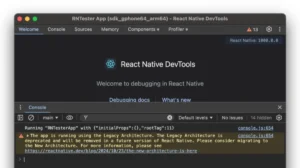
- Error Reporting Improvements: React Native DevTools now surfaces original messages, stack traces, error causes, and Owner Stacks for component errors, drastically reducing time-to-resolution during debugging sessions.
Official Responses and Community Collaboration
The collaborative nature of React Native 0.81 has drawn widespread praise from institutional partners and independent contributors alike. Meta’s engineering teams worked closely with Expo developers to finalize the precompiled iOS build architecture, a partnership that highlights the unified front presented by modern React Native tooling providers.
Expo’s engineering leadership noted that precompiled builds represent a paradigm shift for large teams managing complex iOS native codebases, reducing feedback loops during local development and continuous integration (CI) runs.
Meanwhile, community feedback channels on GitHub and Discord have focused heavily on the deprecation of <SafeAreaView>. Maintainers have officially pointed teams toward the robust, cross-platform react-native-safe-area-context library as the permanent replacement. Library authors have also received technical guidance regarding the newly introduced RN_SERIALIZABLE_STATE macro and the corresponding CMake function (target_compile_reactnative_options), which ensures seamless compilation for custom native components operating under the New Architecture.
Broader Impact and Industry Implications
The arrival of React Native 0.81 carries profound implications for enterprise mobile strategies and indie developers alike. By aligning strictly with Android 16’s edge-to-edge layout rules and predictive back gestures, the framework ensures that cross-platform apps do not look or feel like second-class citizens on modern Google hardware.
The push toward responsive UI layouts and adaptive design for large-screen devices—tablets and foldables—also signals that cross-platform frameworks are expected to support multi-window and varying aspect ratios natively without developer friction. Although teams can temporarily opt out of certain large-screen restrictions, the writing is on the wall for Android 17 compatibility.
Furthermore, the dramatic reduction in iOS build times via precompilation addresses a perennial complaint from enterprise engineering managers: developer productivity lost to long compilation cycles. As these experimental features graduate to general availability in upcoming releases, the total cost of ownership for maintaining large-scale React Native codebases is projected to decrease significantly.
Finally, the deprecation of older standards—such as legacy JSC support, outdated Node.js runtimes, and obsolete Xcode versions—demonstrates a maturing ecosystem willing to shed technical debt to maintain high performance, strict security standards, and seamless modern tooling integration.
As version 0.81 becomes the new stable baseline—and with older versions like 0.78.x officially transitioning to unsupported status under React Native’s support policy—development teams are strongly encouraged to utilize the React Native Upgrade Helper and plan their migration paths accordingly. For projects leveraging Expo, support for React Native 0.81 will be baked into the upcoming Expo SDK 54 release as the default environment.
Related posts: