Single-Agent vs. Multi-Agent AI Systems: Determining When Architectural Complexity Is Worth the Investment

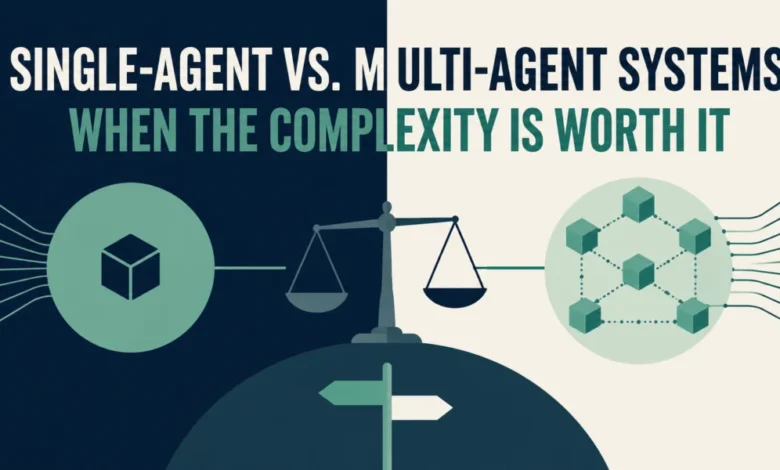
In the rapidly evolving landscape of generative artificial intelligence, developers and enterprises are increasingly confronted with a fundamental architectural dilemma: should a single, highly capable autonomous agent manage a workflow from start to finish, or should the task be distributed among a collaborative team of specialized agents? This decision is not merely academic; it carries significant consequences for the operational cost, system latency, reliability, and long-term scalability of AI-driven applications. While the industry has witnessed a surge of enthusiasm for complex, multi-agent frameworks, a pragmatic assessment reveals that architectural choices must be dictated by specific functional requirements rather than the pursuit of technological novelty.
Defining the Agentic Paradigm
To understand the divergence between these two approaches, one must first define the concept of an "agentic" system. Unlike a standard large language model (LLM) interaction, which operates on a simple input-output basis, an agentic system is characterized by its capacity for autonomous decision-making. These systems leverage LLMs as a reasoning core to interact with the external world. An agent assesses a goal, selects appropriate tools—such as web browsers, code execution environments, or database interfaces—and follows a recursive loop of action, observation, and refinement.
The primary distinction between a single-agent and a multi-agent system lies in the orchestration of these loops. A single-agent system acts as a monolithic entity, maintaining its own state and context while navigating a set of tools. Conversely, a multi-agent architecture decomposes a complex objective into smaller, modular sub-tasks, delegating them to a network of agents that must communicate and synchronize their progress.
The Case for Single-Agent Systems: Efficiency and Simplicity
For a vast majority of enterprise applications, the single-agent architecture remains the gold standard for efficiency. By centralizing the logic within one agent, developers benefit from reduced latency, as the system avoids the overhead of inter-agent communication and synchronization. From a financial perspective, single-agent systems are more cost-effective, consuming fewer tokens by minimizing the redundant reasoning cycles often required to coordinate multiple actors.
Furthermore, debugging a single-agent system is significantly more straightforward. Developers can trace a single conversation history and a linear decision path to identify the root cause of a failure. This predictability is vital for high-stakes environments, such as customer support triage, automated data extraction, and report summarization. In these scenarios, a single, well-prompted agent—equipped with a robust set of tools—can achieve performance levels that satisfy most business requirements without the need for intricate architectural overhead.
The Complexity Tax of Multi-Agent Architectures
The transition to a multi-agent system introduces what industry experts refer to as a "complexity tax." As teams scale, they encounter significant trade-offs that can degrade system performance if not managed with precision.
- Compounded Latency: In a multi-agent framework, workflow is often sequential. If Agent A must wait for the output of Agent B to fulfill its own sub-task, the total time to completion increases linearly with each handoff.
- Economic Escalation: Multi-agent systems inherently require a higher volume of model calls. As multiple agents "think" and exchange data, token consumption spikes, potentially rendering an application cost-prohibitive compared to a monolithic counterpart.
- Fragility and Error Propagation: In a distributed system, an error generated by an initial agent can cascade downstream, leading to a "hallucination chain" where subsequent agents build upon faulty premises. Detecting and correcting these errors becomes exponentially more difficult when multiple decision-makers are involved.
- Orchestration Overhead: Managing the "state" of the system—ensuring each agent understands what its peers have already accomplished—requires sophisticated infrastructure. Developers must design protocols for memory management, handoff procedures, and strict stop conditions to prevent agents from entering unproductive, infinite loops.
Strategic Justifications for Multi-Agent Systems
Despite the "complexity tax," there are specific operational scenarios where a multi-agent architecture is not only beneficial but necessary. Industry benchmarks and engineering case studies suggest that the move to a multi-agent system is justified when one or more of the following four conditions are met.
1. The Implementation of Adversarial Critic Workflows
Large language models often struggle to critique their own output objectively. Research into "self-correction" suggests that models suffer from an inherent bias toward their own initial generations. By employing a dual-agent structure—where one agent serves as an "Actor" and the other as a "Critic"—developers can establish a robust quality assurance layer. The Critic, prompted with distinct objectives and guardrails, can identify logical errors or hallucinations that the Actor would otherwise overlook.
2. Tool-Set Optimization
An agent’s performance can degrade when it is overwhelmed with too many tools. If a task requires vastly different capabilities—such as high-level research followed by complex financial modeling—a single agent may struggle to select the correct tool from an expansive menu. Separating these into specialized agents reduces the "decision surface," ensuring that each agent focuses only on the tools relevant to its specific domain.
3. Exploiting Parallel Execution
Workflows that involve independent sub-tasks are prime candidates for multi-agent systems. If an application must gather data from five different APIs, assigning five parallel agents to perform these tasks simultaneously can reduce the total execution time from minutes to seconds. This form of concurrency is a major architectural advantage that single-agent systems cannot replicate.
4. Context-Specific Personas and Safety Guardrails
In regulated industries, a single task may require shifting between a customer-facing tone and a technical, data-centric internal analysis. Managing these disparate requirements within a single system prompt often leads to "prompt drift," where the agent struggles to maintain the correct persona. Deploying specialized agents with distinct system instructions ensures that safety protocols and behavioral guidelines are strictly enforced based on the agent’s current role.
The Heuristic for Decision-Making
When determining the appropriate architecture, stakeholders should apply a human-centric heuristic: if a professional employee could complete the task at a single desk, using a single browser tab, and without needing to consult a separate department, a single-agent system is likely sufficient. However, if the task requires a human to "switch hats"—moving from a creative writer to a legal reviewer, for example—the multi-agent approach provides the modularity required to mirror that expertise.
Comparative Analysis at a Glance
| Feature | Single-Agent | Multi-Agent |
|---|---|---|
| Latency | Minimal, linear response | Higher, compounded by handoffs |
| Operating Cost | Efficient, lower token usage | Higher, requires multiple model calls |
| Debuggability | High, linear trace logs | Low, requires complex observability |
| Workflow Suitability | Focused, linear tasks | Parallel, adversarial, or specialized tasks |
| System Stability | Contained, isolated failures | Susceptible to cascading errors |
A Path Forward: Start Simple
The most successful AI deployments follow a philosophy of "incremental complexity." Organizations should prioritize building the simplest possible system first. By deploying a single agent, developers can observe where the system naturally hits its limitations.
Failure, in this context, acts as a diagnostic tool. If the agent consistently fails to verify its own work, the evidence clearly points toward the need for a Critic. If the agent struggles with tool selection, it indicates a need for specialization. If the latency becomes a bottleneck for linear processes, the need for parallelization becomes apparent.
Ultimately, the architecture of an AI system should emerge from the observed requirements of the task, rather than being forced into a complex framework prematurely. By starting with a single, capable agent and extending the architecture only when the limitations of that agent become a barrier to progress, teams can ensure that their technical investment remains aligned with their functional goals, maintaining both cost-efficiency and system integrity in an increasingly complex digital ecosystem.