Automating AWS Managed Service Lifecycle Upgrades Using AWS DevOps Agent and Kiro

The rapid pace of cloud innovation necessitates a constant cadence of version upgrades for managed services, a process that historically places a significant operational burden on engineering teams. As AWS services such as Amazon Elastic Kubernetes Service (EKS), Amazon Relational Database Service (RDS), Amazon OpenSearch Service, and Amazon ElastiCache reach the end of their standard support cycles, they trigger Planned Lifecycle Events (PLEs) via AWS Health. Managing these events requires engineers to manually track resources, assess version compatibility, update infrastructure-as-code (IaC) definitions, and ensure that deployments remain within strict deadlines. To mitigate this, a new automated workflow—leveraging the AWS DevOps Agent and Kiro—is transforming these reactive, labor-intensive tasks into a governed, event-driven, and highly reliable pipeline.
This technological shift addresses a critical pain point for modern DevOps teams. When multiple AWS services reach end-of-support simultaneously, the cumulative effort of manual upgrades can lead to operational fatigue and an increased risk of human error. By shifting the role of the engineer from manual executor to high-level reviewer of automated pull requests (PRs), organizations can significantly reduce the mean time to remediation (MTTR) and improve the consistency of their infrastructure management.
The Anatomy of the Automated Upgrade Pipeline
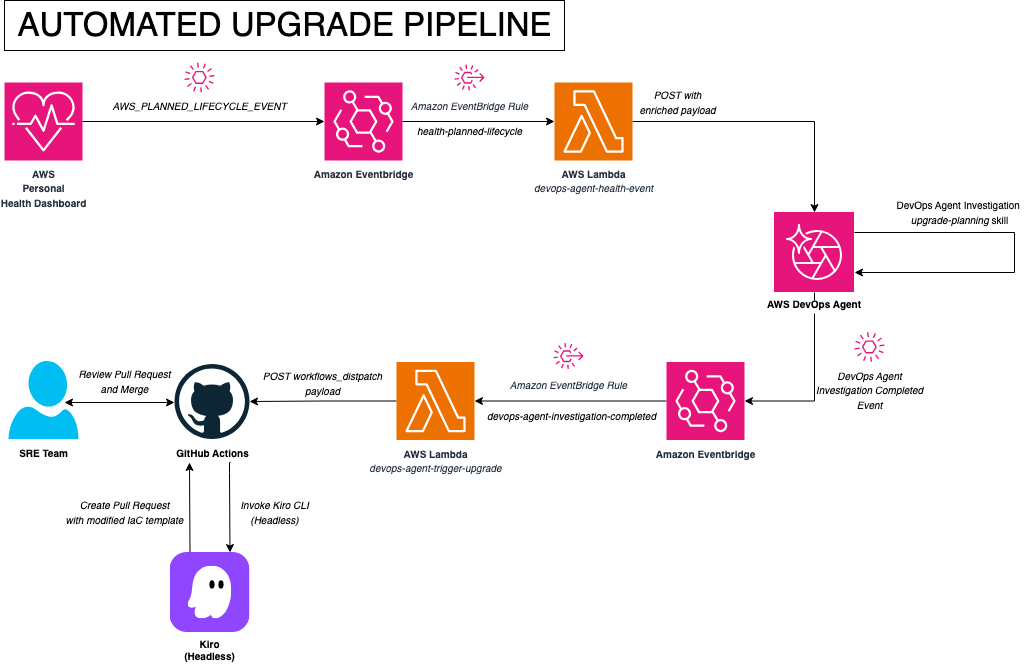
The architectural foundation of this solution relies on a closed-loop system integrated with AWS services, specifically Amazon EventBridge, AWS Lambda, and GitHub Actions. The process is initiated when an AWS Health PLE is published to the default EventBridge bus. This signal acts as a catalyst for the AWS DevOps Agent, which is configured to treat the notification as a high-priority incident.
Upon receipt, the system enters the investigation phase. The AWS DevOps Agent utilizes a specialized skill—specifically designed for EKS upgrade planning—to perform a deep-dive analysis. This agentic investigation involves scanning cluster topology, verifying version increment paths, validating add-on compatibility, and identifying deprecated APIs. The agent then produces a structured AWS Cloud Development Kit (CDK) Change Spec. This specification is crucial as it dictates the target version for every component while simultaneously providing a rollback readiness assessment, which is vital for maintaining uptime.
Following the investigation, the pipeline proceeds to the code and validation phase. A trigger Lambda function fetches the generated journal records and, upon detecting a valid Change Spec, dispatches a GitHub Actions workflow. This workflow does not merely apply changes; it enforces rigorous safety constraints. By using the Kiro CLI in headless mode, the system performs precise file edits to the infrastructure repository, limited strictly to the relevant stack files. This compartmentalization ensures that the agent cannot inadvertently alter unintended parts of the codebase, thereby adhering to the principle of least privilege.
Rigorous Safety and Validation Mechanisms
The safety model of this pipeline is built upon several non-negotiable constraints. First, the pipeline strictly enforces the "one minor version at a time" rule, as EKS does not support skipping Kubernetes versions. Second, it utilizes the 7-day version rollback window provided by EKS. During the investigation, the agent confirms that the rollback readiness status is valid, ensuring that if an upgrade fails, a path to recovery is immediately available.
Furthermore, the pipeline mandates specific ordering for upgrades, particularly regarding the Amazon VPC CNI add-on. Because Amazon Machine Images (AMIs) are optimized for specific networking configurations, the CNI plugin must be updated before node groups. The CDK stack uses explicit DependsOn declarations to ensure this sequence is maintained, preventing pod networking failures. By automating these constraints, the pipeline eliminates the ambiguity that often characterizes manual upgrade procedures.
The Closed-Loop Failure Mitigation Path
Perhaps the most sophisticated aspect of this architecture is the failure detection and mitigation loop. In a traditional environment, a deployment failure after a merge requires urgent human intervention. In this automated framework, if a cdk deploy command fails, the system immediately recognizes the terminal state—such as ROLLBACK_COMPLETE or UPDATE_ROLLBACK_FAILED—emitted by AWS CloudFormation.
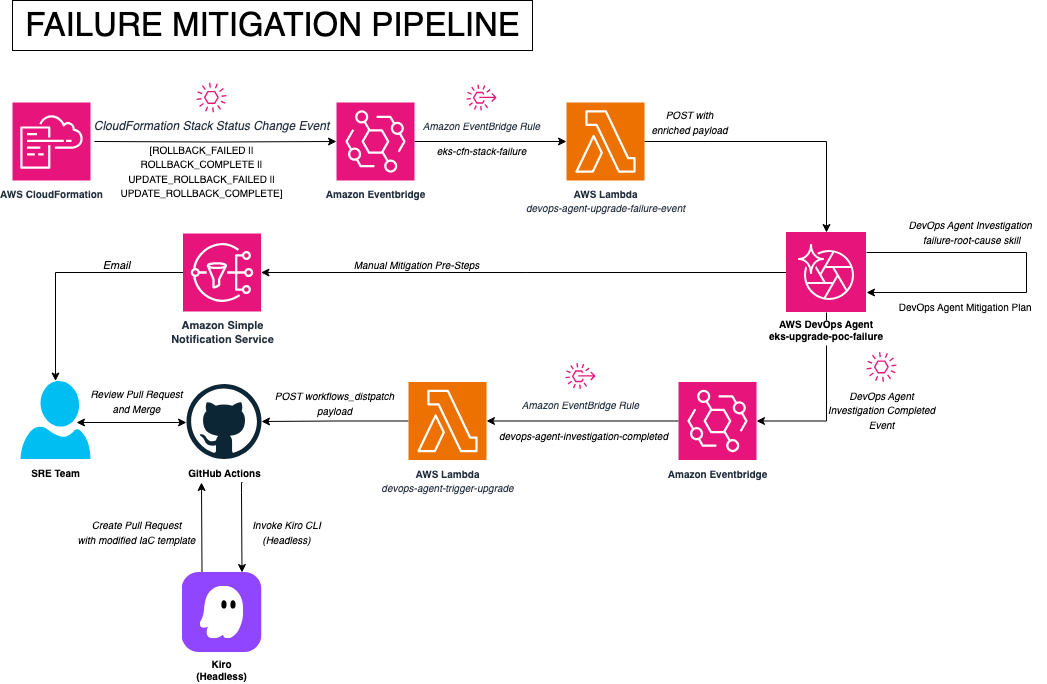
The system then triggers a secondary root-cause analysis. The AWS DevOps Agent investigates the failure, differentiates between transient issues and configuration errors, and produces a mitigation plan. If a version rollback is deemed the most efficient recovery method, the agent prioritizes it. If a code-based fix is necessary, the agent generates the required patch and opens a new pull request. This self-healing capability ensures that even when an upgrade encounters an unexpected obstacle, the remediation process begins instantly, providing SRE teams with actionable insights and pre-validated fixes rather than raw logs.
Maintaining Operational Knowledge with Daily Skill Reviews
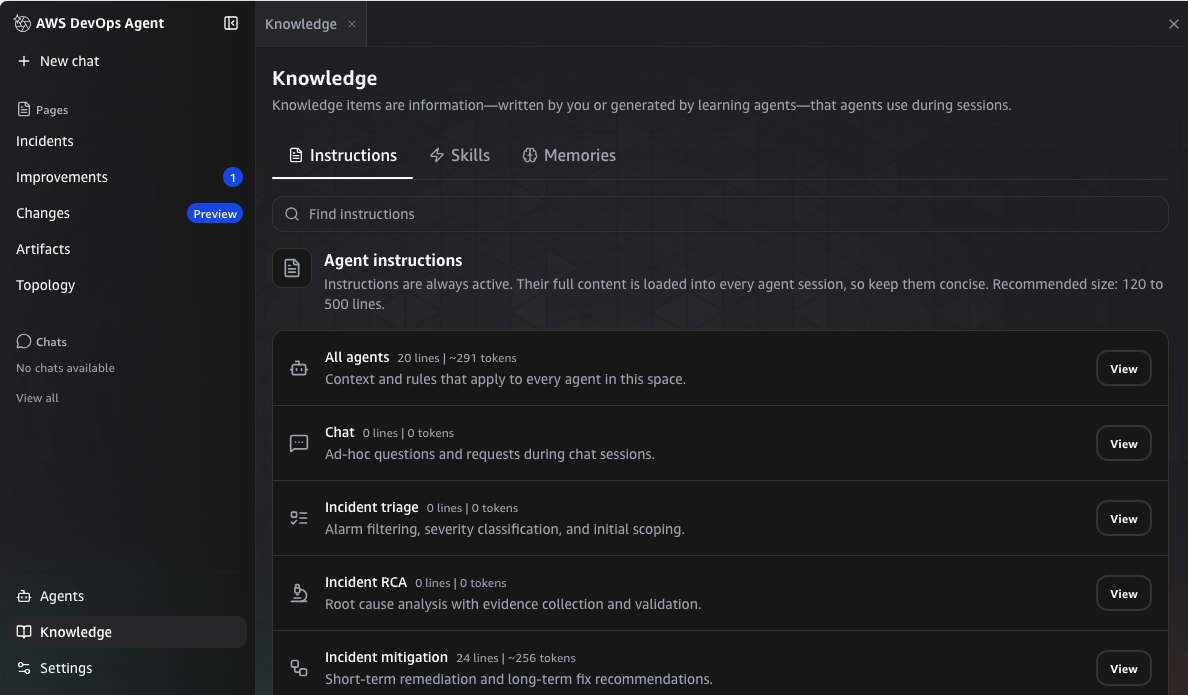
One of the primary challenges in AI-driven automation is "model drift," where the underlying knowledge of an agent becomes outdated as the cloud provider introduces new features or changes deprecation schedules. To solve this, the pipeline includes a daily self-maintenance loop. An EventBridge rule triggers a daily review of the agent’s skills against current AWS API data.
If the agent detects that its internal logic regarding EKS versions or add-on defaults is misaligned with the current AWS landscape, it automatically initiates a workflow to update its own skill files. This keeps the agent’s intelligence evergreen without requiring manual intervention from the team. The result is a system that grows and evolves alongside the AWS platform it manages.
Broader Implications and Strategic Value
The shift toward agent-driven lifecycle management represents a fundamental change in infrastructure operations. For enterprise organizations, the ability to automate mundane, high-risk tasks such as service upgrades offers several strategic advantages:
- Risk Reduction: By replacing manual editing with validated, agent-driven file modification, organizations minimize the risk of syntax errors or configuration drifts that often lead to outages.
- Scalability: As the number of accounts and regions grows, manual management becomes impossible. This pipeline scales linearly with the number of clusters, enabling teams to manage hundreds of environments with the same overhead as a single cluster.
- Human Capital Optimization: By automating the "toil" of version upgrades, senior engineers are freed to focus on high-value architectural improvements, performance optimization, and strategic product development.
- Consistency and Traceability: Every change is linked to an investigation ID, providing a clear audit trail for compliance and security teams. The ability to trace a deployed version back to the specific investigation that authorized it ensures complete observability.
Conclusion
The integration of the AWS DevOps Agent with Kiro and existing CI/CD workflows marks a maturation in cloud-native operations. By moving from manual checklist-driven upgrades to an automated, policy-governed, and self-healing system, organizations can achieve a higher level of operational excellence. While the initial setup requires careful configuration—including IAM roles, webhook credentials, and GitHub PAT management—the return on investment is realized through improved uptime, reduced operational burden, and the ability to confidently adopt new service features as soon as they are released.
As cloud service providers continue to increase the frequency of updates, the capability to automate the lifecycle of these services will transition from a "nice-to-have" feature to an essential component of the modern DevOps toolkit. By leveraging event-driven architectures and agent-based intelligence, organizations can ensure their infrastructure remains secure, performant, and up-to-date without sacrificing the stability of their production workloads. The provided sample code and architectural framework serve as a robust starting point for any team looking to reclaim their time and modernize their operational posture.