The Expanding Horizon of Rust in Web Backend Development
For many years, the Rust programming language was primarily recognized for its strengths in low-level systems programming, embedded systems, and performance-critical infrastructure, areas where its guarantees of memory safety and concurrency without a garbage collector are invaluable. However, the landscape of Rust’s application has broadened considerably. Recent industry trends and developer surveys indicate a notable shift, with web backend development emerging as a key growth area. According to the JetBrains Developer Ecosystem 2025 survey report, building web backends with Rust has ascended to become the third most popular use case for the language. This statistic is not merely an anecdotal observation but a concrete indicator of increasing confidence in Rust’s stability, performance, and the maturity of its ecosystem for mission-critical, long-lived backend systems.
Rust’s entry into the backend space is not about directly competing with established frameworks like Node.js or Django in all their typical applications. Instead, Rust carves out its niche where the stakes are particularly high: in infrastructure APIs, complex data processing pipelines, high-throughput microservices, edge computing, and security-sensitive services. In these environments, the potential for memory safety bugs and concurrency issues, which Rust largely eliminates at compile time, can have severe operational and financial consequences. Its ability to deliver bare-metal performance while ensuring robust safety makes it an attractive choice for applications demanding both speed and reliability. This strategic positioning highlights Rust as a solution for backend challenges that require an uncompromising approach to performance, security, and resource efficiency.
The Rust ecosystem has responded to this demand with a proliferation of mature web frameworks and libraries, each offering distinct advantages. While frameworks like Actix-web, Rocket, and Warp have garnered significant attention for their unique design philosophies and performance characteristics, Axum has distinguished itself as a particularly popular choice. Its ergonomic design, modular architecture, and tight integration with Tokio, Rust’s dominant asynchronous runtime, have propelled its adoption. This popularity is further evidenced by its impressive metrics: over 850,000 daily downloads on crates.io, Rust’s official package registry, and more than 25,000 stars on GitHub, reflecting widespread community engagement and trust.
Decoding Axum: An Ergonomic Framework for Asynchronous Web Services
Axum, hosted under the tokio-rs organization on GitHub, is an HTTP routing and request-handling library that prioritizes developer ergonomics and modularity. Its lineage from the Tokio team, the maintainers of Rust’s most widely used async runtime, is evident in its design philosophy. Axum intentionally builds upon the robust asynchronous infrastructure already present in the Rust ecosystem, aiming to "get out of the way" of developers by providing a lean and efficient layer for web application logic.
At its core, Axum empowers developers to:
- Define HTTP routes: Easily map incoming HTTP requests to specific handler functions.
- Extract data from requests: Seamlessly parse path parameters, query strings, headers, and request bodies into Rust types.
- Manage state: Integrate application-specific state across requests using type-safe mechanisms.
- Handle errors: Implement robust error handling strategies that align with Rust’s idiomatic error management.
- Leverage middleware: Crucially, Axum distinguishes itself by not introducing its own bespoke middleware system. Instead, it fully embraces
tower::Service, a fundamental trait from the Tower ecosystem.
The reliance on tower::Service is a cornerstone of Axum’s design and a significant differentiator. Tower is a library of modular and reusable components for building robust network applications. By leveraging tower::Service directly, Axum inherently gains access to a rich suite of middleware components for functionalities such as timeouts, tracing, compression, rate limiting, and authorization. This architectural choice means developers can integrate these powerful features simply by pulling in existing Tower middleware, eliminating the need to re-implement common concerns. Furthermore, this design fosters greater ecosystem compatibility, allowing middleware developed for applications built with hyper (the HTTP implementation Axum uses) or Tonic (a gRPC framework built on Tokio) to be shared across Axum projects. This unified approach significantly reduces development overhead and promotes a more cohesive asynchronous Rust ecosystem.
Axum’s deliberate decision to work exclusively with Tokio and Hyper, without aiming for runtime or transport layer independence, is another aspect of its focused design. This tight integration allows for optimized performance and a streamlined development experience, ensuring that developers can fully leverage the capabilities of Rust’s asynchronous primitives. For those seeking to delve deeper into its capabilities, comprehensive documentation is readily available, detailing its features and usage patterns.
Axum in Real-World Production Environments
The adoption of Axum extends across a spectrum of applications, from critical commercial infrastructure to widely used open-source tooling, testifying to its reliability and versatility. One of the most prominent examples of Axum in production is crates.io, the official Rust package registry. As the central repository for all Rust libraries, crates.io serves the entire Rust community, handling countless cargo build and cargo add requests daily. Its foundation on Axum speaks volumes about the framework’s ability to manage high-traffic, mission-critical web applications with exceptional stability and performance.
Beyond crates.io, Axum’s influence is evident in cloud computing infrastructure. Cloudflare Workers, a serverless platform that allows developers to deploy code to the edge of Cloudflare’s global network, directly supports Axum through the workers-rs crate. This integration enables developers to write highly performant Cloudflare edge functions using the familiar Axum routing model, pushing application logic closer to users for reduced latency and enhanced responsiveness.

Axum has also become the recommended foundation for several emerging Rust web stacks and starter templates, simplifying the onboarding process for new projects. Loco, a Rails-inspired Rust framework designed for rapid web application development, is built directly on top of Axum, leveraging its robustness for its underlying web infrastructure. Similarly, the popular open-source chess platform Lichess.org utilizes Axum extensively for several of its core background services and microservices, demonstrating its suitability for scalable, real-time applications. These examples collectively underscore Axum’s growing status as the default recommendation when developers inquire about building a web service in Rust, solidifying its position as a cornerstone of the modern Rust web development landscape.
Elevating Developer Experience with RustRover 2026.2
The introduction of Axum support in RustRover 2026.2 directly addresses a critical pain point in web development: the often-tedious process of tracing route definitions to their corresponding handlers and client calls. In complex Axum projects, manually navigating through codebases to understand endpoint relationships can be time-consuming and prone to error. RustRover’s new capabilities are designed to transform this experience, making it more intuitive and efficient.
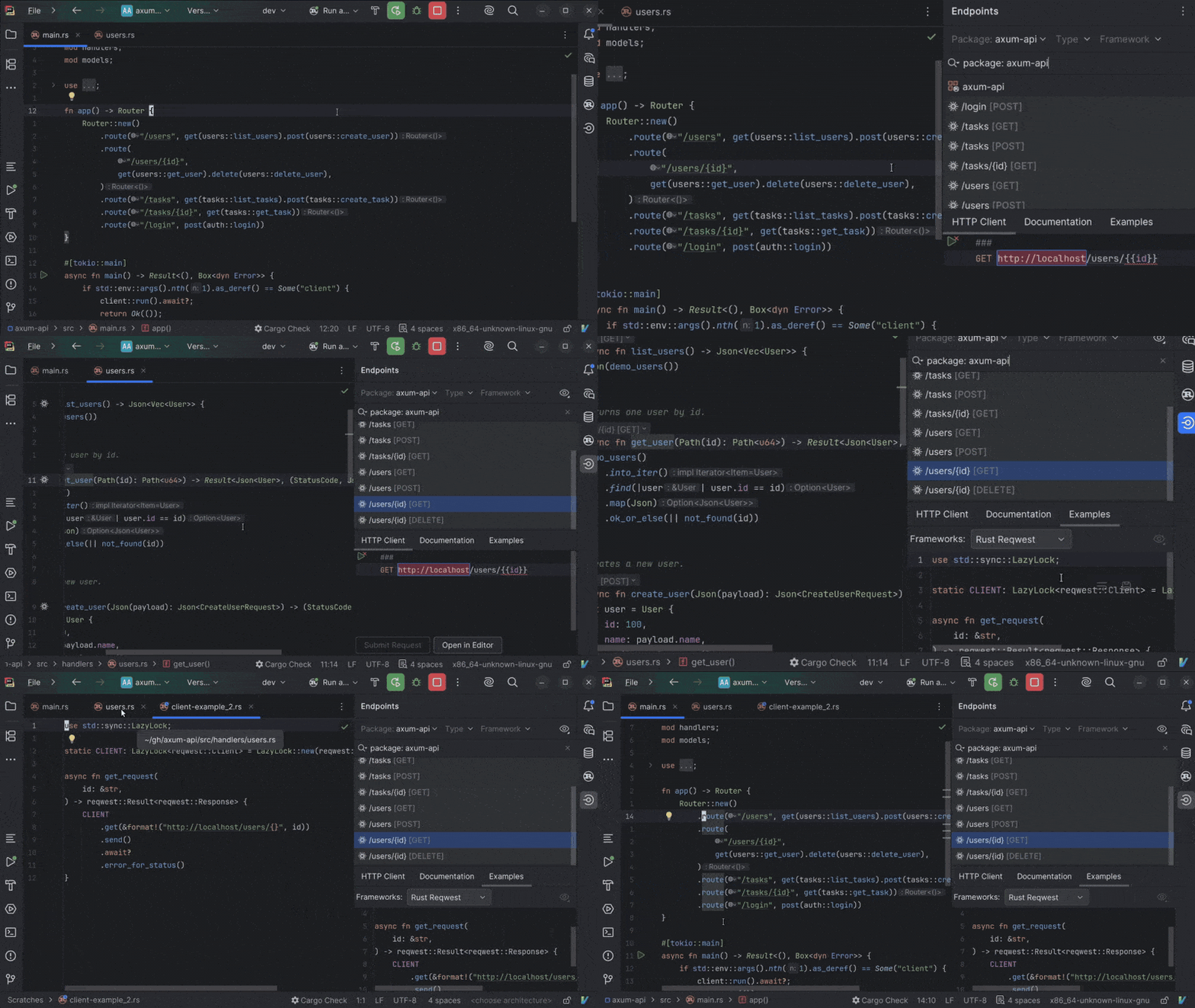
RustRover 2026.2 introduces robust support for both the Axum and Reqwest libraries. The IDE now intelligently understands the defined routes within a project, enabling several key features:
- URL Resolution and Endpoint Discovery: Developers can quickly identify all defined endpoints and understand their structure.
- Seamless Navigation: The IDE facilitates direct navigation between route definitions and their respective handler functions, eliminating the need for manual code searches. This is particularly useful in large projects where handlers might reside in different modules or files.
- Enhanced Route Visualization: Route calls now include informative references and inlay hints. These visual cues provide immediate context about endpoint relationships, making the flow of requests easier to comprehend at a glance. For instance, an inlay hint might display the HTTP method or the associated handler function directly next to the route string, offering immediate clarity.
- Reqwest Support and Request Generation: Complementing Axum support, RustRover 2026.2 also enhances developer productivity for client-side interactions. With Reqwest integration, developers can now generate client calls with significantly less manual setup. This feature streamlines the process of creating requests to Axum endpoints, ensuring consistency and reducing boilerplate code. The IDE can intelligently infer parameters and structure, accelerating the development of client applications or integration tests.
These features collectively aim to reduce cognitive load and accelerate the development cycle for Axum-based projects. By bringing advanced framework-specific intelligence directly into the IDE, RustRover empowers developers to focus on the core logic of their web services rather than wrestling with navigation and setup tasks. The initial release of Axum support is a foundational step, and JetBrains has indicated a commitment to further investment in this area, actively soliciting feedback from the community to refine and expand these capabilities. This iterative approach ensures that future updates will continue to address the evolving needs of Rust web developers.
Strategic Implications and Broader Impact
The integration of Axum support into RustRover 2026.2 carries significant strategic implications for both JetBrains and the broader Rust ecosystem. For JetBrains, it reinforces RustRover’s position as a leading IDE for Rust development, demonstrating a commitment to supporting the language’s expanding use cases, particularly in the critical backend domain. In a competitive IDE market, specialized framework support is a key differentiator, attracting and retaining developers who rely on such tools for their daily work. This move is also a testament to JetBrains’ responsiveness to community demand, acknowledging Axum’s rapid growth and its importance to a substantial segment of Rust developers.

For the Rust ecosystem, this integration represents another stride towards maturity and enterprise readiness. IDE support for popular frameworks is a crucial indicator of a language’s readiness for mainstream adoption. By simplifying the development experience for Axum, RustRover lowers the barrier to entry for new Rust web developers and boosts the productivity of seasoned professionals. This, in turn, can accelerate the adoption of Axum and Rust for a wider array of web backend projects, potentially attracting more companies and developers to leverage Rust’s unique advantages. The enhanced tooling reduces friction, allowing developers to build complex, high-performance, and secure web services more efficiently, thereby contributing to the overall growth and reputation of Rust as a robust backend language.
Looking Ahead: Continuous Improvement and Community Engagement
JetBrains has explicitly stated that Axum support in this release is marked as "initial," signifying an ongoing commitment to its development. This transparent approach encourages developers to actively participate in shaping the future of this integration. By reporting issues via JetBrains’ YouTrack system or leaving comments, the community can directly influence the direction and prioritize future enhancements. This collaborative model is fundamental to the success of specialized IDE features, ensuring they evolve in lockstep with the framework itself and the real-world needs of developers. Future iterations are expected to deepen the integration, potentially including more advanced refactoring tools, live debugging enhancements tailored for asynchronous web services, and even more sophisticated code generation capabilities.
Acknowledging the Foundations: The Importance of Open-Source Sustainability
The capabilities introduced in RustRover 2026.2 would not be possible without the foundational work of the Tokio team and the dedicated Axum contributors. Their sustained efforts in building and maintaining this exceptional piece of open-source infrastructure are paramount. Axum, being free and MIT-licensed, forms the backbone of a growing number of production systems worldwide, underscoring the critical role of open-source projects in modern software development.
JetBrains’ article concludes with a powerful note of gratitude and a call to action: encouraging users whose daily work benefits from Axum to consider sponsoring the Tokio project on GitHub. This emphasis on open-source sustainability is vital. Financial support enables core maintainers to dedicate time and resources to development, maintenance, and community support, ensuring the continued evolution and reliability of essential libraries like Axum. The health of the Rust ecosystem, and by extension, the effectiveness of tools like RustRover, is intrinsically linked to the ability of open-source projects to thrive.
The release of RustRover 2026.2 with its robust Axum support marks a pivotal moment for Rust web development. It signifies the maturity of the Axum framework and JetBrains’ commitment to providing cutting-edge tooling for the Rust community. Developers are encouraged to download RustRover 2026.2 to experience these new capabilities firsthand and contribute their feedback, thereby playing an active role in shaping the future of Rust’s ascent in the web backend domain.