Microsoft exposes dual-pronged cyber threat campaigns involving AI-powered financial fraud and sophisticated passkey-themed cloud compromises.

In a comprehensive security advisory released this week, Microsoft has detailed two distinct, high-impact cyberattack campaigns that illustrate the evolving sophistication of modern threat actors. These campaigns, which have been active throughout the summer of 2026, demonstrate a strategic pivot toward generative artificial intelligence for social engineering and the abuse of trusted infrastructure to bypass traditional multi-factor authentication (MFA) protocols. By combining psychological manipulation with technical exploitation, these threat actors have successfully targeted enterprise-level financial departments and cloud-based identities across multiple sectors.
The Rise of AI-Assisted Executive Impersonation
The first campaign highlighted by Microsoft represents a significant escalation in business email compromise (BEC) tactics. Between August 3 and August 5, 2026, threat actors launched a massive, coordinated effort that dispatched over one million fraudulent emails. The objective was to deceive accounts payable departments into authorizing Automated Clearing House (ACH) transfers under the guise of paying for annual ServiceNow subscriptions.
What distinguishes this operation from standard phishing attempts is the seamless integration of generative AI. The attackers utilized AI tools to generate highly personalized email templates and supporting narratives, effectively removing the tell-tale grammatical errors and generic phrasing that often flag phishing attempts. By tailoring these messages to specific enterprise environments, the threat actors significantly increased the perceived legitimacy of their requests.

The campaign focused heavily on organizations in the United States, particularly those within the IT services, consumer goods, real estate, and manufacturing sectors. The methodology employed was multi-layered:
- Domain Spoofing: Attackers registered domains designed to mimic legitimate corporate and vendor infrastructure.
- Executive Impersonation: Emails were crafted to appear as though they were sent by CEOs or high-level executives, utilizing the specific names and contact details of these leaders, which were likely scraped from professional social networking platforms.
- Narrative Construction: Rather than sending a simple invoice, the attackers created fabricated, lengthy email threads that included forged supporting conversations, creating an illusion of internal approval processes.
- Financial Exploitation: By embedding these fake invoices within a "unified narrative," the attackers aimed to lower the guard of financial personnel, encouraging them to initiate wire transfers to attacker-controlled accounts.
This approach signifies a shift from "spray-and-pray" phishing to highly targeted, narrative-driven fraud that leverages the inherent trust employees place in executive leadership.
Passkey-Themed Social Engineering and Cloud Intrusion
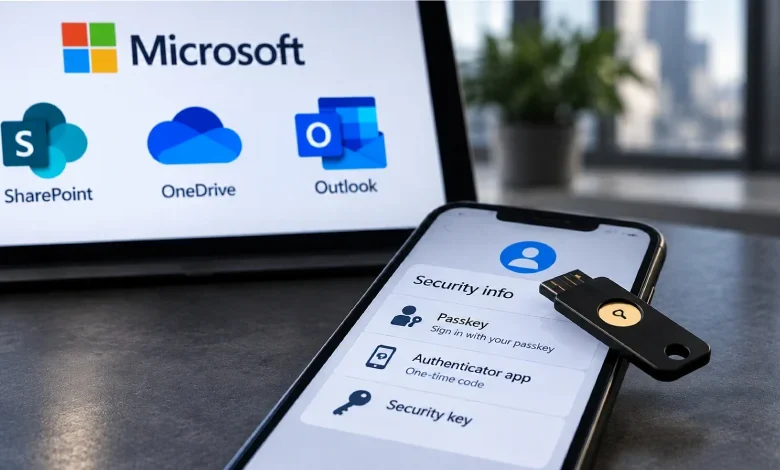
The second campaign, which has been under observation since May 2026, shifts the focus from financial fraud to identity theft and unauthorized cloud access. This campaign employs a "help desk" persona to manipulate employees into compromising their own security credentials.
The attack flow typically begins with a phone call or a text message to an employee’s personal device, where the attacker poses as a representative from their organization’s IT department. The social engineering pretext is simple yet effective: the employee is told they must immediately update their passkey, MFA, or single sign-on (SSO) configuration to prevent a loss of access to corporate systems.

Once the victim is hooked, they are redirected to a sophisticated counterfeit portal that perfectly replicates the Microsoft sign-in experience. By using adversary-in-the-middle (AitM) techniques or exploiting device-code authentication flows, the attackers capture the user’s session tokens or credentials. In some instances, the attackers have been observed utilizing compromised accounts to spread these phishing messages internally via Microsoft Teams, further accelerating the breach within an organization.
Technical Attribution and the E-Crime Ecosystem
Microsoft has linked the initial access components of these campaigns to several known threat groups, including Storm-3121 and Storm-3032. The latter is identified as a designation for the collective known in the security community as UNC6671, or by other monikers such as Cordial Spider and PREY-0058.
These groups are characterized by their "as-a-service" business model. They utilize shared phishing infrastructure, commoditized credential-harvesting panels, and a common playbook for voice-based social engineering. The fact that different threat groups are leveraging the same infrastructure suggests a high degree of collaboration or a "franchise" model of cybercrime, where individual affiliates purchase access to specialized tools to execute their specific extortion goals.
For example, while Storm-3121 has been linked to extortion operations like ShinyHunters and Falcon, Storm-3032 (UNC6671) has been observed transitioning from earlier affiliations with the BlackFile group to their current operations under the "Helix" brand. This fluid movement between criminal groups underscores the difficulty of tracking these actors; they operate as a loose-knit collective that shares resources, making it easier for them to scale operations and adapt to defensive security measures.

Establishing Persistence and Bypassing MFA
Once the attackers gain initial access, their primary objective is to move beyond the initial compromise to establish persistent, long-term control. Microsoft researchers noted that the attackers rarely rely on a single stolen credential. Instead, they quickly register their own authentication methods—such as a new phone number, an authenticator app, or a software-based one-time password (OTP) token—directly to the victim’s account.
This action effectively "locks in" the attacker’s presence. By enrolling their own second-factor authentication, they can bypass subsequent MFA challenges, ensuring they maintain access even if the victim changes their password. Once this persistence is established, the attackers pivot toward post-exploitation activities, which include:
- Graph API Abuse: The attackers use the Microsoft Graph API to automate the collection of sensitive data from SharePoint, OneDrive, and Outlook.
- Internal Reconnaissance: They map the organization’s network, identify high-value targets, and enumerate internal services to facilitate further lateral movement.
- Credential Harvesting: They search through emails and documents for further credentials or keys that could provide access to even more secure systems.
Microsoft’s security team has emphasized that these API calls often appear benign when viewed in isolation. Because each request looks like a standard interaction with Microsoft services, they are difficult to detect using traditional, signature-based security tools. Organizations must, therefore, adopt a more holistic approach to security, focusing on cross-event correlation and behavioral patterns rather than individual API calls.
Broader Implications and Strategic Recommendations
The surge in these campaigns serves as a stark reminder that even the most robust technical security measures, such as MFA, are not infallible when faced with sophisticated social engineering. The "passkey" lure is particularly dangerous because it exploits the very tools meant to increase security, turning user awareness of modern authentication methods against them.

For organizations, the primary takeaway is the urgent need for "Zero Trust" architectures that prioritize behavioral analysis and identity verification at every step. Microsoft recommends that IT departments focus on the following defensive strategies:
- Identity Verification: Implement stricter policies for help desk interactions, ensuring that any request for authentication updates is verified through out-of-band communication channels.
- Holistic Monitoring: Utilize advanced threat detection tools that can correlate events across the entire Microsoft 365 environment, identifying anomalies in Graph API usage and unusual sign-in patterns.
- User Education: Employees must be trained to recognize that official IT departments will never ask them to update security settings via a link sent to a personal phone number or during an unsolicited phone call.
- Conditional Access: Leverage Conditional Access policies that require managed, compliant devices for access to sensitive corporate resources, which would prevent attackers from using unmanaged devices to exfiltrate data.
The shift toward AI-facilitated fraud and highly personalized social engineering marks a new chapter in cybersecurity. As threat actors continue to refine their playbooks, the divide between "human-centric" attacks and "system-centric" exploits is narrowing. Protecting against these threats requires not just better software, but a fundamental change in how organizations verify identity and monitor for subtle, anomalous behaviors that signify a breach is already in progress. The 2026 campaigns demonstrate that in the modern digital landscape, the most effective security tool remains a vigilant, informed, and skeptical workforce.