React Native 0.86 Ushers in a New Era with Seamless Edge-to-Edge Android Support and Enhanced Developer Tools

The React Native ecosystem has officially welcomed its latest iteration, React Native 0.86, a significant release that promises to streamline development workflows and enhance the user experience across mobile platforms. This update, building upon the foundation of previous releases, introduces robust support for Android’s edge-to-edge display mode on Android 15 and newer, alongside notable enhancements to the React Native Developer Tools. Crucially, this marks the second consecutive major release of React Native to ship without any user-facing breaking changes, underscoring a strategic commitment by the development team to foster more predictable and frictionless upgrade paths for developers.
A Transformative Move: React Native Joins the React Foundation
A pivotal development accompanying the release of React Native 0.86 is the relocation of its core repository and associated projects. The official GitHub repository for React Native, along with React, Metro, Yoga, and the React Native Website, has transitioned from the long-standing facebook organization to the newly established react organization. This strategic migration signifies a broader shift in the governance and stewardship of the React ecosystem. The move aligns with the formal establishment of the React Foundation, an independent entity dedicated to the sustained growth and evolution of React and its surrounding technologies.
This transition to an independent foundation is a landmark event for the React community. Historically, React and React Native development has been heavily influenced and supported by Meta (formerly Facebook). The creation of the React Foundation signals a maturation of the ecosystem, aiming to foster greater community involvement, diversify funding sources, and ensure the long-term health and adaptability of React-related projects, independent of any single corporate entity. While the GitHub repository has changed, users are assured that all existing URLs, issues, and pull requests will be automatically redirected, ensuring a seamless transition with no immediate action required from developers. This move is expected to foster a more open and collaborative development environment, potentially accelerating innovation and addressing developer needs more directly.
Embracing the Full Screen: Enhanced Edge-to-Edge Support on Android
React Native 0.86 delivers a significant upgrade for developers targeting modern Android devices with its comprehensive implementation of edge-to-edge display support. This release includes extensive fixes and improvements for Android 15 and subsequent versions, ensuring that applications can elegantly extend beyond the traditional screen bezels. The enhancements are particularly impactful for scenarios where Android’s system-level edge-to-edge mode is enforced, even if the edgeToEdgeEnabled Gradle property has not been explicitly configured within the project.
The implications of this update are substantial. Edge-to-edge displays offer users a more immersive visual experience, allowing apps to leverage the entire screen real estate. For developers, this means a more consistent and modern look and feel for their applications across a wider range of Android devices. Historically, achieving true edge-to-edge compatibility could involve complex workarounds and platform-specific code. React Native 0.86 aims to abstract away much of this complexity, providing a more unified API and behavior.
Key fixes within this area include ensuring that system bars (like the status bar and navigation bar) are correctly handled and that content is not obscured. This involves addressing how the application’s layout interacts with system UI elements and ensuring that touch events are properly managed across the entire display area. This release also focuses on improving the visual consistency of the app’s background and content when interacting with different system UI configurations, such as gesture navigation. By addressing these nuances, React Native 0.86 empowers developers to create visually stunning and highly functional applications that take full advantage of the latest Android display capabilities. This enhancement is particularly relevant as device manufacturers increasingly adopt full-screen designs, making this feature a critical component for modern app development.
Refining the Developer Experience: React Native DevTools Get Smarter
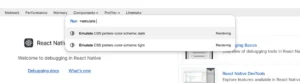
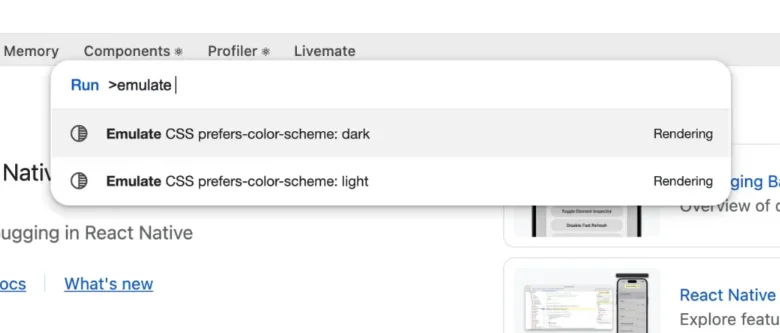
The developer experience is a cornerstone of React Native’s success, and React Native 0.86 brings welcome enhancements to the React Native Developer Tools. A standout feature is the newly integrated support for light and dark mode emulation. Developers can now simulate their app’s appearance across different themes directly within DevTools, utilizing the Emulation.setEmulatedMedia functionality. This allows for quick and efficient testing of how an application’s UI adapts to system-wide dark mode settings without the need to constantly switch device preferences.
Accessing this feature is intuitive. By opening the Command Palette within DevTools (typically via cmd + shift + P on macOS or ctrl + shift + P on Windows/Linux), developers can find and select the option to emulate light or dark modes. This capability is invaluable for ensuring that color schemes, typography, and UI elements are correctly rendered and accessible in both environments. It’s important to note that this is a temporary emulation, designed to provide immediate feedback during development. The setting will revert to its default state when the DevTools session is disconnected, preventing unintended persistent changes. This improvement significantly accelerates the design and testing cycle for applications with distinct light and dark mode implementations.
A Commitment to Stability: No User-Facing Breaking Changes
React Native 0.86 continues a positive trend observed in its predecessor, React Native 0.83, by shipping without any user-facing breaking changes. This deliberate approach to release management underscores the React Native team’s dedication to making the upgrade process as seamless and predictable as possible for the global developer community. For developers currently working with React Native 0.85, the upgrade to 0.86 is expected to be a straightforward affair, requiring minimal to no modifications to existing application code.
This focus on backward compatibility is a significant benefit for both individual developers and large organizations managing extensive React Native codebases. Breaking changes can often introduce substantial rework, delays, and the potential for introducing new bugs. By minimizing these disruptions, the React Native team fosters greater confidence in adopting new versions and encourages developers to stay up-to-date with the latest improvements and security patches. The project’s versioning policy, detailed in their documentation, defines what constitutes a breaking change, providing transparency and setting clear expectations for the community. This commitment to stability is a crucial factor in React Native’s continued adoption and its ability to compete in the rapidly evolving mobile development landscape.
Deprecations and Future Considerations
While React Native 0.86 prioritizes stability, the release does signal the deprecation of certain APIs, indicating a move towards more modern or efficient alternatives in future versions. Although specific deprecated APIs were not detailed in the provided content, this practice is standard for software development, allowing developers ample time to migrate away from outdated functionalities before their eventual removal. Developers are encouraged to consult the official React Native documentation for a comprehensive list of deprecated APIs and their recommended replacements to ensure long-term project maintainability. This proactive approach to deprecation helps prevent technical debt from accumulating within the ecosystem.

Under the Hood: Runtime, Layout, and Infrastructure Enhancements
Beyond the headline features, React Native 0.86 incorporates a multitude of under-the-hood improvements across various aspects of the framework. These changes, while not always immediately visible to end-users, are critical for the performance, stability, and future extensibility of React Native applications.
Runtime and Web Spec Alignment: Efforts continue to align React Native’s runtime behavior with web standards. This synchronization helps bridge the gap between web and native development, potentially enabling greater code sharing and a more consistent developer experience across platforms.
Rendering, Layout, and Animation: Optimizations in the rendering pipeline, layout engine, and animation system are consistently being made. These improvements can lead to smoother animations, faster screen updates, and more responsive user interfaces, directly impacting the perceived quality of the application.
Accessibility: Enhancements to accessibility features ensure that React Native applications are usable by a wider audience, including individuals with disabilities. This aligns with global efforts to create more inclusive digital experiences.
Infrastructure and Dependencies: Updates to underlying infrastructure and dependencies are crucial for security and performance. This includes keeping build tools, compilers, and libraries up-to-date, which can introduce performance gains and address potential vulnerabilities.
JSI (JavaScript Interface) Advancements: The JavaScript Interface (JSI) is a key component for enabling efficient communication between JavaScript and native code. React Native 0.86 introduces new JSI APIs designed to enhance the capabilities of the C++ interface, allowing for more sophisticated interactions between native modules and the JavaScript engine. This could lead to improved performance for native modules and greater flexibility in their implementation. Specific additions aim to provide more robust memory management and efficient data transfer mechanisms.
Android Input, Navigation, and Images: The release also includes targeted improvements for Android, focusing on areas such as input handling, navigation patterns, and image processing. These platform-specific refinements can lead to a more native-feeling experience on Android devices, addressing common user interaction paradigms and optimizing resource usage for visual elements.
Android Networking: Further enhancements to Android networking capabilities can lead to more reliable and performant network requests, crucial for applications that rely heavily on data fetching and API interactions.
A Collaborative Effort: Acknowledgements and Community Contributions
React Native 0.86 is a testament to the vibrant and collaborative nature of the React Native community. The release comprises over 596 commits contributed by an impressive 97 developers. This broad participation highlights the ongoing dedication of individuals and organizations worldwide to the advancement of the React Native framework. The release notes specifically acknowledge the significant contributions of community members who played a key role in shaping this version, underscoring the project’s reliance on and appreciation for external input.
Upgrading to React Native 0.86: A Seamless Transition
React Native 0.86 now stands as the latest stable version, with prior versions like 0.83.x transitioning to an unsupported status, as per React Native’s support policy. Developers looking to adopt the latest version have two primary pathways. For existing projects, the React Native Upgrade Helper remains an invaluable tool. This web-based utility allows developers to compare code changes between different React Native versions and provides guidance on how to integrate these updates into their specific projects. Supplementing the Upgrade Helper, the official Upgrading documentation offers comprehensive instructions and best practices for navigating version transitions.
For those embarking on new projects, creating an application with React Native 0.86 is straightforward. The recommended approach is to use the latest version of the @react-native-community/cli package. By running npx @react-native-community/cli@latest init MyProject --version latest, developers can bootstrap a new project initialized with the most recent stable release of React Native.
For users of the Expo managed workflow, React Native 0.86 will be made available through the expo@canary releases. This allows Expo developers to access the latest React Native features and improvements within their familiar development environment, albeit in a pre-release channel that may contain experimental features. This phased rollout ensures that Expo users can benefit from the latest advancements while maintaining the stability and ease of use that Expo provides. The continuous evolution of React Native, marked by releases like 0.86, reinforces its position as a leading framework for building high-quality, cross-platform mobile applications.