React 17 Is Officially Released and Focuses on Paving the Way for Future Incremental Upgrades

The React team has officially launched React 17, a landmark release that marks a departure from the traditional approach of shipping new developer-facing features. Instead, this version is strategically architected to function as a "stepping stone," prioritizing structural improvements that simplify the long-term maintenance and upgrade paths for large-scale web applications. By addressing deep-seated issues within the event delegation system and enabling more flexible version management, the React team is setting the foundation for future iterations, including the highly anticipated React 18 and beyond.
A Departure from Feature-Driven Development
In the ecosystem of front-end web development, major framework releases are typically associated with a flurry of new hooks, API changes, or rendering optimizations. However, the release of React 17 stands as an outlier in this history. Following the release of the Release Candidate (RC) in August 2020, the final version confirms that no new developer-facing features were included.
This decision was deliberate. The React team identified that the primary friction point for many organizations, particularly those managing legacy codebases, was the "all-or-nothing" upgrade model. Historically, upgrading React meant migrating an entire application’s dependency tree simultaneously. While this is straightforward for greenfield projects or smaller applications, it becomes an immense, high-risk undertaking for enterprise-level applications with complex dependencies. React 17 addresses this by enabling "gradual upgrades," a paradigm shift that allows developers to host multiple versions of React within a single page or application tree.
The Chronology of React’s Evolution
To understand the significance of this update, one must look at the timeline of the library’s growth. Since its open-source debut in 2013, React has evolved from a simple UI library to a cornerstone of modern web development. The transition from React 15 to 16 introduced the "Fiber" reconciliation engine, which brought asynchronous rendering and improved stability. However, as the ecosystem matured, the technical debt of older versions began to manifest in how React interacted with the browser’s DOM.
By 2020, the React team determined that to move forward with future, more complex features—such as Concurrent Mode—they needed to resolve underlying conflicts caused by the way React handled event delegation. By refining the event system in version 17, the team has effectively cleared the path for the future release of React 18, ensuring that developers are not trapped in a version-locking cycle.
Technical Analysis: Re-engineering Event Delegation
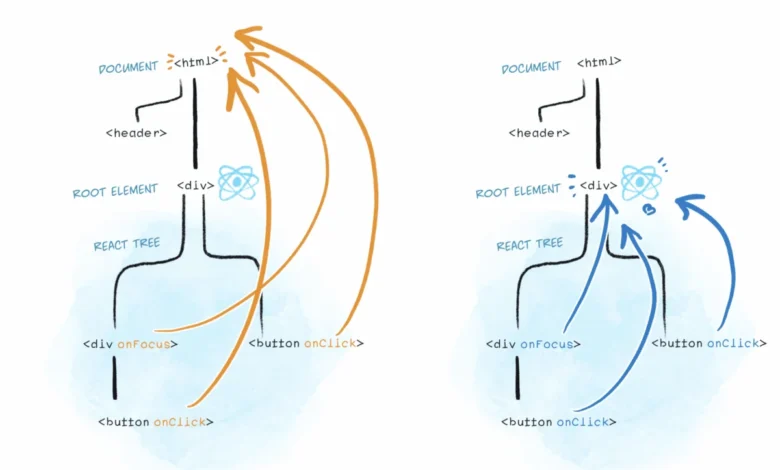
The most significant technical change in React 17 is the modification of the event delegation system. Previously, React attached event listeners to the document node of the browser. While this was efficient for early versions of the library, it created significant hurdles for modern web environments where React might need to coexist with other technologies, such as jQuery or other versions of React.
In React 17, the library now attaches event listeners to the specific root DOM container where the React tree is rendered. This change is critical because it isolates the event system. If an application contains a nested component tree managed by React 17 and another by an older version, or even by a non-React library, the event bubbling no longer risks cross-contamination.
This architectural shift is based on extensive feedback from the developer community. Over the years, the project’s issue tracker documented numerous edge cases where event propagation caused unexpected behavior in complex integrations. By moving the listener to the root container, the React team has provided a cleaner, more predictable integration model. Internal testing at Facebook, which maintains a codebase with over 100,000 components, confirmed that fewer than twenty components required adjustments to accommodate this shift, suggesting that the vast majority of the community will experience a seamless transition.

The "Gradual Upgrade" Strategy and Implications
The ability to perform gradual upgrades is arguably the most transformative aspect of this release for the enterprise sector. Under the new model, a development team can keep a legacy section of a site running on an older version of React while migrating other, more active modules to newer versions. This approach reduces the "all-or-nothing" risk factor, allowing for incremental refactoring over months or years rather than requiring a massive, multi-week code freeze to handle a major library migration.
While the React team emphasizes that for most projects, upgrading the entire application at once remains the "best solution," the provision of this new capability is a significant concession to the needs of large-scale, long-term software maintenance. The team has provided a dedicated repository demonstrating how to lazy-load older versions of React, serving as a blueprint for organizations dealing with massive technical debt.
Supporting the Ecosystem: JSX and React Native
Alongside the core changes, React 17 officially supports the new JSX transform. This feature, which was also backported to versions 16.14.0, 15.7.0, and 0.14.10, allows developers to compile JSX into JavaScript without requiring the import React from 'react' statement in every file. This represents a modernizing trend in the ecosystem, simplifying the build pipeline and slightly reducing bundle sizes.
For mobile developers, the integration remains consistent. React Native support for these changes was incorporated into version 0.64. This ensures that the benefits of the version 17 architecture—specifically regarding event handling and stability—are available to the mobile development community, maintaining the parity between web and native platforms that the React team has prioritized for years.
Industry Impact and Future Outlook
The release of React 17 represents a shift in philosophy for the React core team—a move toward infrastructure stability over feature-set expansion. By focusing on the "plumbing" of the framework, they have addressed the most persistent pain points reported by the community.
For the average developer, the implications are twofold. First, the immediate impact is a low-friction upgrade path that requires minimal code changes. Second, the long-term impact is the removal of the "version wall." No longer will developers feel forced to stay on outdated versions of React because the cost of upgrading a massive, aging codebase is too high.
As the web continues to demand faster, more responsive, and increasingly complex user interfaces, the importance of a stable, upgradeable framework cannot be overstated. By prioritizing this "stepping stone" release, the React team has ensured that the library remains sustainable for the next decade of web development. As the community begins to transition to this version, the focus will likely shift back to the advanced, experimental features that have historically defined the framework’s competitive advantage, now supported by a much more robust and flexible foundation.
For those ready to integrate the update, the installation process remains straightforward via npm or Yarn. The team continues to urge developers to consult the official documentation for specific migration strategies, particularly for those looking to leverage the new, more granular approach to version control within their application architectures. The message from the React team is clear: they are preparing the ground for the next era of UI development, and this release is the essential first step in that journey.