Engineering teams tasked with managing large-scale Java estates are increasingly confronting a familiar but high-stakes pressure: the recurring deadline for JDK support. With hundreds of services often requiring migration—ranging from simple dependency audits to complex transformations from javax to jakarta namespaces and the adoption of modern test frameworks—manual upgrades are no longer sustainable. As these organizations look to integrate autonomous AI agents to accelerate these transitions, they are discovering that the speed of automation comes with a complex set of operational, financial, and security risks.
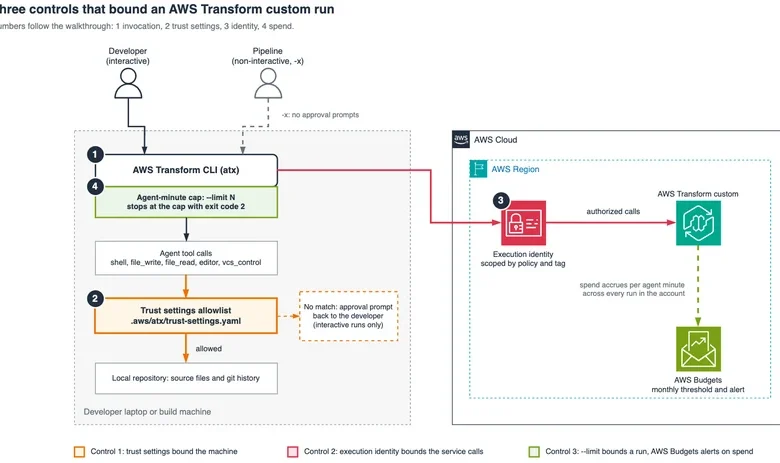
The paradigm shift in software maintenance is clear: where a developer might spend weeks manually refactoring a single repository, an AI agent can perform build operations, source code edits, and commit cycles in a matter of minutes. However, the deployment of such agents across an entire fleet of services requires a rigorous governance framework. AWS Transform custom has emerged as a focal point for this transition, providing the tooling necessary to scale these migrations while maintaining control through three primary configuration levers: trust allowlists, scoped execution identities, and granular spending caps.
The urgency of this transition is driven by the industry-wide sunsetting of older JDK versions. In the current enterprise landscape, a central engineering group might oversee hundreds of microservices, many of which face end-of-support deadlines within two quarters. Missing these deadlines exposes infrastructure to security vulnerabilities and compliance risks. Consequently, the transition to agentic workflows is less of a luxury and more of an operational imperative.
Unbounded Risks and the Need for Guardrails
The autonomy of an AI agent—which possesses shell access, environment credentials, and the ability to modify source code—necessitates a new approach to security. Experts in DevOps governance identify three specific risks that must be mitigated before fleet-wide deployment: tool execution, identity management, and runaway costs.
First, the risk of unchecked tool execution is significant. Agents perform their work by invoking system tools, such as git, compilers, and file editors. Without a defined allowlist, an agent might execute commands that deviate from the intended transformation path. While the initial impulse for many teams is to use broad "trust-all" flags to bypass approval prompts, this effectively removes the guardrails that prevent unauthorized shell command execution.
Second, identity management is a critical vulnerability. The AWS credentials assigned to an agent during a local, interactive run are often the same ones inherited by CI/CD pipelines. If a role is granted broad permissions—such as the ability to both execute transformations and manage the definition of those transformations—a compromised or misconfigured agent could potentially rewrite the very logic it is intended to enforce.
Third, the financial risk is often overlooked until the end of the billing cycle. AWS Transform is billed on an agent-minute basis, tracking the time an agent spends reasoning, planning, and modifying code. In a small, isolated test, the costs are negligible. However, when scaled across hundreds of repositories, an unmonitored fleet of agents could accrue significant costs, particularly if recursive loops or inefficient planning patterns emerge.
Implementing a Multi-Layered Governance Strategy
To manage these risks, engineering teams are adopting a three-tiered control strategy. The first tier involves the creation of a "trust settings" file. By establishing an allowlist in the ~/.aws/atx/trust-settings.yaml file, organizations can explicitly define which shell commands are permitted. This allows teams to categorize commands into trusted operations (such as standard build commands) and those that require manual intervention. In practice, this shift has been shown to reduce interactive approval prompts from dozens to zero, allowing developers to focus on higher-value code review rather than repetitive tool authorization.
The second tier focuses on identity segregation. By utilizing AWS-managed policies such as AWSTransformCustomExecuteTransformations, teams can enforce the principle of least privilege. This policy grants the necessary permissions to perform transformations while withholding the ability to author or delete them. For further security, teams can utilize resource tagging. By tagging transformation packages with specific metadata and scoping IAM policies to require these tags, organizations can ensure that their pipeline roles are only authorized to execute approved, pre-vetted transformation definitions.
The third tier, financial control, involves the implementation of per-run limits and account-level budgeting. By using the --limit flag in the AWS Transform CLI, administrators can hard-cap the number of agent minutes a single task can consume. If an agent hits this limit, the process exits with a specific error code (typically code 2), allowing the pipeline to pause and notify a human engineer for review. This serves as a vital circuit breaker for complex or malfunctioning tasks. When coupled with AWS Budgets and cumulative spend alerts, this tiered approach creates a robust, automated framework for large-scale modernization.
Chronology of the Modernization Workflow
The typical lifecycle of a successful, governed transformation begins on a developer’s workstation. Initially, a discovery run is performed without restrictive configurations to identify the specific tool calls and shell commands required for the migration. This data is then used to populate the trust allowlist.
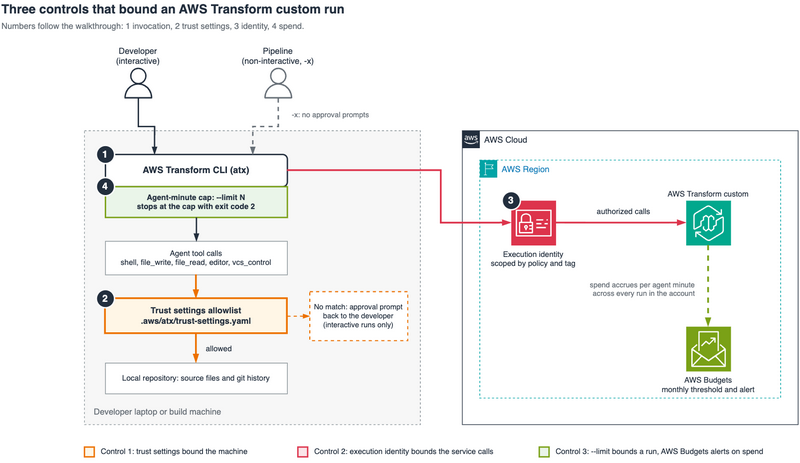
Once the allowlist is established, the configuration is moved to the CI/CD pipeline. The pipeline is then provisioned with a scoped execution identity, ensuring it cannot alter transformation definitions. Finally, the transformation is executed across the fleet, with each run protected by a predefined agent-minute cap. If a budget alert is triggered, the organization can pause the rollout, review the usage via AWS Cost Explorer, and refine the transformation parameters before proceeding.
Broader Implications for Enterprise DevOps
The shift toward autonomous modernization represents a fundamental change in how enterprises manage technical debt. By treating infrastructure and source code transformation as a governed, configuration-based process, organizations can maintain consistent security and cost standards even as they offload repetitive labor to AI.
Industry analysts note that this model effectively bridges the gap between the speed required by modern development cycles and the compliance requirements of large enterprises. The ability to audit, gate, and cap agent activity transforms the AI agent from a "black box" of potential risk into a predictable, measurable component of the DevOps toolchain.
However, the efficacy of this approach relies on rigorous maintenance. As CLI versions evolve and new transformation definitions are introduced, organizations must remain vigilant. The persistence of "lessons learned" by agents—whereby previous runs can influence future behavior—means that teams must continue to review the output of their automated pipelines, ensuring that human intent remains the primary driver of architectural changes.
Conclusion
The successful deployment of AI-driven Java modernization is not merely a matter of selecting the right agent; it is an exercise in rigorous governance. By implementing trust allowlists, enforcing identity separation, and setting strict financial guardrails, engineering teams can safely navigate the transition to modern JDK environments. As these tools continue to mature, the ability to codify and automate these guardrails will become a defining characteristic of high-performing engineering organizations. Through this structured approach, the industry is effectively moving toward a future where technical debt is addressed not through manual, error-prone effort, but through secure, scalable, and fully observable autonomous processes.