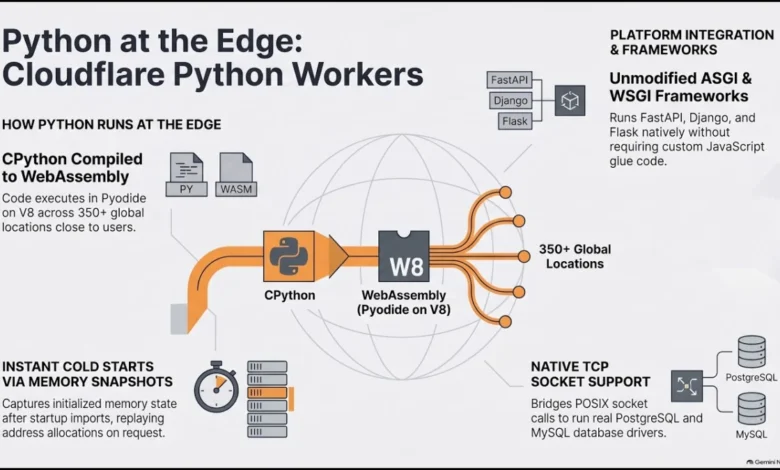
In a significant milestone for serverless computing and the Python ecosystem, Cloudflare has officially announced the general availability of Python Workers. This development marks the culmination of a years-long technical initiative to bridge the gap between Python’s massive developer community and the performance-oriented edge computing architecture provided by Cloudflare. By integrating CPython—compiled to WebAssembly via the Pyodide project—directly into the Cloudflare Workers runtime, the platform now allows developers to execute Python applications at over 350 locations worldwide, drastically reducing latency by processing data closer to the end user.
The transition from a beta phase to general availability signals that Cloudflare has successfully addressed the complex challenges of runtime stability, dependency management, and resource isolation that historically plagued attempts to run full-featured Python environments in distributed edge nodes. The project was brought to fruition through the collaboration of key figures in the Pyodide and WebAssembly communities, including Hood Chatham, Gyeongjae Choi, and Dominik Picheta, who have worked extensively to ensure that Python applications can now perform with the speed and reliability expected of modern cloud-native infrastructure.
A Chronology of Innovation in Edge Computing
The journey toward Python Workers began with the fundamental realization that while JavaScript and TypeScript were the native languages of the browser and the edge, the vast majority of backend data science, machine learning, and business logic was written in Python. Projects like Pyodide originally emerged to bring the Python interpreter into the browser via WebAssembly (Wasm). Simultaneously, Cloudflare was pioneering the "browser in the server" approach, allowing developers to execute code in distributed V8 engine instances.
The strategic integration of these two technologies required a shift in how Python is packaged and executed. During the initial development phase, which began in earnest around late 2023, the engineering team focused on creating a seamless developer experience. By 2024, the beta version allowed early adopters to test the waters, but it wasn’t until late 2026 that the platform achieved the maturity required for production-grade deployments. The intervening years were spent perfecting the "memory snapshot" technology—a critical advancement that enables the runtime to bypass the lengthy initialization and startup processes typically associated with loading heavy Python environments.
Technical Foundations and the Role of WebAssembly
At the heart of the new offering is the Emscripten toolchain, which provides the critical link between Python’s C-based source code and the WebAssembly environment. WebAssembly serves as the isolated sandbox where the Python interpreter runs, ensuring that code execution is secure and performance-efficient.
However, running Python in a Wasm environment presented several hurdles, particularly regarding Input/Output (I/O) operations. Traditional Python code expects a standard Linux-like environment for file system access and socket communication. To resolve this, the Cloudflare team had to implement sophisticated adapters that translate system calls into JavaScript-compatible instructions. This architecture allows a FastAPI application to run as if it were on a traditional server, even though it is being executed within the highly restrictive, ephemeral context of an edge worker.
One of the most complex technical achievements highlighted by the engineers involves socket support. Because browsers and edge runtimes do not inherently support standard blocking network sockets, the team had to wire Node.js-style socket APIs into the Python interpreter. This allows code that relies on standard network libraries to function without modification. Furthermore, the development of "WebLoop," an event loop specifically designed to unify Python’s asyncio with the browser’s event-driven nature, ensures that I/O operations do not hang or crash the runtime.
Packaging and the Impact of PEP 783
The shift toward general availability was heavily supported by improvements in the broader Python packaging landscape. The adoption of PEP 783, which focuses on standardizing the creation of Python packages for unconventional platforms like Wasm, has been a major tailwind for the project. Previously, the Cloudflare engineering team had to manually maintain and cross-compile hundreds of Python packages to ensure compatibility with their environment. This was not only labor-intensive but also prone to errors and version mismatches.
With the advent of the new packaging standards, library maintainers can now use tools like cibuildwheel to generate wheels that are compatible with Pyodide and WebAssembly natively. This shift effectively decentralizes the maintenance burden, allowing popular libraries like NumPy, Pandas, and various data processing utilities to be utilized by Python Workers with significantly less friction. By moving toward a model where the ecosystem provides Wasm-ready wheels, Cloudflare has cleared a massive hurdle for developers who previously had to rely on custom-built environments.
Implications for the Serverless Landscape
The introduction of Python Workers changes the calculus for many organizations considering their cloud architecture. Traditional serverless offerings, such as AWS Lambda or Google Cloud Functions, typically operate within the confines of regional data centers. While highly capable, these services are subject to the physical limitations of light speed; requests must travel to the region where the function resides. Cloudflare’s model, by contrast, deploys the code to every one of its 350+ points of presence.
This geography-agnostic deployment strategy offers significant advantages for applications that are sensitive to latency, such as real-time API services, edge-based data transformation, and personalized content delivery. Furthermore, the cost structure associated with Cloudflare’s edge computing model is often more favorable for high-frequency, low-compute tasks. With a generous free tier that includes 100,000 requests per day, it provides a low-barrier entry point for hobbyists and developers testing the viability of their applications.
Database and Storage Integration
A key feature of the Python Workers release is the deep integration with Cloudflare’s broader data storage ecosystem, specifically D1 and R2. D1, the company’s distributed SQL database powered by SQLite, is particularly well-suited for this environment. Because D1 supports replication across the globe, a Python Worker can query a local database instance with sub-millisecond latency. This eliminates the need for the worker to make cross-continental round trips to a primary database server, a frequent bottleneck in distributed application design.
R2, the company’s object storage service, complements this by providing an S3-compatible storage layer without the prohibitive egress fees often associated with cloud storage providers. When combined with Python’s robust data handling libraries, developers can now build full-stack applications entirely on the edge. They can store user assets in R2, manage relational metadata in D1, and execute business logic in Python—all within a single, unified deployment flow managed by the Wrangler CLI.
Addressing Constraints and Future Directions
Despite the progress, it is important for developers to understand the constraints of the edge. Python Workers operate within memory limits (currently set at 128MB) and strict CPU time caps. These limits are inherent to the serverless model, where resources are shared and intended for discrete execution cycles rather than long-running processes. The engineering team explicitly advises against using Python Workers for resource-intensive data science operations that require loading massive datasets into memory. Instead, they encourage a stream-oriented approach, utilizing libraries that can process data in chunks.
Looking ahead, the team is continuing to optimize the runtime. The focus has shifted from establishing basic functionality to refining the developer experience and performance. The "memory snapshot" research, which allows the runtime to save the state of a fully initialized Python environment and restore it instantly, is likely to become a standard optimization technique for cold starts. This would make Python Workers nearly as responsive as their JavaScript counterparts, essentially removing the final barrier to widespread adoption.
As the ecosystem matures, the role of Python on the edge will likely expand. While it may not replace high-compute virtual machines or heavy Kubernetes clusters, it offers a compelling alternative for the vast majority of web applications that prioritize responsiveness and global availability. For developers who have long sought to use Python’s clean syntax and extensive library support without sacrificing the performance of edge-native deployments, the wait is effectively over. The general availability of Python Workers represents a maturation of the serverless paradigm, moving beyond language-specific silos and toward a truly polyglot edge computing future.