Speculative Decoding Explained: Achieving 3x Faster Inference for Large Language Models

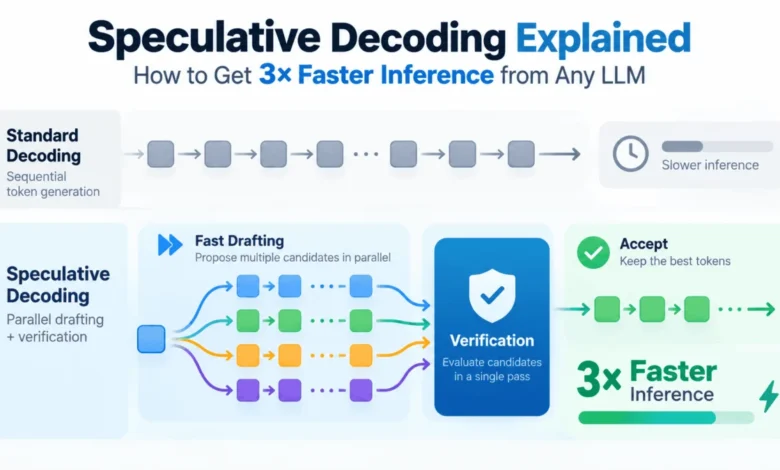
The deployment of Large Language Models (LLMs) has transformed the landscape of artificial intelligence, yet a persistent technological bottleneck remains: the autoregressive nature of token generation. Because models generate text one token at a time, the computational overhead required to produce coherent, human-like responses scales linearly with output length, creating significant latency for real-time applications such as coding assistants and conversational agents. Speculative decoding has emerged as a transformative architectural strategy, enabling a 2x to 3x increase in inference speed without requiring model retraining, quantization, or any sacrifice in output quality.
The Autoregressive Bottleneck: A Historical Perspective
Since the inception of Transformer-based architectures, the autoregressive generation process has been the industry standard. In this cycle, the model processes the entire context—the prompt and all previously generated tokens—to predict the probability distribution of the next token. This process must be repeated in its entirety for every subsequent token.
From a hardware perspective, this creates a "memory-bandwidth bound" environment. Modern GPU accelerators, such as the NVIDIA H100 or A100, possess immense computational throughput capable of performing trillions of floating-point operations per second. However, the bottleneck is not the arithmetic itself but the movement of data. Because the model’s weight parameters—which can number in the hundreds of billions—must be fetched from high-bandwidth memory (HBM) to the compute cores for every single token, the processor spends the vast majority of its time idling, waiting for memory transfers. Consequently, raw compute power is wasted, and the latency for a multi-token response becomes a functional barrier to high-performance enterprise integration.
Evolution of the Speculative Decoding Paradigm
The concept of speculative decoding gained significant traction in early 2023 following research collaborations between teams at Google and various academic institutions. The methodology was designed to address the inefficiency of the standard decoding loop by introducing a tiered, parallelized architecture.
The chronology of this development reflects a broader industry shift toward "inference-efficient" AI. While earlier efforts focused on model compression—such as pruning or aggressive quantization—which often resulted in a slight degradation of model intelligence, speculative decoding proposed a mathematical shift. By utilizing a "draft-and-verify" cycle, the system separates the burden of generation from the requirement of accuracy.
The Draft-and-Verify Mechanism
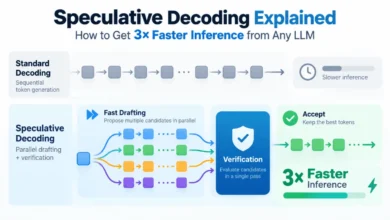
The architecture operates on a two-model hierarchy:
- The Draft Model: A smaller, computationally inexpensive model (often a model with significantly fewer parameters, such as a 1B parameter model paired with a 70B parameter target) is tasked with generating a draft sequence of several tokens in quick succession.
- The Target Model: The main, high-quality model then performs a single forward pass. Instead of generating tokens sequentially, it evaluates the draft sequence in parallel.
This parallel evaluation is made possible by the structure of the Transformer block. In a single forward pass, the target model calculates the probabilities for the entire draft sequence simultaneously. If the target model’s predicted probability for a token aligns with the draft model’s suggestion, the token is accepted. If there is a discrepancy, the target model overrides the draft model, correcting the sequence. Because this validation happens at the speed of a single matrix multiplication, the system effectively "mass-produces" tokens, achieving the speed of the smaller model while maintaining the logical integrity and accuracy of the larger model.
Supporting Data and Performance Metrics
Empirical tests conducted by researchers at Google and UC Berkeley have demonstrated that when a draft model is well-aligned with the target model, acceptance rates frequently reach 70% to 80%. In these scenarios, the system effectively generates up to five or six tokens for the cost of a single target-model inference pass.
Data from recent implementations suggests that the speedup is highly dependent on the "gap" between the two models. If the draft model is too simple, the acceptance rate drops, leading to more frequent rejections and re-computations. If the draft model is too complex, the time taken to draft the initial sequence becomes a bottleneck itself. Finding the "Goldilocks zone"—a draft model that is small enough to be near-instant but smart enough to predict the target model accurately—is currently the primary focus of engineering teams at major AI labs.
Modern Implementations: From Medusa to Prompt Lookup
As the field has matured, several variants have moved beyond the traditional two-model setup, reducing the memory overhead required to hold a secondary draft model.
- Medusa: This approach replaces the external draft model with multiple "prediction heads" attached to the target model. These heads predict tokens at different positions simultaneously. Because the heads share the same backbone as the target model, they have access to the same internal state, often leading to higher acceptance rates than independent draft models.
- Eagle: By leveraging the internal hidden states of the target model, Eagle captures richer contextual information, allowing for more accurate predictions of future tokens. This is particularly effective for complex, domain-specific tasks where general-purpose draft models might struggle.
- Prompt Lookup Decoding: This is perhaps the most efficient implementation, as it requires zero additional parameters. By scanning the prompt and the preceding conversation for recurring sequences, the model "guesses" that the output will contain phrases already present in the input. This has proven remarkably successful in coding environments, where boilerplate code or specific syntax patterns repeat frequently.
Broader Impact and Industry Implications
The implications of these advancements for enterprise AI are substantial. For businesses deploying LLMs, latency is synonymous with cost. Reducing the time-to-first-token and increasing the total tokens-per-second directly translates to lower operational expenses and a more responsive user experience.
Industry leaders in the inference space, such as the developers behind vLLM and llama.cpp, have begun integrating these speculative techniques as standard features. This signals a transition in the industry from prioritizing model size and raw parameter count to prioritizing "inference efficiency" as a core competitive advantage.
However, there are trade-offs. In high-throughput, multi-tenant serving environments—where a single server handles hundreds of simultaneous requests—speculative decoding can be counterproductive. The extra compute required for the draft phase consumes GPU resources that could otherwise be allocated to serving additional concurrent users. Thus, while speculative decoding is a massive boon for latency-sensitive, single-user applications, it requires careful capacity planning in massive-scale cloud deployments.
Conclusion and Future Outlook
Speculative decoding represents a fundamental rethinking of how we interact with large-scale neural networks. By proving that one does not need to trade accuracy for speed, the research community has provided a clear path toward the next generation of real-time AI. As these techniques continue to evolve—potentially moving toward hardware-native acceleration for draft verification—the gap between the computational cost of an LLM and the requirements of real-time software will continue to narrow. For practitioners, the focus is shifting from "how can we make the model smaller" to "how can we make the model faster," with speculative decoding serving as the primary bridge between the two. The era of the single-token-at-a-time bottleneck is rapidly drawing to a close, replaced by a more sophisticated, parallelized approach to machine intelligence.