The Consolidation of the Robot Data Stack Highlights an Unclaimed Verification Loop in AI Training Pipelines

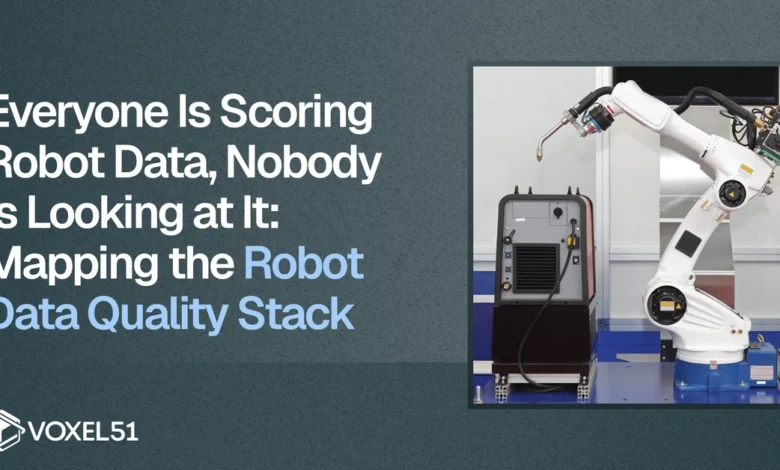
The robot data stack is undergoing rapid structural consolidation, mirroring the evolution of the computer vision and image machine learning data pipelines of the previous decade. Over the past eighteen months, robotics labs and artificial intelligence research groups have repeatedly implemented a nearly identical shortlist of demonstration quality metrics—including spectral smoothness, jerk, idle-timestep detection, actuator saturation, and sensor health metrics. While this independent convergence highlights an urgent industry-wide demand for standardized data hygiene, it also signals that basic quality scoring is fast becoming a commodity. Concurrently, controlled audits published this year reveal a critical vulnerability: action-only quality metrics frequently fail to catch systemic failures and can even invert, ranking defective robot demonstrations above clean ones. Consequently, while the industry is saturated with automated scoring tools, the crucial verification layer—the mechanism that translates a raw metric into an actionable training decision—remains largely unclaimed.
Speedrunning the Image Machine Learning Data Stack
To understand the current trajectory of robot learning infrastructure, industry analysts often point to the maturation of the image machine learning data stack between 2015 and 2020. During that five-year window, the machine learning community settled formatting standards, such as the COCO dataset conventions, before progressing through labeling tooling, quality and curation utilities (such as label-error detection and near-duplicate removal), and finally integrated workflow platforms.
Robot learning data is currently replicating this exact developmental sequence, but compressed into a timeframe of roughly two years and applied to a significantly more complex modality. Unlike static images or independent samples, robotic datasets consist of multi-channel temporal episodes ticking at varying frequencies across a shared clock. Quality is an emergent property of a trajectory unfolding over time, rendering static frame inspections insufficient. Furthermore, robotic failures are frequently silent. Real-world releases, such as the Boreas Road Trip and KITTI dataset documentations, have historically highlighted hardware synchronization issues—such as inertial measurement unit (IMU) clock drift, message dropouts spanning hundreds of milliseconds, and temporal offsets between spinning LiDAR arrays and passive cameras. Such systemic anomalies routinely evade standard summary statistics computed across legacy datasets.
Mapping the Modern Robot Data Stack
The modern robot data stack has assembled itself layer by layer to manage these complex temporal properties, though the stability of each tier varies considerably.
At the foundational logging layer, the format wars have largely subsided. The MCAP format has emerged as the definitive standard, largely because it embeds each channel’s schema directly inside the file structure, ensuring long-term legibility independent of specific message packages. This structural advantage prompted its adoption as the default ROS 2 bag format starting with the Iron release.
Conversely, the training data layer remains highly fragmented. A persistent format war endures because distinct training formats serve as load-bearing infrastructure for separate model lineages. Ecosystems like Hugging Face rely on LeRobot, Open X-Embodiment and OpenVLA architectures utilize RLDS, ALOHA and robomimic platforms depend on HDF5, and Diffusion Policy applications rely heavily on Zarr. This fragmentation necessitates custom, highly duplicated conversion scripts across the industry.
Visualization tools have likewise bifurcated based on operational intent. Platforms like Foxglove prioritize debugging via live connections and deep protocol fluency, Rerun focuses on programmatic logging and streaming, and dataset-first platforms manage massive corpora comprising tens of thousands of episodes.
The Commoditization of Quality Scoring
Automated quality scoring has transitioned from an academic luxury to an operational necessity driven by the sheer scale of modern robotics datasets. Large-scale collection initiatives, such as the DROID dataset encompassing 76,000 demonstration trajectories across 350 hours of interaction, or the Open X-Embodiment pool of dozens of datasets, make manual data curation economically unviable. Historical benchmarks indicate that raw collection pipelines frequently suffer from contamination rates between 20 and 40 percent, with operator skill representing a major source of downstream policy variance.
To address this, researchers have imported motor-control metrics, such as spectral arc length and log dimensionless jerk, into demonstration curation. Implementations like RINSE and spectral power density (PSD) rankings have demonstrated that filtering datasets for trajectory smoothness can dramatically improve downstream policy success rates—frequently allowing models trained on carefully curated subsets to outperform those trained on raw, unrefined data collections. More advanced, compute-intensive tiers of verification—including mutual information estimates (DemInf), influence functions (CUPID), and data modeling frameworks (DataMIL)—further reinforce the empirical finding that training on smaller, rigorously selected subsets yields superior policy performance.
However, because these basic computational scorers rely on straightforward mathematical transformations like discrete Fourier transforms (DFTs) and basic summary statistics, they are rapidly commoditizing. Open-source repositories and internal QA scripts now routinely generate these metrics, stripping individual scoring mechanisms of their competitive differentiation.
Audit Findings and the Dangers of Automated Gating
Despite the proliferation of automated scoring tools, recent controlled audits published in mid-2026 expose severe limitations in relying on metrics in isolation. When researchers injected known defects into controlled simulation environments, the performance of action-only quality metrics split dramatically based on defect type.
While subtle perturbations like correlated action noise and sensor tremors were reliably detected by multivariate outlier scoring, structural errors—such as an untimely gripper release during a critical transport phase—evaded action-only metrics entirely. In several instances, smoothness metrics actively inverted, scoring defective demonstrations as superior to clean executions. Policies curated purely via these flawed smoothness thresholds performed significantly worse than uncurated baselines.
Companion benchmarking studies on contact-rich pick-and-place environments similarly demonstrated that high defect-detection statistical accuracy (AUROC) did not correlate with downstream policy success. Furthermore, several metrics were found to inadvertently rely on episode length as a proxy for quality, rendering their detection capabilities invalid once duration was controlled.
These findings yield a vital design principle for artificial intelligence engineers and roboticists: automated scores must function strictly as triage tools rather than automated deletion gates. Wiring a quality threshold directly to an automated exclusion pipeline risks systematically purging high-value demonstration data while retaining subtle structural failures.
The Missing Verification Loop and Future Outlook
The primary bottleneck in contemporary robotics pipelines is not the computational generation of scores, but the operational integration of review workflows. Practitioners currently face a fragmented user experience where metrics reside in static command-line tables, visualization software operates independently of metadata scoring, and dataset curation requires generating entirely new physical copies of massive training files.
Industry participants emphasize that closing this gap requires a unified verification loop: an infrastructure layer that supports synchronized episodic playback, robust querying capabilities, embedding spaces, and inline metadata tagging within a single interface. Emerging tooling developments—such as native MCAP ingestion and multimodal episodic playback integrated into platforms like FiftyOne—attempt to bridge this gap by aligning disparate sensor streams, camera feeds, and telemetry logs onto a single temporal clock alongside automated quality scores.
As the robot data stack continues to mature, the competitive advantage will no longer belong to organizations capable of writing basic metric scripts. Instead, the robotics teams and AI laboratories that succeed in the upcoming training cycles will be those that successfully integrate automated triage with seamless human verification, transforming raw data lakes into high-performance training assets in a matter of seconds.