Unlocking Local AI Powerhouse Performance in WebAssembly Image Editors Through the Rust Companion Pattern

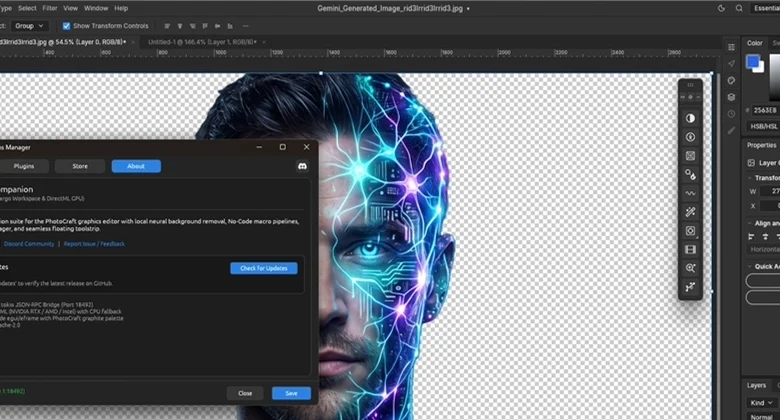
The intersection of web technologies and desktop applications has long promised a seamless blend of cross-platform portability and native execution speeds. PhotoCraft, a modern, open-source desktop image editor powered by an internal WebAssembly (Wasm) plugin engine, epitomizes this architectural philosophy. WebAssembly has revolutionized browser- and sandbox-based environments by delivering rock-solid security, sandbox isolation, and reliable cross-platform portability. However, as developers increasingly push modern neural networks to run locally on consumer hardware, Wasm hits hard physical boundaries that complicate heavy creative workflows like studio-grade background removal, generative inpainting, and seam-blended super-resolution.
For millions of digital artists and creative professionals, this limitation historically forced an undesirable compromise. Users were trapped between reliance on cloud-based subscriptions—which frequently introduce valid privacy and data-sovereignty concerns—or engaging in awkward, manual file-export roundtrips to external desktop utilities. Recognizing the demand for a local, offline, zero-telemetry alternative that maintains the security posture of the host application without sacrificing performance, developers embarked on building a novel native companion architecture.
The Evolution of Local AI Constraints in Sandboxed Environments
To understand the necessity of an external companion architecture, one must examine the fundamental limitations hindering local artificial intelligence execution inside standard WebAssembly runtimes. When developers attempt to integrate heavy machine learning models directly into a sandboxed Wasm environment, three distinct bottlenecks emerge.
First, memory management within standard Wasm runtimes often struggles with the massive tensor allocations required by modern convolutional neural networks and transformer-based architectures. Second, thread synchronization and direct hardware acceleration access are severely restricted by sandbox isolation policies, preventing the software from effectively leveraging discrete Graphics Processing Units (GPUs) or dedicated Neural Processing Units (NPUs). Finally, the overhead of data marshalling across the boundary between the sandboxed application and system memory introduces debilitating latency, rendering real-time interactive editing nearly impossible.
These hardware and architectural barriers transformed what should have been instantaneous, fluid creative tasks into sluggish operations. For high-end creative workflows involving gigapixel imagery, processing times inside the sandbox routinely stretched past eight to twelve seconds per operation, locking up the CPU completely and causing severe dropped frames in the user interface.
Solution Overview: The Native Rust Companion Pattern
Rather than attempting to fork, patch, or fundamentally rewrite the upstream editor codebase—a path fraught with maintenance debt and upstream synchronization hurdles—architects designed a standalone native companion application written entirely in Rust. This companion operates as an independent operating system process running parallel to the host editor. It communicates with PhotoCraft via its existing JSON-RPC control socket over a local TCP port (18492) and facilitates high-speed pixel buffer exchanges through the system clipboard and shared memory corridors.
Structured as a comprehensive Cargo workspace encompassing six distinct crates and roughly 25,000 lines of rigorous Rust code, the companion app is governed by strict engineering constraints. The development lifecycle utilizes automated architectural linters, strict definitions of done, comprehensive resource guards, and continuous integration (CI) pipelines enforcing bilingual localization.
The dependency flow within the workspace maintains strict unidirectional boundaries. At the foundation sits core_contracts, a crate housing zero internal dependencies. Every other component within the workspace relies solely on these core contracts, while the companion_app crate binds the modular architecture together into a cohesive, single binary distribution. This modularity ensures that changes to the user interface or inference engine never destabilize the foundational data contracts.
Taming Asynchronous Peers via the JSON-RPC Bridge
Inter-process communication across asynchronous network boundaries inherently introduces race conditions and reliability challenges. The host editor may occasionally hitch during resource-intensive operations, trigger blocking modal dialogs, or terminate abruptly. To ensure the native companion never hangs or falls out of sync, engineers implemented robust transactional request locking utilizing asynchronous Tokio networking primitives.
In early developmental iterations, the TCP writer and reader halves possessed independent mutexes, leading to dangerous interleaving where concurrent calls would mix response streams. The definitive solution involved implementing a transactional request lock that spans the entire lifecycle of a request-response transaction.
Furthermore, engineers had to solve the persistent contention caused by background utility tasks, such as the color poller. When an interactive plugin panel remains open, a background worker polls the active brush color every 180ms to keep overlay palettes synchronized with the canvas. Because this poller shared the primary bridge client, it created constant contention for the socket lock. The resolution involved substituting blocking calls with a non-blocking try_lock() mechanism. If the bridge is actively engaged in executing a heavy inference command or layer operation, the poller silently skips that tick rather than queuing behind long-running computational workloads.
Vector-First UI Design and Dynamic Widget Generation
The companion application provides its interface via a two-tier floating toolstrip rendered using egui and eframe. Hovering at persistent screen coordinates directly above the main canvas, the overlay operates without cluttering the operating system’s taskbar or obstructing the primary workspace.
To ensure visual consistency across diverse operating systems and eliminate rendering anomalies, the project enforces a strict "Zero-Tofu" policy. Standard default fonts in lightweight immediate-mode GUI frameworks frequently lack comprehensive Unicode coverage, causing emojis and non-standard symbols to render as unreadable placeholder squares (tofu). By purging emojis from textual elements and embracing a vector-first design philosophy, the interface relies entirely on crisp vector primitives and localized typography.
Crucially, the user interface layer avoids hardcoding plugin-specific forms. Instead, it dynamically parses the plugin.json manifest upon initialization, instantly instantiating sliders, dropdowns, toggles, and input fields on the fly. This decoupled architecture allows third-party creators to introduce entirely new image processing filters featuring custom parameter controls simply by writing the corresponding JSON definitions, empowering the companion to render the interface immediately without requiring a recompilation of the underlying Rust binary.
Real-World Performance Benchmarks: ONNX Runtime and DirectML
The true validation of the companion pattern lies in empirical performance data. By decoupling AI execution from the Wasm sandbox and routing it through native ONNX Runtime bindings (ort) utilizing DirectML for GPU hardware acceleration on Windows—with transparent CPU fallback for non-compatible platforms—the system achieves dramatic efficiency gains.
Benchmarking segmentation and background removal tasks (such as RMBG-1.4 processing a standard 1024×1024 pixel image) illustrates the stark performance differential:
- Wasm Sandboxed (Wasmtime via CPU): Consumes 8,200 to 12,000 milliseconds per image, results in a 100% CPU lockup, and severely drops host UI frames.
- Native Companion (CPU Fallback): Completes the operation in approximately 1,850 milliseconds while operating as a background worker, preserving a smooth 60 frames-per-second overlay user interface.
- Native Companion (DirectML Cold Start on Discrete GPU): Slashes processing time to roughly 380 milliseconds, imposing zero host CPU load and yielding a twenty-five-fold speedup over sandboxed execution.
- Native Companion (DirectML Warm Start with LRU Caching): Drops execution latency to approximately 210 milliseconds by eliminating model initialization overhead.
To maintain this speed across sequential user interactions, the companion implements an LRU (Least Recently Used) session cache. Because modern ONNX runtime iterations support thread-safe execution handles, cached execution sessions (Arc<Session>) are safely shared across asynchronous tasks. Furthermore, for ultra-high-resolution 4K and 8K canvases, the engine incorporates a high-resolution tiling pipeline. Instead of overwhelming hardware VRAM by processing massive images in a single pass, the engine slices the canvas into overlapping tiles, executes model inference tile-by-tile within a cached session, and seamlessly blends the edges using cosine feathering to eliminate visible seam artifacts.
Security Architecture and Supply Chain Mitigation
With the introduction of community-contributed plugins distributed as .pcpl archives—ZIP-based packages containing manifests, optional scripts, icons, and neural network weights—security becomes paramount. Maliciously crafted packages attempting path traversal attacks (commonly known as "Zip-Slip vulnerabilities," where file paths like ../../startup.exe attempt to overwrite critical system binaries) pose a severe threat to desktop applications.
To neutralize these vectors, the companion package extractor enforces rigorous multi-layered validation. The extraction engine verifies safe internal extraction paths, explicitly rejects absolute paths and parent directory traversal components (..), and universally forbids symbolic links within plugin packages.
Additionally, the system operates under a strict Zero-Core Hardcoding principle. No specific model filenames, neural input shapes, or plugin identifiers are hardcoded into the Rust application core. Everything is dynamically declared via structured JSON manifests, ensuring that the runtime builds user interfaces, schedules inference execution graphs, and issues canvas commands purely based on cryptographically verified contracts.
Broader Implications and Open-Source Availability
The development and deployment of the PhotoCraft Companion represent a significant milestone in desktop application engineering. By demonstrating that high-performance, privacy-focused local artificial intelligence can be successfully married to secure, sandboxed web-technology editors without sacrificing user experience, the project provides a blueprint for future hybrid desktop architectures.
The PhotoCraft Companion is available as an open-source project, dual-licensed under the permissive MIT and Apache-2.0 licenses. Developers, security researchers, and digital artists interested in inspecting the codebase, contributing architectural enhancements, or designing custom plugin manifests can access the repository directly via GitHub.
Related posts: