Android Studio Revolutionizes Development with the Launch of Bring Your Own Agent Support

The landscape of professional software engineering is undergoing a tectonic shift, driven by the rapid maturation of generative artificial intelligence and autonomous coding assistants. As engineering teams increasingly rely on specialized AI agents to accelerate development cycles, the need for flexible, platform-agnostic tooling has never been greater. Addressing this demand, Google has announced a major update to its integrated development environment (IDE), Android Studio, introducing the "Bring Your Own Agent" (BYOA) feature. This development marks a significant departure from closed-ecosystem approaches, allowing developers to integrate third-party AI agents—including Anthropic’s Claude, OpenAI’s Codex, and Google’s own Antigravity—directly into their Android development workflows.
The Evolution of AI-Assisted Development
The integration of AI into the Integrated Development Environment (IDE) began in earnest with basic autocomplete suggestions, but the industry has moved rapidly toward "agentic" workflows. Unlike traditional assistants that merely suggest code snippets, modern coding agents can plan, debug, and execute complex technical tasks across entire codebases.
The timeline of this transformation has been compressed. In 2023, the focus was primarily on integrating large language models (LLMs) into standard workflows. By late 2024, the industry saw the rise of specialized agents capable of multi-step reasoning. In 2025, Android Studio made its first major move toward openness by allowing developers to connect to remote models. Today’s introduction of the BYOA feature represents the logical conclusion of this trajectory: giving developers the autonomy to choose the "brain" behind their IDE based on project requirements, performance benchmarks, and personal preference.

Mechanics of the BYOA Architecture
The BYOA feature functions as an extensible layer within the Android Studio infrastructure. By offloading the logic of code generation and architectural planning to external agents, the IDE focuses on what it does best: providing a stable, AI-optimized environment with deep knowledge of the Android software development kit (SDK).
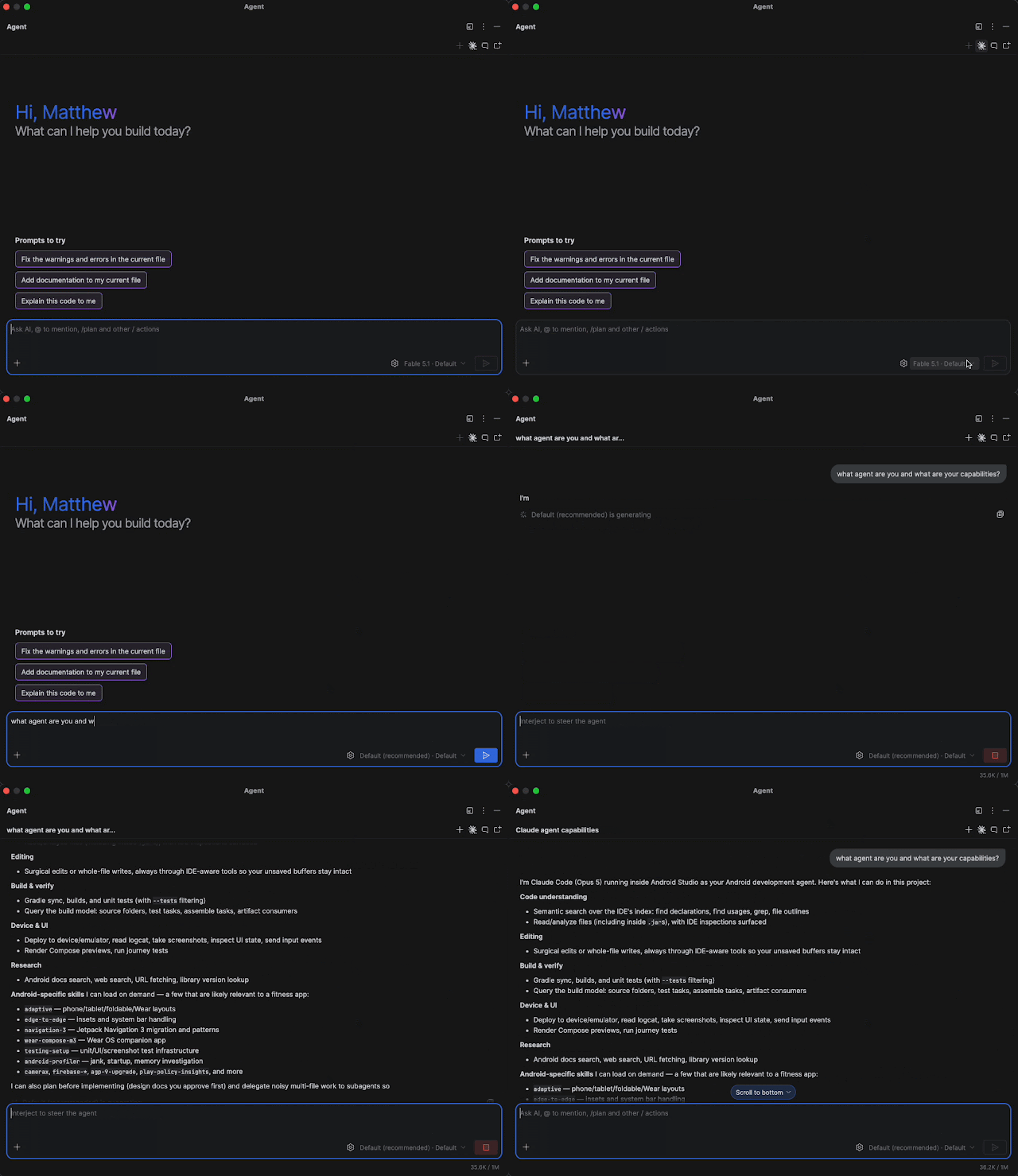
When a developer selects an agent—such as the Claude Agent or OpenAI’s Codex—the IDE establishes a secure bridge that allows the agent to interface with the Android Knowledge Base. This is a critical distinction; these agents are not merely chatting with the code but are context-aware. They have access to the latest Android best practices, library updates, and API specifications. This integration ensures that the code generated is not only syntactically correct but also idiomatic to the Android ecosystem.
The Role of Google Antigravity and Gemini
While the BYOA initiative promotes an open ecosystem, Google continues to iterate on its native offerings. The "Google Antigravity" agent serves as the premium bridge to the company’s flagship Gemini models. For developers requiring the highest levels of performance, Antigravity provides native access to Gemini Flash 3.8.
This model is particularly optimized for long-horizon tasks—complex assignments that require keeping track of multiple files, architectural constraints, and long-term project goals. According to internal Google metrics, the transition to models capable of managing "long-horizon" tasks has resulted in a 40% reduction in context-switching time for developers working on large-scale modular apps. By leveraging the Google AI Pro or Ultra plans, developers can unlock higher usage quotas and lower latency, creating a seamless experience that competes directly with third-party alternatives.

Strategic Implications for Engineering Teams
The shift toward agent-agnostic development environments carries significant implications for corporate IT and individual developers alike. For enterprise environments, the primary concern remains security and data governance. Google has emphasized that even when using the Antigravity agent, the security protocols associated with Gemini Enterprise remain intact. This ensures that intellectual property and sensitive codebases are protected by the same encryption and compliance standards that govern Google Cloud.
Furthermore, the choice of an agent is no longer just about coding speed; it is about cost-efficiency and model-specific capabilities. Some teams may prefer the logical reasoning capabilities of Anthropic’s Claude for complex refactoring, while others may opt for the rapid, lightweight generation of other models for prototyping. BYOA allows organizations to standardize their tooling while providing their engineers with the flexibility to choose the best instrument for the specific task at hand.
Data-Driven Performance and Benchmarking
The effectiveness of these agents is increasingly measured by standardized testing. The "Android Bench," an industry-standard framework for evaluating how AI models handle Android-specific coding tasks, has seen significant updates to reflect the rise of agentic workflows. In recent benchmarks, agents capable of executing multi-step tasks outperformed traditional chat-based models by a factor of three in terms of successful compile-ready code output.
The data indicates that as developers transition to using agents for structural tasks—such as implementing dependency injection or navigating complex navigation graphs—the rate of "hallucination" or syntax error decreases when the agent has direct, native access to the Android Knowledge Base. This suggests that the future of IDEs is not just in the models themselves, but in the "glue" that binds those models to the specific constraints of the target platform.

Industry Reaction and Expert Analysis
Industry analysts have largely framed this move as a pragmatic response to the fragmentation of the AI market. By positioning Android Studio as a platform rather than a silo, Google is effectively future-proofing its IDE against the volatility of the AI model landscape.
"The days of being locked into a single vendor’s model are numbered," says Dr. Elena Vance, a lead researcher in developer productivity tools. "By allowing developers to swap agents, Google is acknowledging that the ‘best’ model is a moving target. What is state-of-the-art today might be superseded in six months. A platform that allows for this rapid iteration is fundamentally more valuable to the professional developer."
However, this transition is not without challenges. Integrating disparate agents into a single IDE requires rigorous standardization of APIs and data privacy agreements. Developers will need to navigate varying pricing models, as some agents function on a "pay-per-token" basis, while others are bundled with existing enterprise subscriptions.
Getting Started: A New Workflow
The rollout is currently limited to the Android Studio "Rabbit 2" Canary release, which is intended for early adopters and those looking to test the cutting edge of the technology. The setup process is designed to be straightforward:

- Environment Preparation: Ensure the installation of the latest Android Studio Canary build.
- Registry Access: Navigate to the Agent Registry within the IDE settings menu.
- Authentication: Select the preferred agent (Claude, Codex, or Antigravity) and authenticate using the respective API key or enterprise credentials.
- Context Configuration: Allow the agent to index the local project to populate the Android Knowledge Base.
Once configured, the agent resides in the side panel, ready to be invoked for tasks ranging from writing unit tests to generating UI layouts.
Conclusion
The introduction of Bring Your Own Agent support is a clear signal that the era of the "one-size-fits-all" coding assistant is ending. By embracing a multi-agent future, Google is fostering an environment where productivity is not dictated by the limitations of a single model, but by the collective intelligence of the industry’s most powerful AI tools. As the software development community continues to navigate the complexities of generative AI, the ability to choose, test, and integrate the right tool will likely become the primary differentiator for high-performing engineering teams. The next phase of development will focus on refining these agent interactions, reducing latency, and further deepening the integration between AI reasoning and the core Android architecture.
Related posts: