Canonical Overhauls Ubuntu Kernel Release Strategy to Combat Accelerated AI-Driven Cybersecurity Threats

In a significant shift for the Linux ecosystem, Canonical has officially announced a fundamental restructuring of its Stable Release Update (SRU) cycle for the Ubuntu kernel. Historically, the company operated under a dual-track system, separating standard bug fixes from high-priority security patches. This legacy model, which featured a four-week cycle for general maintenance and a bi-weekly cadence for critical Common Vulnerabilities and Exposures (CVE) mitigation, is being retired in favor of a consolidated, high-velocity two-week cycle. By staggering these cycles, Canonical aims to deliver a hardened, production-ready kernel update to its user base every single week.
The Evolution of the Ubuntu Kernel Lifecycle
To understand the magnitude of this change, one must examine the traditional mechanics of Ubuntu’s software delivery. A Stable Release Update (SRU) is the mechanism by which Canonical backports critical fixes and security enhancements to versions of Ubuntu that have already reached their general availability milestone. Historically, this ensured that stability was not compromised by the rapid pace of upstream development.
The previous methodology relied on a bifurcated track:
- Standard Updates: A four-week cycle dedicated to non-critical bug fixes, performance improvements, and hardware support updates.
- Security Updates: A secondary track operating on a two-week cadence, specifically reserved for urgent CVE remediation.
This structure was designed for an era where the discovery of vulnerabilities was a largely manual process, often performed by individual researchers or small, coordinated teams. However, the emergence of sophisticated automated vulnerability research tools—often referred to in the industry as "clankers" or autonomous AI agents—has fundamentally altered the threat landscape. These systems are capable of parsing massive repositories like git.kernel.org at unprecedented speeds, identifying potential memory leaks, buffer overflows, and privilege escalation vectors long before human researchers would have noticed them.

Chronology and Operational Mechanics of the New Cycle
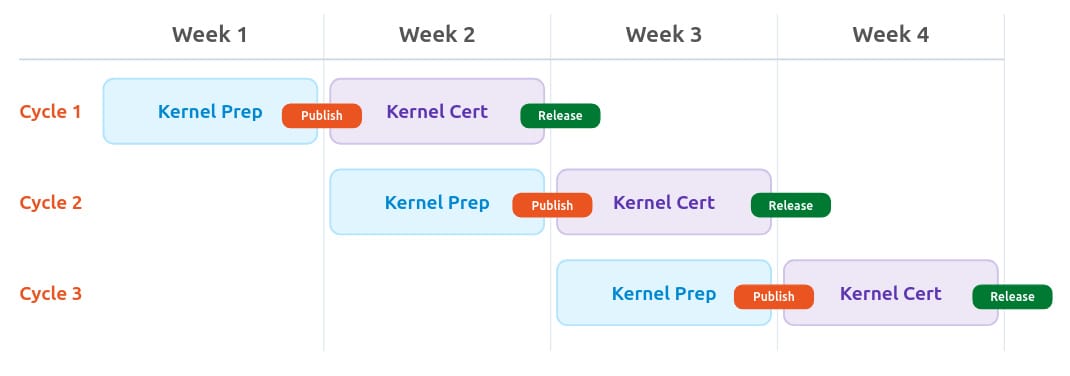
Under the new paradigm, Canonical has transitioned to a streamlined two-week pipeline. The efficiency of this system is achieved through a continuous rolling start; while each individual cycle lasts two weeks, the overlap ensures that a new cycle begins every seven days. This allows the engineering team to maintain a consistent cadence of releases.
The workflow is divided into two distinct phases:
Phase One: Integration and Preparation (Week 1)
The first week is dedicated to the selection of patches and the initial build process. Canonical’s kernel engineers curate specific fixes, apply them to the current kernel source, and perform automated smoke tests. These tests are designed to identify immediate regressions or build failures before the package moves to the next stage. Once this validation is complete, the kernel release candidates are pushed to the -proposed pocket. This repository acts as a testing ground where early adopters and enterprise partners can evaluate the builds before they are certified for general distribution.
Phase Two: Certification and Deployment (Week 2)
The second week is reserved for the rigorous Ubuntu Certified hardware testing program. Canonical subjects these builds to an extensive suite of tests across a vast array of machine types, architectures, and hardware configurations. This ensures that the patches do not introduce instability or hardware-specific regressions. By the end of this week, the kernel is cleared for public release. If a build fails to meet the stringent quality standards required for general deployment, it is withheld, and users are provided with specific guidance on system hardening or manual mitigation strategies until a verified fix is available.
Data-Driven Security in the Age of LLMs
The move toward a weekly release cadence is not merely a logistical upgrade; it is a defensive reaction to the changing nature of exploit development. Recent reports have highlighted that large language models (LLMs) and automated AI agents are increasingly used to scan open-source code for vulnerabilities. This automation has turned vulnerability hunting into a high-speed race.

According to industry analysts, the "window of exposure"—the time between a vulnerability being discovered and a patch being deployed—is the most critical metric in modern cybersecurity. In a worst-case scenario, automated exploit scripts can be generated within hours of a CVE being disclosed. Canonical’s stated objective is to drastically reduce the latency between public disclosure and remediation. Specifically, the company is aiming to provide effective workarounds or patches within a 24- to 48-hour window, providing a vital buffer for system administrators managing enterprise-grade infrastructure.
Implications for Enterprise and DevOps Teams
For organizations that cannot afford to wait for the conclusion of the two-week certification cycle, Canonical is promoting the use of the -proposed repository as an accelerated path. This strategy shifts a portion of the responsibility onto the user; by deploying candidates from the -proposed pocket, internal DevOps teams can conduct their own acceptance tests in environments that mirror their specific production setups. This "shift-left" approach to kernel testing is increasingly common in high-availability environments where downtime or kernel panics represent a significant financial or operational risk.
However, the rapid update cadence also poses challenges for system administrators. Frequent kernel updates necessitate a more robust testing infrastructure and a clear strategy for rolling back updates if issues arise. Canonical’s emphasis on transparency—promising to communicate clearly when a build is not safe for general deployment—is an essential component of this new strategy, intended to mitigate the risks associated with such a high-velocity update schedule.
Broader Impact on the Linux Kernel Community
Canonical’s decision has significant ripple effects across the Linux ecosystem. As one of the primary stewards of Linux kernel distribution, Canonical’s operational choices often influence downstream distributions, including those based on Ubuntu such as Linux Mint, Pop!_OS, and various enterprise-grade cloud images.
Furthermore, this pivot highlights a growing trend of "defensive automation." As AI-driven threats scale, the human-centric security models of the past decade are proving insufficient. By integrating the same level of automation into their release cycle that attackers are using to identify vulnerabilities, Canonical is attempting to maintain the security integrity of the Ubuntu platform without sacrificing the stability that has made it a preferred choice for cloud infrastructure and desktop computing alike.
The shift also underscores the growing importance of the "certified hardware" ecosystem. By maintaining an intensive testing regime that keeps pace with weekly releases, Canonical is reinforcing its value proposition to enterprise customers, who rely on the guarantee that their specific hardware configurations will remain stable despite the accelerated security patching schedule.
Conclusion: A New Baseline for Security
The transition to a weekly kernel update cycle marks a pivotal moment for Ubuntu. While the technical implementation of the new SRU process is robust, its success will depend on the ability of the community and enterprise users to adapt to a faster-moving environment. Canonical has effectively drawn a line in the sand, acknowledging that in an era of AI-powered vulnerability discovery, the traditional boundaries of software release cycles are no longer sufficient to ensure system safety.
As the Linux community observes these changes, the outcome will likely serve as a blueprint for other major distributions grappling with similar threats. The move is a testament to the fact that in the modern digital landscape, security is not a static state, but a continuous, high-speed process of evolution and response. For Ubuntu users, the result should be a more resilient operating system, better equipped to withstand the relentless pace of modern cyber threats, provided that the necessary infrastructure is in place to manage the velocity of these critical updates.
Related posts: