Microsoft Patch Tuesday September 2026 Analysis Reveals Escalating Vulnerability Volume and Ecosystem Strain

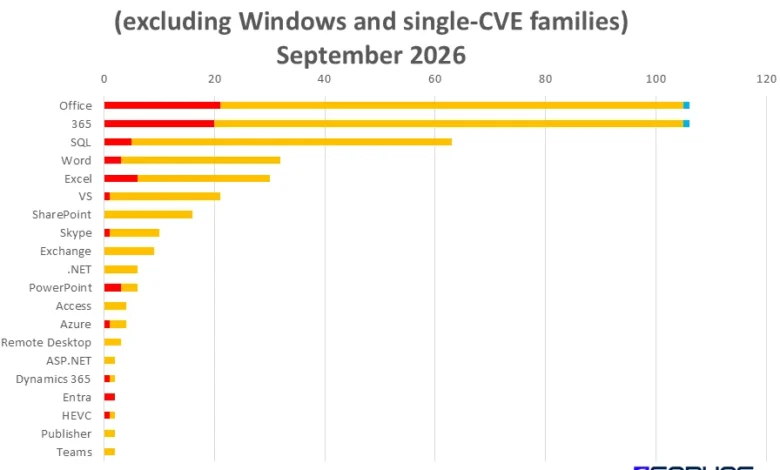
On September 9, 2026, Microsoft released an extensive security update package addressing 973 distinct vulnerabilities across 39 product families. This massive deployment, while routine in the context of the monthly Patch Tuesday cadence, underscores a significant and ongoing trend in software security: the relentless growth in the volume of discovered flaws, likely accelerated by the integration of AI-driven vulnerability discovery tools in the modern research landscape.
Of the 973 CVEs (Common Vulnerabilities and Exposures) addressed in this cycle, 114 are classified as Critical, representing the highest tier of security risk. Perhaps more concerning for security operations centers and IT administrators is the fact that 58 of these vulnerabilities are currently projected to be exploited within the next 30 days. Furthermore, 284 of the vulnerabilities carry a CVSS (Common Vulnerability Scoring System) Base score of 8.0 or higher, indicating a high degree of severity and ease of exploitability. Notably, none of the vulnerabilities included in the September release were publicly disclosed prior to the patch issuance, a testament to the efficacy of the current coordinated disclosure programs despite the immense pressure of rising patch volumes.
The Context of an Accelerating Security Landscape
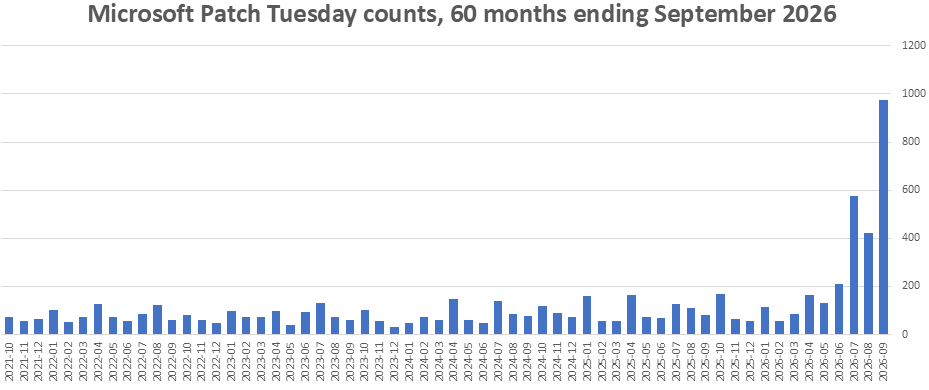
The sheer magnitude of the September 2026 update is not an anomaly but rather the latest data point in a five-year upward trajectory. As illustrated by historical patch volume trends, the industry has moved far beyond the era when a monthly count of 100 patches was considered substantial. The current "whirlwind" phase of vulnerability management places unprecedented strain on security teams.
The analytical burden alone is staggering. The summary documentation provided by Microsoft to assist security analysts in understanding the scope of the month’s changes would, if printed, exceed 3,000 pages. This volume of information necessitates a high degree of automation for organizations hoping to maintain a proactive security posture. The shift toward AI-assisted fuzzing and automated bug discovery has fundamentally altered the economics of vulnerability research, allowing researchers to identify bugs at a pace that often outstrips the development cycle of legacy software.
Chronology and Notable Security Advisories
While Microsoft’s main release was the focal point of the month, the broader ecosystem remained active in the days surrounding September 9. The Google Chrome team proactively released 24 Edge-related patches prior to the official Patch Tuesday date, reflecting the integrated nature of modern browser security. Simultaneously, Adobe addressed 21 vulnerabilities affecting Acrobat.
An additional layer of complexity was introduced by external software foundations. The OpenSSL Software Foundation issued a warning regarding CVE-2026-34182, an improper validation of integrity-check values within Cryptographic Message Services (CMS) data. Carrying a CVSS Base score of 9.1, this vulnerability highlights the persistent risk inherent in foundational cryptographic libraries. Furthermore, MITRE identified CVE-2025-70873, an information disclosure vulnerability affecting SQLite v3.51.1, which remains a critical component in countless applications.
Beyond the standard release, nine Microsoft CVEs had been patched prior to September 9. These updates were categorized as Critical and carried an average CVSS score of 9.0, including two vulnerabilities with a "perfect" 10.0 score. These specific items primarily affected Azure, Copilot, Discovery Studio, Entra, Fabric, and Power Automate. Because these were remediated before the official cycle, they remain largely transparent to the average system administrator, yet they serve as a reminder of the continuous, behind-the-scenes patching cycle for cloud-native infrastructure.
The "Patch Gap" and Ecosystem Dependencies
A critical realization for enterprise IT managers this month is the limitation of the patch delivery system. The principle that "a patched system is safer than an unpatched one" faces a practical hurdle when patches are delayed due to product-specific development lifecycles.
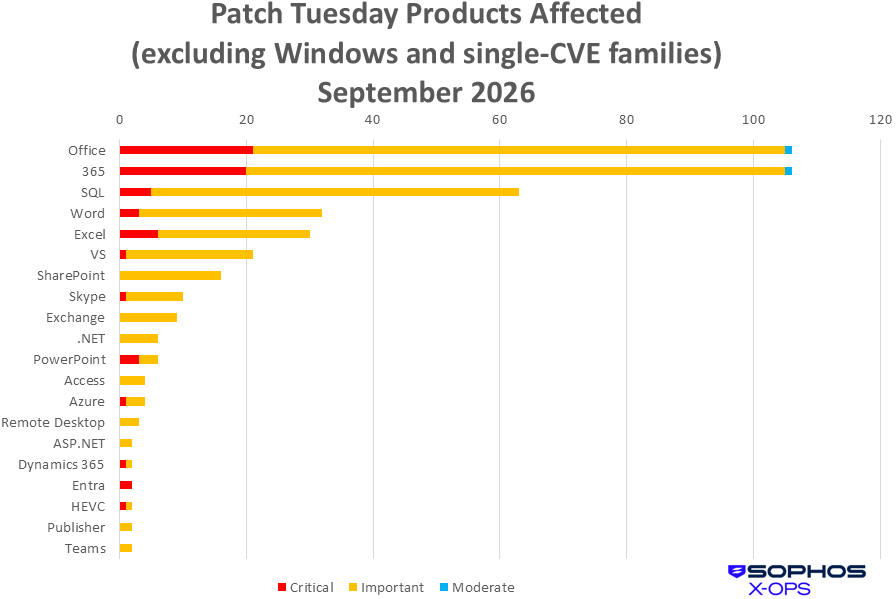
In September 2026, this limitation was clearly visible in the release notes for Office for Mac. Out of the total monthly volume, 82 CVEs identified in the Microsoft documentation were not accompanied by a corresponding fix for the macOS version of Office. Among these 82 vulnerabilities are two Critical-severity, 9.8-rated flaws. Several of these pending patches involve vectors as simple as the Preview Pane or the mere act of viewing an email message in Outlook. This "runway" issue—where the patch development for one platform lags behind another—highlights the risks inherent in a heterogeneous computing environment. Organizations relying on Office for Mac must exercise heightened caution, as they remain exposed to these vulnerabilities until the specific product-family patches are finalized and deployed.
Quantitative Analysis: By the Numbers
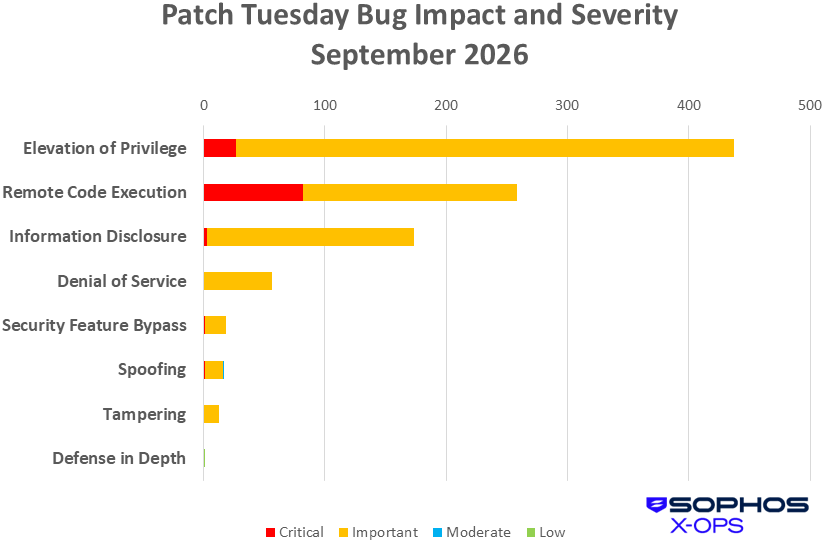
The breakdown of the September 2026 patch cycle reveals that Elevation of Privilege (EoP) remains the most prevalent category of vulnerability. In fact, September’s data pushed the cumulative number of EoP vulnerabilities for the year past the 1,000 mark. This trend aligns with the ongoing cat-and-mouse game between operating system hardening and adversary attempts to escalate access once a foothold has been established.
Windows Update Stack vulnerabilities and Advanced Local Procedure Call (ALPC) flaws were identified as the only two CVEs currently under active exploitation in the wild. These are classified as Important-severity and exhibit a mirror-image relationship: every supported version of Windows is affected by one or the other, but never both. The Update Stack issue (CVE-2026-81963) involves link-following and improper access control, while the ALPC issue (CVE-2026-85880) is characterized by a heap-based buffer overflow and the use of uninitialized resources. The latter (CWE-122) remains the most common CWE type in this month’s dataset, reinforcing the necessity of rigorous memory management in kernel-level code.
Broader Implications and Strategic Outlook
The cadence of Patch Tuesday, once a predictable, manageable event, is now subject to quarterly rhythms that analysts are still attempting to decode. Traditionally, the first month of each quarter (January, April, July, October) tends to be heavier in volume. September is historically a period of relative respite; however, given the unprecedented volume of this month’s release, there is growing apprehension among security professionals regarding what the October cycle might hold.
The industry is currently in a state of transition. With the Chrome team moving toward a bi-weekly patching cadence and the overall volume of vulnerabilities showing no signs of stabilization, the traditional "once-a-month" update model may eventually become unsustainable. For organizations, this necessitates a shift toward a risk-based vulnerability management strategy. Relying on manual patching cycles is increasingly insufficient when 58 vulnerabilities are identified as being actively exploited within a 30-day window.
The integration of Sophos and other security vendor protections into the workflow provides a necessary buffer. By identifying specific CVEs and providing endpoint IPS or firewall-level mitigations, these vendors allow organizations to "virtual patch" or block exploit attempts before the underlying OS updates are fully tested and deployed.
Conclusion for System Administrators
The September 2026 update serves as a stark reminder that software complexity is the enemy of security. With nearly 1,000 patches issued in a single cycle, the burden of testing and deployment has reached a critical threshold. Administrators are advised to prioritize the 114 Critical-severity vulnerabilities and the two actively exploited Elevation of Privilege flaws immediately.
For those managing diverse environments, the pending Office for Mac patches serve as a warning to maintain rigorous monitoring of the published CVE information. As the industry moves into the final quarter of 2026, the data suggests that the "AI-finder age" has permanently elevated the baseline for patch management. Organizations that fail to adopt automated, data-driven approaches to identifying and deploying these updates will find themselves increasingly vulnerable in an environment where the window between disclosure and exploitation continues to shrink. For detailed tracking of individual vulnerabilities and their impact on specific system architectures, administrators should refer to the comprehensive data workbooks provided by the manufacturer, utilizing the pivotable data to manage their specific risk profiles effectively.