Radaris.com Domain Seizure Marks a Major Escalation in the Legal Battle Over Data Broker Accountability


The landscape of online personal data brokering faced a significant, perhaps unprecedented, disruption recently when a New Jersey court ordered the transfer of Radaris.com and over a dozen associated domains to Atlas Data Privacy Corp. This development follows a protracted legal struggle centered on the enforcement of Daniel’s Law, a New Jersey statute designed to shield the personal information of law enforcement officers, judges, and government personnel from commercial exposure. For years, Radaris—a prominent player in the people-search industry—maintained a reputation for ignoring data removal requests, a strategy that has finally met a concrete, judicial consequence.
The Genesis of the Conflict: Daniel’s Law
Daniel’s Law was enacted in the wake of a tragic incident involving the family of a federal judge, serving as a legislative safeguard to ensure that individuals tasked with public safety and judicial administration are not subjected to the dangers of doxxing or targeted harassment. The statute mandates that data brokers must remove the personal information of protected officials upon request. Crucially, the law imposes a penalty of $1,000 per violation for companies that fail to comply.
Atlas Data Privacy Corp, a firm dedicated to enforcing privacy compliance, initiated litigation against Radaris in February 2024. The lawsuit alleged systematic disregard for the law’s provisions. What followed was a complex legal chess match, characterized by what plaintiffs describe as "shell games" and "island-hopping" tactics, where Radaris appeared to rotate its corporate registration across jurisdictions such as the Marshall Islands, the British Virgin Islands, and the Seychelles to evade accountability.
Chronology of Evasion and Litigation
The history of Radaris’s legal entanglements reveals a long-standing pattern of procedural obstruction. In 2017, the company faced a class-action lawsuit where it initially failed to contest the claims, resulting in a $7.5 million default judgment. When plaintiffs moved to collect, Radaris engaged in a vigorous defense, ultimately stalling the enforcement of that judgment.
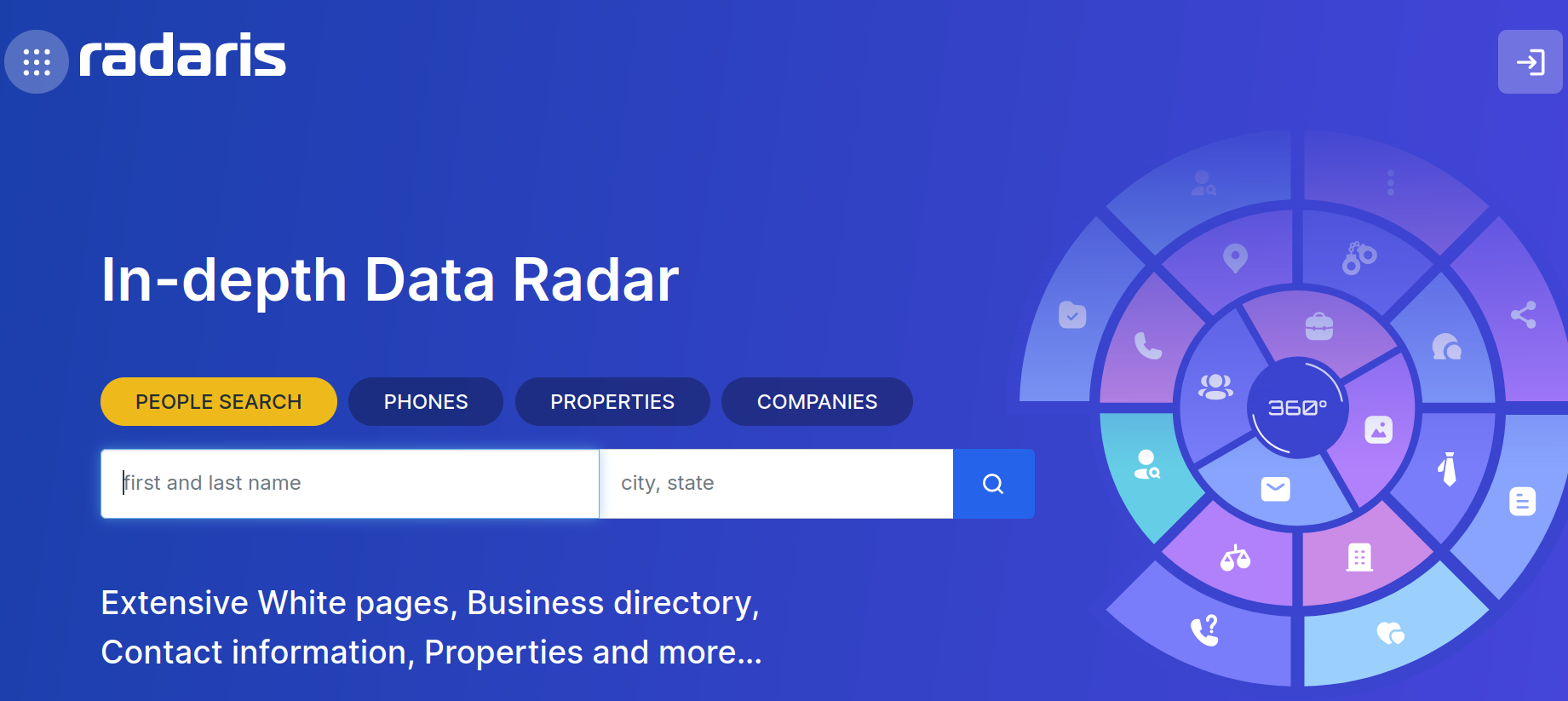
The current escalation began in early 2024. Following the initial lawsuit by Atlas, investigative reports shed light on the operation’s structure. The company was found to be managed by Igor and Dmitry Lubarsky, brothers residing in Massachusetts. Despite claims from their legal representatives that the company was Ukrainian-owned, subsequent investigations confirmed the Lubarskys’ central role in managing a sprawling network of people-search and affiliate marketing sites.
The litigation hit a turning point in June 2025, when Atlas re-filed its complaint with an expanded scope, targeting a wider array of the Radaris family of companies. Throughout the process, the defendants utilized delay tactics, only appearing in court at the eleventh hour. The defense strategy relied heavily on challenging the standing of the entities named in the lawsuit, arguing that the specific domains were owned by foreign corporations—such as the Cyprus-based Bitseller Expert Limited or the Marshall Islands-based Andtop Company—which, they argued, were not the proper targets for the litigation.
The Shell Game: Operational Structure
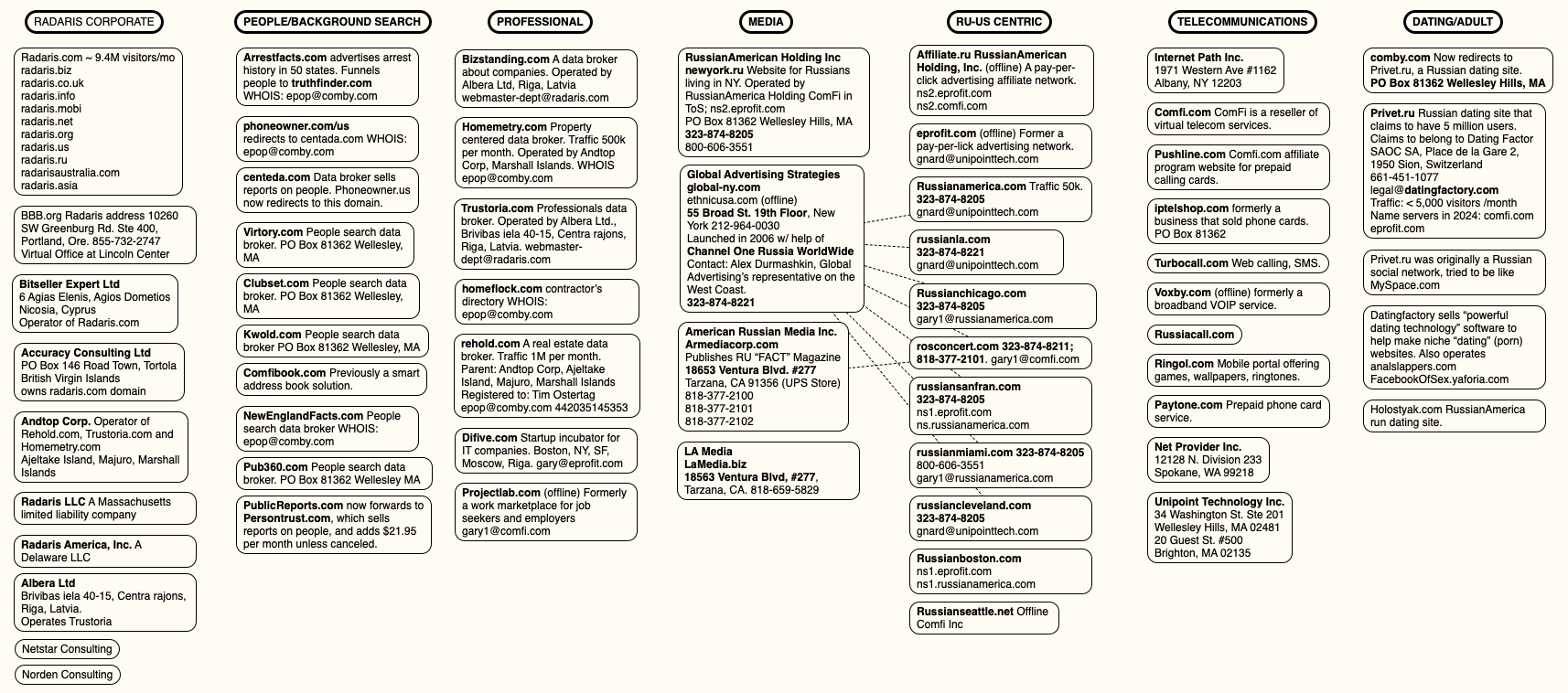
Internal documents obtained during the discovery process provide a rare glimpse into the mechanics of the people-search industry. Atlas reported the recovery of over 10,000 emails and corporate files, which allegedly confirm that entities like Radaris America, Inc., Veripages, and various other "solutions" groups are, in reality, a singular operation managed by a small Boston-area group.
These documents suggest that the administrative, financial, and technical infrastructure of these sites is centralized, sharing common banking accounts, payment processors, and virtual office addresses. Furthermore, the records reveal a complex web of revenue streams. Radaris.com and its sister sites—such as Veripages.com—are linked to significant monthly earnings, often generated through partnerships with marketing firms like the Lifetime Value Company. Perhaps most ironically, evidence suggests that the Radaris family of sites also derived revenue from partnerships with "data removal" services like Onerep, creating a circular ecosystem where consumers pay to have their data removed from sites that are effectively part of the same corporate umbrella.
Legal and Constitutional Challenges
The transfer of the Radaris.com domain, now redirecting to an Atlas-hosted notice regarding the court order, is being contested. Defense attorney Victor Worms has signaled an intent to vacate the default judgment, arguing that the court acted beyond its jurisdiction by transferring a domain name belonging to an entity that, he contends, is not a legal person capable of being sued.

This case is currently part of a broader, national constitutional debate. Roughly 150 data broker firms are currently facing similar suits from Atlas, and many have moved to federal court, challenging the constitutionality of Daniel’s Law. The core of their argument is that such statutes are overly broad and infringe upon First Amendment rights regarding the dissemination of publicly available information. While the Third Circuit Court of Appeals has yet to issue a definitive ruling, the legal consensus is that the matter is destined for the U.S. Supreme Court.
The constitutional friction is not limited to New Jersey. While at least 14 states have implemented laws mirroring Daniel’s Law, the judiciary’s stance remains inconsistent. In August 2025, a federal district court in West Virginia struck down that state’s version of the law, declaring it facially unconstitutional. This creates a patchwork of privacy protections that complicate the operations of both data brokers and privacy advocates.
The Broader Implications for Data Privacy
The Radaris case serves as a microcosm of the systemic challenges inherent in the modern data economy. Privacy experts, including Justin Sherman, author of The Middlemen, emphasize that the current legal framework is largely ill-equipped to address the reality of 21st-century digital surveillance.
"The lack of comprehensive federal privacy law is not for a lack of knowledge," Sherman noted, highlighting the systemic failure to address the proliferation of people-search sites. Most state and federal laws include broad exemptions for "public" or "government" records, which encompass everything from marriage certificates and property filings to criminal records and professional licenses. These exemptions effectively legalize the aggregation and sale of personal dossiers, leaving the average citizen vulnerable even if specific groups—like law enforcement—are granted protections.
The recent breach at IDScan.net, which exposed the sensitive driver’s license information of 153 million Americans, underscores the danger of this unregulated data aggregation. When companies are permitted to scan, store, and share identification data without stringent federal oversight, the risk of mass identity theft increases exponentially.
Future Outlook
The outcome of the Radaris case will likely serve as a bellwether for the data brokerage industry. If the domain transfer is upheld, it establishes a powerful legal precedent: that the digital assets of data brokers—their domains and web traffic—are fair game for seizure when those companies persistently violate privacy laws. Conversely, a successful appeal by Radaris would embolden the industry to continue its "shell game" tactics, potentially stalling legislative efforts to reign in the sale of personal information for years to come.
As the litigation continues, the spotlight remains on the efficacy of state-level privacy legislation. While laws like Daniel’s Law provide a vital, if narrow, shield for public officials, they remain a "wake-up call" rather than a comprehensive solution. Without a unified federal standard that addresses the commercialization of public records, the battle over personal privacy in the digital age will remain a fragmented, expensive, and protracted conflict between individuals and an industry designed to turn their lives into a commodity. The Radaris case, while a landmark in terms of enforcement, is ultimately a single skirmish in a much larger, ongoing struggle for control over personal data in the information age.