React Native 0.86 Official Release Brings Robust Android 15 Edge-to-Edge Support and DevTools Enhancements

The software development community has officially welcomed the arrival of React Native 0.86, a milestone update that highlights a sustained industry-wide push toward seamless platform integrations and developer experience optimizations. Released to the public following extensive beta testing, version 0.86 introduces comprehensive edge-to-edge layout support tailored specifically for Android 15 and later iterations, alongside critical enhancements to React Native DevTools. Notably, this version marks the second consecutive major release—following version 0.83—to debut entirely free of user-facing breaking changes. This achievement underscores a deliberate engineering pivot toward backward compatibility and predictable migration pathways for enterprise applications and independent developers alike.
The release also coincides with a monumental organizational restructuring for the framework. Core repositories, including React Native, React, Metro, Yoga, and the official React Native documentation portal, have successfully migrated from the legacy facebook GitHub organization to the dedicated react organization. This structural transition mirrors the formal evolution of React and its associated technologies into the newly established React Foundation—an independent, nonprofit entity formed to guarantee the long-term governance, financial security, and open-source neutrality of the broader React ecosystem.
Chronology of the React Native Evolution
To fully appreciate the significance of version 0.86, it is necessary to examine the recent evolutionary trajectory of the framework. Over the past twenty-four months, the core React Native engineering team, bolstered by hundreds of global open-source contributors, has systematically modernized the architecture. The rollout of the New Architecture—featuring Fabric for rendering and TurboModules for native module loading—set the stage for performance parity with native applications.
However, rapid modernization historically brought the friction of frequent breaking changes, complicating the upgrade cycles for large-scale enterprise deployments. Recognizing this pain point, core maintainers implemented a stringent versioning and deprecation policy. Versions 0.83 and now 0.86 represent the maturation of this strategy. By prioritizing backward compatibility, the framework reduces the technical debt traditionally associated with cross-platform mobile development.
The timeline leading up to version 0.86 involved rigorous community collaboration:
- Late 2024: Introduction of strict version stability guidelines and foundational preparations for the React Foundation.
- Mid-to-Late 2025: Acceleration of Android 15 readiness programs, focusing on modern UI design paradigms such as edge-to-edge layouts.
- Current Release (Version 0.86): Consolidation of 596 individual commits contributed by 97 developers worldwide, culminating in a stable, enterprise-ready build.
Comprehensive Android 15 Edge-to-Edge Integration
One of the most pressing technical hurdles for mobile developers targeting modern Android environments is adherence to updated system UI mandates. With Android 15, Google has increasingly enforced edge-to-edge display behaviors by default, requiring applications to draw behind system bars (status and navigation bars) to provide immersive user experiences.
React Native 0.86 addresses this architectural shift by shipping comprehensive fixes for edge-to-edge display rendering. Crucially, these fixes apply even in scenarios where the operating system enforces edge-to-edge behavior globally, bypassing situations where the traditional edgeToEdgeEnabled Gradle property was omitted or improperly configured by the developer. By resolving layout misalignment, padding inconsistencies, and touch-target occlusion issues, version 0.86 ensures that existing cross-platform applications can target Android 15 without requiring extensive layout rewrites.
Industry analysts note that this proactive alignment with Android’s platform roadmaps is critical for maintaining app store compliance and user satisfaction. Mobile applications failing to adapt to edge-to-edge mandates often suffer from visual clipping and awkward dead zones around system gestures. React Native’s native-level intervention abstracts much of this complexity away from application code.
Enhanced Developer Tooling and Workflow Efficiency
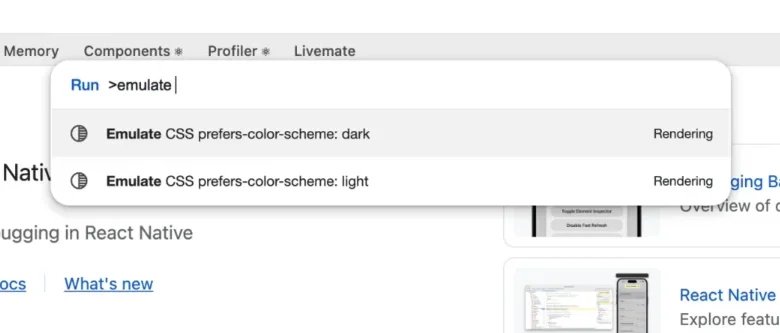
Developer productivity remains a cornerstone of the React Native philosophy. Version 0.86 introduces powerful diagnostic and testing capabilities directly within React Native DevTools, most notably the inclusion of native light and dark mode emulation.
Previously, testing an application’s color scheme responsiveness required navigating deep within physical or virtual device settings, often disrupting testing workflows. With the integration of Emulation.setEmulatedMedia, developers can now toggle appearance modes instantaneously through the DevTools Command Palette, accessible via the standard cmd/ctrl + shift + P shortcut. Following web development paradigms, this state operates as a temporary override that automatically resets upon the disconnection of the DevTools session. This seemingly minor convenience significantly accelerates UI/UX validation cycles for design systems supporting multiple visual themes.

Architectural Improvements and JSI Advancements
Beyond user-facing updates, version 0.86 introduces profound under-the-hood enhancements designed to bridge the gap between JavaScript runtime environments and native device capabilities.
The release expands the JavaScript Interface (JSI), the robust C++ layer facilitating direct, synchronous communication between JavaScript code and native platform modules. By introducing new JSI APIs, core maintainers have empowered native module authors to construct higher-performance bridges with reduced serialization overhead. These enhancements improve memory management, accelerate data transfer rates between threads, and allow complex native libraries to interface with JavaScript engines more efficiently.
Concurrently, the release implements targeted optimizations across runtime and web specification alignment, rendering layout engines, accessibility APIs, and Android-specific input handling. Accessibility improvements focus on screen reader reliability and semantic role translations, ensuring that applications built with version 0.86 meet rigorous digital accessibility standards such as WCAG and regional mobile compliance laws.
Official Responses and Community Governance
The transition of the React Native repository to the react organization under the React Foundation has received universal acclaim from enterprise stakeholders and community maintainers alike. Leaders from major technology companies utilizing React Native have praised the move as a vital maturation step that safeguards the framework’s independence from corporate ownership shifts.
"The establishment of the React Foundation and the relocation of core repositories represent a mature milestone for our community," noted a prominent core contributor during the release cycle. "It guarantees that React and React Native remain public goods, driven by technical merit and global collaboration."
Furthermore, the scale of community participation in version 0.86—featuring 596 commits from 97 distinct contributors—illustrates the robust health of the open-source pipeline. Special recognition was awarded to key community members whose architectural contributions optimized rendering pipelines and streamlined dependency management.
Broader Industry Implications and Technical Analysis
From an economic and strategic perspective, the release of React Native 0.86 reinforces the framework’s viability for mission-critical enterprise applications. In competitive sectors such as fintech, e-commerce, and health tech, upgrade friction and unpredictable breaking changes are major cost drivers. By delivering consecutive releases devoid of user-facing breaking changes, the React Native core team directly addresses the total cost of ownership (TCO) for mobile engineering departments.
Technical analysis of the upgrade path indicates that teams operating on version 0.85 can execute migrations to 0.86 with negligible code modifications. This predictability encourages faster adoption cycles, ensuring that security patches, platform compliance updates, and performance gains propagate rapidly throughout the ecosystem.
Upgrading and Migration Guidelines
With the release of version 0.86, official support status shifts. Version 0.86 now stands as the latest stable production release, while version 0.83.x officially moves into unsupported territory in accordance with the project’s formalized release and support lifecycle policy.
Developers and engineering teams planning their migration paths are strongly encouraged to utilize the official React Native Upgrade Helper to inspect exact code diffs between versions. For new application scaffolding, developers can initialize projects using the updated command line interface:
npx @react-native-community/cli@latest init MyProject --version latestFor teams leveraging the Expo ecosystem, React Native 0.86 will roll out progressively through official expo@canary release channels, allowing developers to test compatibility within managed workflows prior to general availability. As the mobile landscape continues to evolve alongside shifting operating system paradigms, React Native 0.86 establishes a resilient, stable foundation for the next generation of cross-platform applications.