Introducing FlowScript 0.1: A Novel Approach to Describing Application Semantics Before Writing Code

Software architecture and application modeling have long grappled with a foundational disconnect between how systems are conceptualized and how they are ultimately implemented. Traditional methodologies often rely heavily on visual flowcharts, wireframes, and ad-hoc documentation to bridge the gap between product requirements and engineering execution. However, as modern web and mobile applications grow increasingly complex—incorporating intricate state management, responsive multi-pane layouts, conditional user permissions, and asynchronous actions—two-dimensional diagrams frequently fall short. They capture rigid execution sequences while failing to articulate the underlying semantic relationships that govern an application’s true behavior.
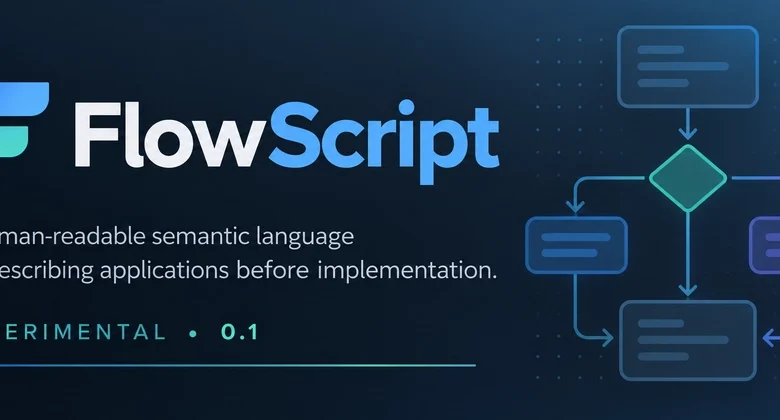
To address these architectural limitations, an independent open-source initiative has launched FlowScript 0.1, an experimental domain-specific language (DSL) designed to capture the semantic model of an application in a compact, human-readable notation before a single line of implementation code is written. Publicly released on GitHub, the initial draft proposes a paradigm shift: treating application architecture as a distinct, decoupled layer that exists independently of underlying tech stacks, frontend frameworks, backend databases, or deployment architectures.
The Genesis of Application Semantics
The core motivation behind FlowScript emerged from a recurring challenge in software engineering: the inadequacy of legacy flowcharts for modeling full-featured software systems. While flowcharts excel at visualizing linear sequences, conditional branching, and simple transitions, modern applications require simultaneous modeling of structural hierarchies, navigation pathways, state machines, user actions, and responsive layout projections. Attempting to force these multidimensional relationships into a traditional flowchart inevitably results in visual clutter and semantic ambiguity.
To solve this, the project’s author questioned whether visual diagrams should merely serve as secondary projections derived from a more fundamental, text-based application model. This inquiry laid the groundwork for FlowScript, aiming to establish a universal text format that defines what an application is and how it behaves, rather than dictating how it is built. By keeping the notation technology-agnostic, a FlowScript document should theoretically remain entirely valid and meaningful even if the underlying software undergoes a complete rewrite from one framework to another—such as transitioning from React to a native mobile framework.
Decoupling Structure, Navigation, and State
One of the most critical conceptual breakthroughs proposed in FlowScript 0.1 is the rigorous separation of structural hierarchy, navigation routing, and state management. In many traditional modeling tools, these distinct concepts are implicitly conflated, leading to fragile architectures where changing a UI layout inadvertently breaks routing or state logic.
FlowScript addresses this by asserting that a mature application model consists of multiple overlapping graphs that answer fundamentally different questions:
- The Structural Tree: Defines strict containment hierarchies, determining what elements or components reside inside others (e.g., a list containing item elements).
- The Navigation Graph: Explicitly dictates pathways of user movement, mapping how a user transitions from a list view to a detailed view and back again, ensuring navigation is never assumed simply because of structural nesting.
- The State Graph: Outlines the lifecycle and state transitions of application objects—such as moving an entity from an "active" state to an "archived" state, or handling asynchronous "loading" and "error" phases.
Furthermore, FlowScript draws a strict boundary between logical application structure and physical presentation. Under this model, a destination page retains its core semantic identity regardless of how it appears on a specific screen size. Using responsive projection mapping, a single semantic destination can be projected as a full-screen page on a compact mobile device, displayed as a side-by-side pane on a tablet, or integrated into a multi-column layout on an expanded desktop display. The responsive presentation changes dynamically, but the core application model remains pristine.
Similarly, user actions—such as clicking a "Save" button—are formally decoupled from system navigation and execution routines. A single user interaction is parsed into discrete semantic events: the user triggers a control, the system executes a background persistence action, and subsequently, the navigation context shifts. By separating actions, conditions, and state predicates, the language aims to make system behavior significantly easier to reason about, test, and maintain.
Syntax Design and Development Methodology
Designed with a deliberately minimalist syntax, FlowScript employs a lightweight keyword-to-value structure (keyword:value) paired with indentation to denote semantic nesting. This balance preserves readability while enforcing strict semantic validation. The core design philosophy prioritizes syntactic simplicity paired with strict semantic integrity, allowing future parsers to thoroughly validate references, targets, and condition rules without burdening the developer with verbose boilerplate code.
Rather than fast-tracking a rigid grammar or compiler tooling, the project follows a deliberate, bottom-up development order:
- Concepts
- Semantic model
- Vocabulary
- Syntax
- Grammar
- Validation
- Tooling
By prioritizing semantic review over a premature syntax freeze, the project invites the broader developer community to scrutinize its underlying assumptions. The creator emphasizes that the primary objective of releasing version 0.1 as an open working draft is to solicit rigorous feedback from software architects, programming language theorists, and developer tooling engineers regarding fundamental modeling primitives rather than superficial syntax preferences.
Implications for the Software Engineering Industry
If proven viable, an expressive semantic modeling language like FlowScript could fundamentally alter the software development lifecycle. By establishing a rigorous, machine-readable application model upfront, future iterations of the tool could theoretically generate multiple automated projections from a single source of truth. These could include comprehensive architecture diagrams, interactive navigation graphs, state transition charts, responsive layout maps, automated documentation, test-case scaffolding, and eventually, implementation-ready code templates.
The ultimate benchmark for the experiment rests on two ambitious criteria: whether an individual unfamiliar with the implementation can fully understand an application’s architecture solely from its FlowScript model, and whether two completely different software implementations can be accurately described by the exact same FlowScript document.
Availability and Community Engagement
FlowScript 0.1 is currently available as an open-source project on GitHub, inviting contributions, critiques, alternative models, and independent parser implementations. Developers, systems architects, and language designers interested in participating in the evaluation of application semantics can review the draft specification, roadmap, and release notes directly through the official repository. As the software industry continues to search for more resilient ways to manage growing system complexity, initiatives like FlowScript offer a compelling glimpse into a future where application design is elevated far above the constraints of individual coding frameworks.