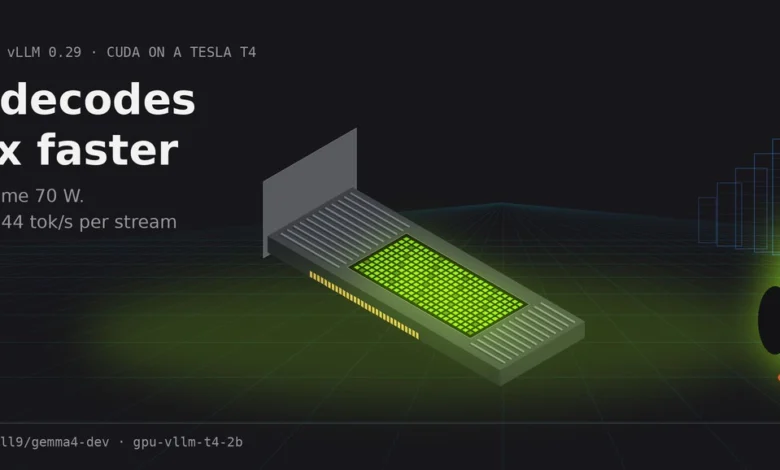
The deployment of modern large language models on aging hardware remains a critical challenge for engineering teams balancing performance with infrastructure costs. Recent benchmarks and a detailed technical case study published on GitHub outline a comprehensive method for successfully running Google’s Gemma 4 E2B models on an NVIDIA Tesla T4 GPU hosted within a Google Cloud Platform (GCP) Compute Engine environment. Utilizing vLLM version 0.29.0 alongside a custom-built suite of Model Context Protocol (MCP) Python tools, the deployment navigates the architectural constraints of the Turing-generation GPU to maximize token generation speeds. The findings highlight the significant performance advantages of Quantization-Aware Training (QAT) integer-4 weights over traditional bfloat16 formats when memory bandwidth is the primary operational bottleneck.
Architectural Overview and Environment Specifications
The target infrastructure consists of an n1-standard-2 Compute Engine virtual machine located in the us-west2-b zone, equipped with 2 vCPUs and 7.8 GB of system RAM. Attached to this instance is a single NVIDIA Tesla T4 GPU based on the Turing microarchitecture, featuring compute capability 7.5, 15,360 MiB of VRAM, and a 70-watt power ceiling. Because the hardware is persistently attached to the virtual machine, the deployment workflow bypasses standard instance provisioning procedures, focusing exclusively on software configuration, dependency resolution, interpreter environments, and model checkpoint optimization.
The deployment relies on two distinct Python environments to segregate control logic from execution. The MCP management tools operate under Python 3.12, while the vLLM inference server executes within a Python 3.13 environment utilizing a custom user base directory mapped to a high-capacity storage volume. Storage architecture is partitioned across three distinct filesystem mounts: a constrained root directory, a dedicated 3.9 GB /tmp filesystem, and a high-capacity /opt1 volume where model caches are stored via symbolic links. This configuration necessitates granular disk space verification tools rather than generic root-level capacity checks.
Chronology and Step-by-Step Deployment Methodology
The integration process follows an incremental, step-by-step validation methodology managed by the MCP server to prevent expensive runtime failures. The pipeline executes five sequential verification checks: check_host_capacity, verify_gpu_arch, apply_turing_patch, verify_turing_patch, and start_vllm_server.
Initially, the machine environment presented a configuration mismatch, featuring a CUDA-enabled build of vLLM operating atop a CPU-only PyTorch build (torch 2.11.0+cpu). This resulted in immediate runtime import failures due to missing shared object libraries such as libcudart.so.13 and libcudnn.so.9. To resolve this, engineers installed the CUDA 13 PyTorch distribution alongside its required runtime dependencies, enabling the interpreter to correctly identify the Tesla T4’s sm_75 architecture.
Subsequently, the software stack was upgraded to vLLM 0.29.0, which enforces a strict dependency on PyTorch 2.13.0+cu130, along with transformers 5.17.0 and triton 3.7.1. A significant hurdle emerged due to Gemma 4’s mixed attention mechanism widths—specifically, 256 for sliding-window layers and 512 for global layers. The Triton attention backend enforced by vLLM required more shared memory at the 512 width than the Turing architecture permits within a single block, which imposes a 64 KiB shared memory limit. To bypass this hardware limitation, the deployment pipeline incorporates a custom Turing patch (applied via apply_turing_patch) that safely clamps tile sizes within the vLLM site-packages.
Furthermore, initial attempts to load model weights resulted in kernel-level Out-Of-Memory (OOM) terminations. With only 7.8 GB of physical system RAM, the host lacked sufficient memory to stage model weights before offloading them to the GPU VRAM. Engineers resolved this by provisioning a 16 GB swapfile on the /opt1 volume, which absorbed peak swap allocations ranging between 4,770 MiB and 6,761 MiB during server initialization.
Comparative Performance Analysis: BF16 vs. QAT Int4
The evaluation compared two specific checkpoints: google/gemma-4-E2B-it (bf16) and google/gemma-4-E2B-it-qat-w4a16-ct (QAT with int4 weights). Because the Tesla T4 natively lacks a bfloat16 datapath, vLLM automatically casts the bf16 weights to standard float16 during execution.
Model loading metrics demonstrate distinct memory footprints between the two formats. The QAT model consumed 8.02 GiB of memory during an 8.02-second loading phase, leaving room for a GPU KV cache size of 519,568 tokens and a maximum concurrency of 31.71x for 16,384-token requests. In contrast, the uncompressed float16 model consumed 9.8 GiB of VRAM over 157.18 seconds, yielding a smaller KV cache size of 315,974 tokens and a maximum concurrency of 19.29x. The QAT model packs linear layers into 4-bit representations while retaining full-width embeddings and vision towers, freeing approximately 1.78 GiB of VRAM for KV caching.
In single-stream decode evaluations, memory bandwidth acts as the primary performance constraint. Generating a single token requires reading the active decoder layer weights from VRAM. Theoretical bandwidth calculations on the Tesla T4 indicate a streaming read ceiling of approximately 277.0 GB/s. Because the uncompressed model requires reading 4.597 GB per decode token, its mathematical ceiling is 60.3 tokens per second. The QAT model reduces this to 1.862 GB per token, raising its theoretical ceiling to 148.8 tokens per second.
Empirical Benchmark Results
Performance sweeps were conducted using vllm bench serve across randomized prompts, evaluating output lengths of 128 tokens, input lengths of 512 and 4096 tokens, and concurrency levels (c) set to 1, 4, 8, and 16.
For 512-token prompts, the QAT model consistently outperformed the uncompressed baseline across all concurrency metrics:
- At Concurrency 1: The bf16 model achieved 37.04 total tok/s (40.44 per stream), while the QAT model reached 62.27 total tok/s (72.31 per stream), representing a 1.79x per-stream speedup.
- At Concurrency 8: Total throughput scaled to 164.62 tok/s for bf16 (25.49 per stream) and 215.91 tok/s for QAT (37.83 per stream).
- At Concurrency 16: Throughput plateaued as the engine capped active sequences at 8 (–max-num-seqs 8), yielding 164.36 tok/s for bf16 and 213.79 tok/s for QAT.
For long-context evaluations utilizing 4096-token prompts, performance converged between the two architectures due to prefill bottlenecks. Across concurrency levels 1 through 16, overall throughput hovered between 12.11 and 15.82 tok/s. Time to First Token (TTFT) measurements indicated identical prefill costs regardless of weight storage format, scaling from approximately 7,200 ms at c=1 up to over 80,000 ms at c=16.
Implications and Operational Takeaways
The findings offer practical insights for engineering organizations deploying modern language models on legacy or cost-effective cloud hardware. The Tesla T4 remains a viable, highly economical inference engine for smaller models when paired with aggressive weight quantization. However, operators must account for hardware-specific constraints, such as the Turing architecture’s 64 KiB shared memory ceiling and the absence of native bfloat16 support, which require software patching and explicit data type casting.
Furthermore, the research underscores the efficacy of Model Context Protocol (MCP) automation in managing complex deployment scripts across fragmented software environments. By systematically validating host capacity, GPU architecture compatibility, kernel patch presence, and swap allocation, engineering teams can successfully bridge the gap between resource-constrained cloud VMs and state-of-the-art open-weights models.
Related posts: