The rapid proliferation of software development powered by artificial intelligence has ushered in a new era of programming productivity, but it has simultaneously introduced unprecedented operational challenges for open-source maintainers. Millions of developers worldwide rely on Next.js, the popular React framework maintained by Vercel, to build high-performance web applications. While this massive adoption drives continuous innovation, it also generates a relentless influx of bug reports, feature requests, and technical inquiries through the project’s GitHub issue tracker. Receiving an average of 36 new reports each week, the project’s core maintainers faced a mounting administrative hurdle that threatened to obscure genuine regressions beneath thousands of outdated, obsolete, or duplicate tickets.
The integration of advanced coding agents by everyday developers significantly accelerated the submission process, enabling users to generate highly detailed bug reports with minimal friction. However, this surge in volume overwhelmed the manual review pipeline. Investigating a single GitHub issue requires a multidisciplinary effort: maintainers must thoroughly read historical context, cross-reference linked pull requests and code commits, attempt to reproduce the reported bug across various Next.js versions, and evaluate whether the underlying behavior has already been addressed. Consequently, the Next.js issue backlog swelled to a historic peak of 3,109 open reports in January 2025.
To combat this bottleneck, Vercel engineers initially implemented automated time-based inactivity workflows. In January 2025, the team introduced a GitHub automation rule that flagged any issue lacking activity for two years—a threshold later shortened to 18 months—and subsequently closed them following a designated grace period. While this blunt-force mechanism reduced the backlog to 2,244 open reports by August 10, 2026, it exposed a fundamental flaw inherent in relying solely on timestamps. Inactivity is an unreliable indicator of technical relevance. An aging issue might indeed be obsolete, but it could also represent a persistent, unresolved regression that simply escaped community attention, or a valid bug affecting an older, unsupported version of the framework. Timestamps cannot discern nuance, leading to the accidental closure of valid community reports that warranted active investigation.
Recognizing that a holistic, intelligent review of the entire backlog was necessary to preserve critical historical context while purging irrelevant noise, Vercel deployed a sophisticated artificial intelligence solution. Leveraging eve—an open-source agent framework developed by Vercel designed for persistent execution sessions, scheduled tasks, and structured data outputs—the team engineered a specialized research agent named closability. Operating within isolated infrastructure via Vercel Sandbox, the agent was granted access to a clean environment containing the Next.js repository, Node.js, Playwright, and Chromium.
The operational mechanics of the closability agent were meticulously designed to mimic a human maintainer’s investigative workflow. Operating on GPT-5.6 Luna with reasoning parameters maximized, the agent spent an average of 30 minutes per issue conducting deep-dive research. Scaled gradually to maintain up to 200 concurrent eve sessions, the agent systematically gathered evidence, tested reproductions, and categorized its findings into a structured Close Queue for human verification. To maintain strict security protocols and prevent malicious manipulation, the agent was intentionally restricted to read-only capabilities outside its sandbox environment. It lacked the permissions to autonomously post comments, close issues, push code, or deploy applications. Furthermore, prompt injection safeguards were hardcoded to ensure the agent ignored conflicting instructions embedded within user-submitted issue texts or repository contents.
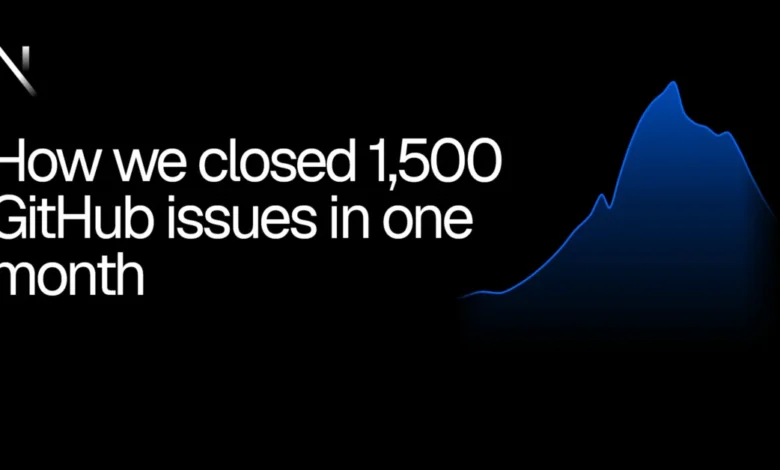
The results of this large-scale AI-driven audit proved transformative. Within approximately three weeks of launching the comprehensive review on June 15, 2026, Vercel successfully closed 1,462 issues across the repository, driving the total open backlog below the 1,000 mark by September 4, 2026, despite the continuous arrival of 218 newly filed reports during the same timeframe. A detailed breakdown of the closed tickets reveals the multi-faceted nature of the backlog: 543 issues (37%) were classified as already fixed, 278 (19%) as duplicate reports, 237 (16%) as expected framework behavior, 89 (6%) as no longer reproducible, 66 (5%) as unsupported or obsolete, and 249 (17%) categorized under other administrative reasons.
To ensure accountability and mitigate the risk of false positives resulting from automated categorization, Vercel implemented a safeguard mechanism prior to the review. A custom GitHub Action was deployed to post an automated notification on eligible closed issues, granting community members a strict 14-day window to contest the closure. By replying with a designated syntax and explanatory rationale, users could prompt an automatic reopening of the ticket if the original poster or prior commenters engaged with the thread. Statistical tracking of this review period demonstrated remarkable accuracy: as of September 4, 2026, an overwhelming 99.8% of the reviewed issues—totaling 1,459 cases—remained closed, with only three tickets successfully reopened by the community, validating the precision of the agent’s evidentiary assessments.
The success of the closability agent catalyzed a broader architectural expansion within Vercel’s internal tooling, giving rise to the collective "Maintainer Agent" framework. This ecosystem integrates multiple independent eve agents designed to handle distinct segments of open-source maintenance, including automated issue reproduction, canary verification, code bisecting to isolate introduced or fixed commits, end-to-end test generation, and preliminary fix preparation. These agents are centrally organized within a structured directory framework and tied directly into a dedicated Next.js internal dashboard. Maintainers utilize this dashboard to visualize backlog trends, review the Close Queue, initiate manual investigations, and interact with a built-in chat agent capable of parsing source code and answering granular queries regarding specific pull requests or issues. High-priority findings and daily summaries are automatically routed to internal communication channels via Slack integration.
Building upon the success of the one-time backlog reduction, Vercel has institutionalized continuous AI oversight to prevent future congestion. Every Monday, the closability agent automatically investigates up to 100 open issues that have remained inactive for at least 30 days, prioritizing tickets that have never undergone previous AI review. If human participants subsequently re-engage with an investigated issue, the saved research is automatically discarded to prioritize active community discourse. Moreover, Vercel has begun granting autonomous agents the authority to close the most clear-cut cases—capped initially at 25 issues per week—without requiring prior manual sign-off from a human maintainer, though every resultant code change continues to undergo rigorous human code review prior to merging.
The broader implications of Vercel’s initiative signal a paradigm shift in how open-source software projects manage community engagement and technical debt in the age of generative artificial intelligence. As the velocity of software development accelerates and AI tools empower a larger global developer base to contribute code and file reports, the administrative overhead placed upon project maintainers threatens to become unsustainable. By successfully deploying transparent, secure, and verifiable autonomous agents to handle the tedious mechanics of issue triage, Vercel has established a scalable blueprint for open-source project management. This approach demonstrates that artificial intelligence can effectively absorb administrative friction without alienating the developer community, ensuring that critical human expertise remains focused on architectural innovation, security hardening, and community collaboration.