Advent of Svelte 2025 launches as a digital celebration of the framework’s evolution through daily technical insights.

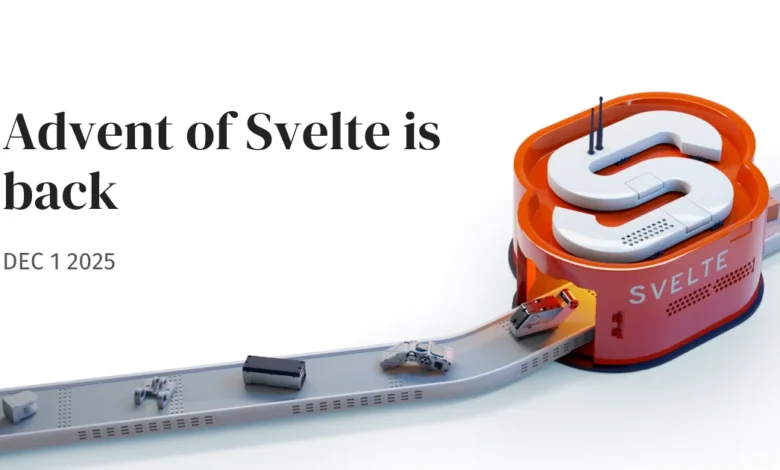
The Svelte Society has officially inaugurated its 2025 Advent calendar, a recurring annual initiative designed to foster developer education and community engagement within the Svelte ecosystem. Hosted at advent.sveltesociety.dev/2025, the project serves as a structured repository of knowledge, releasing one short-form video demonstration each day leading up to Christmas. By focusing on niche features, underutilized functionalities, and high-efficiency programming patterns, the initiative seeks to bridge the gap between basic framework proficiency and advanced application architecture. The series commenced on December 1 with an in-depth examination of the $inspect(…) rune, a cornerstone feature in the latest iteration of the framework, signaling a clear focus on debugging and reactivity management for the remainder of the month.
Chronology and Evolution of the Advent Initiative
The concept of an "Advent calendar" in software development—a series of daily content releases throughout December—has become a staple in the open-source community, popularized by projects ranging from CSS-Tricks to various language-specific guilds. For the Svelte Society, this tradition has evolved significantly over the past three years.
In its inaugural iterations, the Svelte Advent calendar functioned primarily as a series of blog posts, providing written tutorials for developers. However, the 2025 edition represents a shift in strategy toward multimedia content. The decision to move toward short-form video follows broader industry trends indicating that developers prefer visual, time-constrained demonstrations when learning specific framework syntax or debugging techniques.
The timeline for the 2025 release is as follows:
- December 1: Kickoff featuring the $inspect(…) rune.
- December 2–24: Daily unlocking of technical "doors," each containing a specialized video module.
- December 25: Conclusion of the series, intended to summarize the cumulative learnings of the month.
This temporal structure mirrors the release cycles of the Svelte framework itself, which has seen an accelerated development pace since the introduction of Svelte 5 and the transition to the "Runes" system.
Supporting Data: The Rise of Svelte in Modern Web Development
The timing of this educational initiative coincides with a period of significant growth for Svelte. According to the 2024 State of JS survey and various GitHub repository analytics, Svelte consistently ranks among the most "loved" frameworks by developers, often cited for its low boilerplate requirements and high performance.
The reliance on runes, such as the $inspect(…) function featured in the first installment of the Advent series, is a response to the framework’s transition from a compile-time-only model to a more flexible, fine-grained reactivity model. Statistical analysis of developer feedback suggests that while the transition to Svelte 5’s rune system offers superior state management, it also presents a learning curve. By dedicating a daily series to these nuances, the Svelte Society is addressing a critical need for documentation and practical application examples that static manuals often struggle to convey.
Furthermore, current industry data indicates that front-end frameworks are moving toward "signals-based" reactivity. Svelte’s implementation of these patterns, specifically through the $inspect and $state runes, places it in direct competition with frameworks like SolidJS and Vue. The Advent of Svelte serves as a marketing and pedagogical tool to solidify the framework’s market share by ensuring developers can transition from legacy Svelte 4 codebases to the more robust Svelte 5 architecture.
Technical Analysis: The $inspect(…) Rune and Beyond
The inaugural focus of the 2025 Advent calendar is the $inspect(…) rune. In the context of modern Svelte, $inspect(…) is not merely a logging utility; it is a fundamental tool for observation. It allows developers to track state changes in real-time within the console, providing a clearer window into the reactivity graph.
Historically, debugging in Svelte required developers to rely on standard browser console.log statements, which often lacked the necessary context regarding component lifecycle or signal triggers. The $inspect(…) rune rectifies this by hooking directly into the framework’s reactivity system. From a technical standpoint, this allows for the tracing of dependencies—showing exactly which variable change triggered a re-render.
The implications of this for large-scale applications are significant. As web applications grow in complexity, the "black box" nature of reactivity can lead to performance bottlenecks. By providing a dedicated tool for inspection, the Svelte Society is implicitly encouraging a more disciplined approach to state management. The upcoming videos in the series are expected to cover similar architectural utilities, likely touching upon state derivation, custom effects, and performance optimization techniques within the component lifecycle.
Industry Implications and Community Impact
The Svelte Society, as a community-led organization, plays a vital role in the framework’s longevity. Unlike frameworks backed exclusively by corporate entities, such as React (Meta) or Angular (Google), Svelte relies heavily on community-driven education to maintain its momentum.
Industry analysts suggest that the "Advent" format provides a unique advantage: it maintains community engagement during the end-of-year lull, preventing developer churn and keeping the framework top-of-mind during annual planning sessions. For many organizations, these daily snippets act as a "just-in-time" learning mechanism. A developer tasked with a specific bug on December 12 may find that the daily video for that date provides the exact pattern required to resolve the issue, thereby increasing the framework’s perceived value in enterprise environments.
The educational model adopted by the Svelte Society also serves to standardize best practices. In an ecosystem where multiple ways of achieving a result often exist, the official endorsement of specific patterns via this Advent series creates a "standard" approach that community members can adopt, leading to more maintainable codebases across the ecosystem.
Official Stance and Future Outlook
While no formal manifesto was released alongside the calendar, the Svelte Society has communicated that the 2025 initiative is intended to be a "living document" of the framework’s capabilities. Representatives from the core team have noted in previous community forums that the transition to the runes-based system requires a departure from traditional "component-level" thinking toward "state-level" thinking.
The Advent series acts as the primary vehicle for this cognitive shift. By breaking down the framework into small, manageable daily lessons, the Society is effectively lowering the barrier to entry for newcomers while providing deep-dive content for seasoned veterans.
Looking forward, the success of the 2025 Advent series will likely be measured by the engagement metrics of the repository and the subsequent adoption rates of the features highlighted. If the current trajectory holds, the Svelte Society intends to continue this tradition, potentially integrating community-submitted content in future years to further democratize the educational process.
For the professional developer, the Advent of Svelte 2025 is more than a seasonal event; it is a structured program for keeping pace with the rapid iteration of web technologies. As the month progresses, the collection of videos will undoubtedly serve as a foundational reference for developers looking to master the intricacies of Svelte’s reactivity model, debugging capabilities, and performance features. The initiative underscores the necessity of continuous learning in an environment where the tools for building the web are constantly being reimagined.